
A room can have good furniture, a calm colour scheme and a rug you love, and still feel flat. Very often the missing piece is hanging right above you, or rather, it is not there at all. A plain ceiling light washes a room in even light and gives the eye nothing to rest on, so the whole space reads as unfinished even when everything else is in place.
That is exactly where a statement pendant lamp earns its keep. It does two jobs at once. It drops light to the height where you actually live, over a table, beside a chair, above a counter, and it acts as a piece of sculpture in the room. The right pendant can anchor a dining table, soften a hard kitchen corner or turn a bare hallway into a proper entrance.
The trick is choosing a shape, size and material that suits the room rather than copying a photo you liked. A lamp that looks perfect in a tall, open-plan kitchen can overwhelm a low-ceilinged bedroom, and a delicate glass globe can disappear completely in a large living room. The eight ideas below work through the rooms one by one, with the sizing, hanging height and material notes that stop a bold choice from becoming a regret.
Quick Tips Before You Start
- Measure first: note the ceiling height, the table or counter width, and the clearance you need to walk under the lamp.
- Hang for the task, not the ceiling: pendants should light the surface below them, not just fill the middle of the room.
- Put statement pendants on a dimmer wherever you can, so one lamp can handle bright mornings and soft evenings.
- Match the bulb colour to the room: warm white around 2700K suits living spaces, while a slightly crisper white suits a work zone.
1. The Oversized Drum Over the Dining Table
 Save
Before you choose any pendant, measure the room it will hang in. Note the ceiling height, the width of the table or surface below, and the clearance you need to walk underneath without ducking. A shade that looks right in a tall room with a wide table can overwhelm a low ceiling or disappear over a small surface, so the measurements you take now decide the size and height of every pendant in this guide.
A single large drum shade over a dining table is the simplest way to make a dining area feel intentional. The drum shape is calm and graphic, it throws light straight down onto the table, and from across the room it reads as one clear shape rather than a clutter of small fittings. Linen gives a soft glow and suits relaxed rooms, while a metal drum with a white inside gives a sharper pool of light for evening meals.
Size matters more than style here. A good rule is to pick a drum roughly one third to one half the width of the table, so it feels related to the furniture below it rather than floating at random. For a long rectangular table, two smaller drums spaced evenly along its length work better than one huge shade that leaves the ends in shadow. Hang the bottom of the shade about 75 to 90 centimetres above the tabletop, low enough to feel intimate, high enough that nobody has to duck to see across the table.
| Your table | Shade choice | Hang height |
|---|---|---|
| Round or square table | One drum, one third to one half the table width | 75 to 90 cm above the tabletop |
| Long rectangular table | Two smaller drums, spaced evenly | 75 to 90 cm above the tabletop |
| Table with tall chair backs | Same drum, checked from a seated position | High enough to see the person opposite |
Placement: Centre the drum on the table, not on the room, because tables rarely sit dead centre in a real dining space.
Colour: A cream or oatmeal linen shade warms up pale walls, while a black or deep green drum adds weight to a room with dark furniture.
Tip: If your dining chairs have tall backs, sit in one before you fix the height, and check that the shade does not block your view of the person opposite.
2. Clustered Glass Globes in the Kitchen
 Save
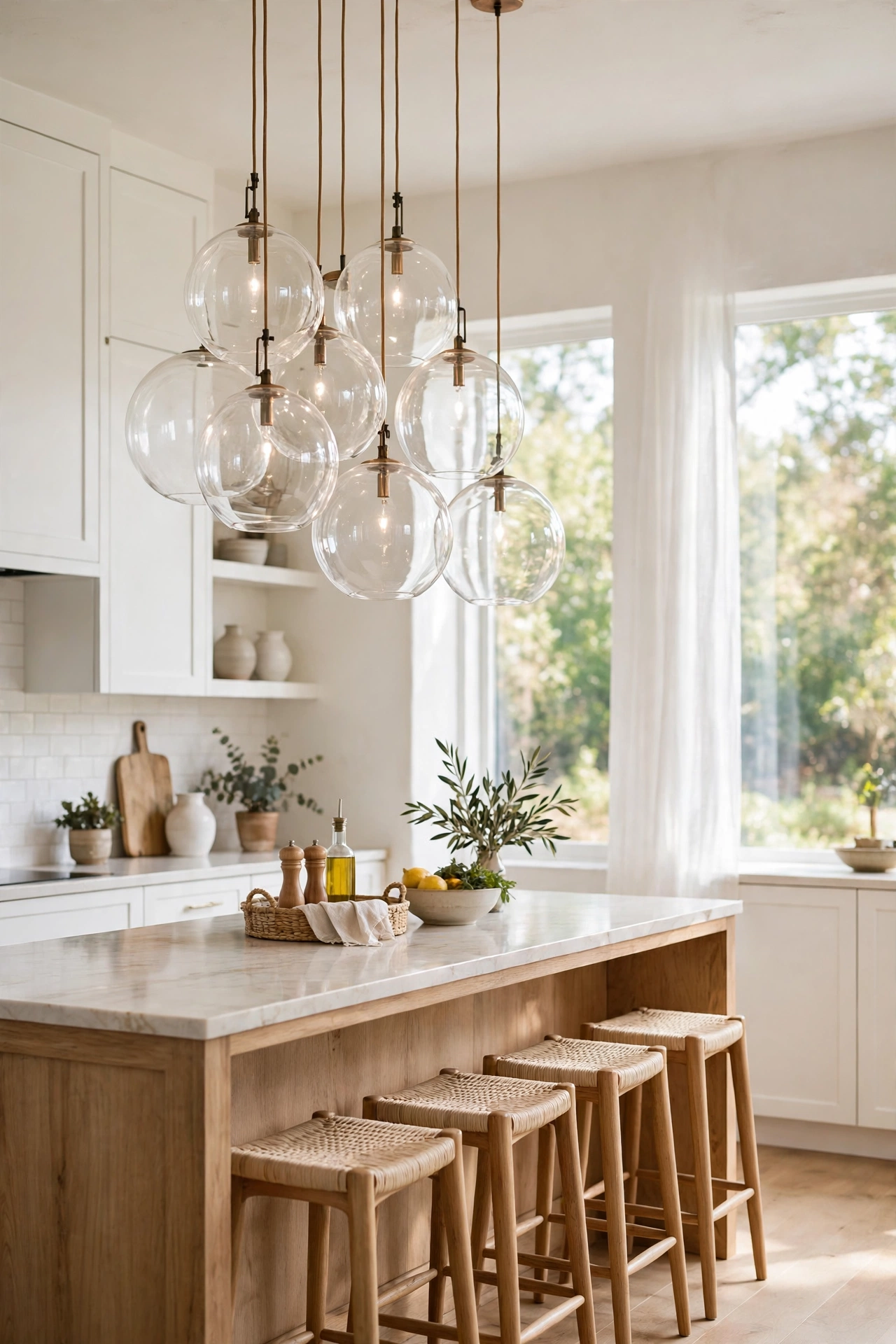
A cluster of glass globes at different heights turns a plain kitchen corner into a feature, without the formality of a chandelier. Clear glass keeps the room feeling open, which helps in kitchens where wall units and tall cupboards already take up a lot of visual space. Smoked or opal glass softens the light and hides the bulb, which suits kitchens that double as evening gathering spots.
Hang the cluster where it will be seen but not bumped into, over a breakfast bar, a small round table or a worktop corner that is not used for chopping. Stagger the drops by 10 to 15 centimetres so the globes read as a group with movement, rather than a flat row. Three globes suit a compact corner, five suit a longer counter, and an odd number almost always looks more natural than an even row.
Placement: Keep the lowest globe clear of head height if the cluster hangs over a walkway, and lower over a table or counter where nobody walks through.
Texture: Pair clear glass with warm wood and brushed metal, so the kitchen keeps a soft edge despite all the hard surfaces.
Tip: Use one dimmer for the whole cluster so the globes can glow gently in the evening instead of glaring while you cook. A cluster also works beautifully above a home coffee station, where it marks the corner as a place to linger rather than just another stretch of counter.
3. A Sculptural Brass Pendant in the Entryway
 Save
An entryway is the first room a guest sees, and it is also the room most often left with a single flush ceiling light. A sculptural brass pendant changes that in one move. Brass catches daylight from the front door and glows warmly in the evening, so the entrance feels welcoming at every hour. Look for a shape with a clear silhouette, a folded cone, a ribbed dome or a simple sphere on a slim stem, rather than a fussy design that will date quickly.
Hang the pendant to suit the ceiling, not a fixed number from a catalogue. In a standard hallway, the bottom of the shade should clear head height comfortably, at least 2.1 metres from the floor, so nobody brushes it coming through the door. In a taller entrance with a stairwell, you can drop it lower over a console table, where it frames the table and gives visitors something to look at as soon as they step inside. If you love the warm metallic look in other rooms too, our brass decor ideas show how to repeat the finish without turning the whole house gold.
Placement: Centre the pendant over a console table or a round entrance table, and keep it clear of the door swing.
Colour: Unlacquered brass will darken gently over time, while lacquered brass keeps a bright, even shine, so pick the finish that matches how much patina you enjoy.
Swap: If solid brass feels too bold, try a brass-trimmed shade in black or cream, which gives the same warmth in a quieter way.
4. Woven Rattan Pendants for a Relaxed Bedroom
 Save
A bedroom pendant should calm the room down, not demand attention the way a dining pendant does. Woven rattan does that job well. It filters light through its weave, casts soft patterned shadows on the ceiling in the evening, and adds a natural texture that plain painted walls often lack. It suits bedrooms with linen bedding, wooden furniture and plants, and it keeps a small room feeling light because you can partly see through it.
Use a rattan pendant as a pair over bedside tables, or as a single larger shade in the centre of the room if the bed already has wall lights or reading lamps. For bedside use, hang each shade so its bottom sits roughly level with the top of the headboard, and check that the shade does not sit so low that you knock it when you sit up in bed. A single central pendant should hang higher, clear of the bed, and work as general light rather than reading light.
Placement: Bedside pendants free up the table surface that a lamp would take, which is a real help in a small bedroom.
Texture: Match the rattan tone to other natural pieces in the room, a wooden bed frame or a woven basket, rather than mixing three different straw colours.
Tip: Choose a warm bulb and a fabric-covered cord, because a harsh white bulb inside an open weave will glare through the gaps.
5. A Black Metal Dome in a Small Home Office
 Save
A home office needs light you can work under, and a statement pendant can provide it without looking like office equipment. A black metal dome is a practical pick. It directs light down onto the desk, its dark outside keeps it from dominating a small room, and its clean curve suits both modern desks and older wooden ones. Inside, a white or pale lining bounces light back down instead of swallowing it.
Hang the dome directly over the desk, not in the centre of the room, and set the bottom of the shade about 60 to 75 centimetres above the desk surface. That height lights papers and a keyboard without shining straight into your eyes when you look up. If you work on video calls, a dome alone can leave your face in shadow, so pair it with a small desk lamp or a wall light at face height rather than relying on the pendant for every kind of light.
Placement: Centre the dome on the desk width, and shift it slightly to the side you write with if the desk sits against a wall.
Colour: Black suits most schemes, but a deep green or navy dome can tie the office into the rest of the house.
Swap: If a dome feels too industrial, a metal shade with a rolled edge or a perforated pattern gives the same focused light with a softer look.
6. Coloured Glass Pendants in the Bathroom
 Save
A bathroom pendant sounds daring, but in the right spot it is one of the most effective upgrades in the house. Coloured glass, amber, smoky blue or soft green, adds colour to a room that is usually all tile and white porcelain, and it does it without taking up counter space. The key is placement and safety: hang pendants beside a mirror or over a freestanding bath, never directly over a shower, and always choose a fitting rated for bathroom use in that zone.
Two slim pendants flanking a mirror give even light on both sides of the face, which is far more flattering than a single light above the mirror that casts shadows downwards. Hang them at roughly eye level when standing, and keep the glass small enough that it does not crowd the mirror. Over a bath, a single pendant hung well clear of the water and the reach of anyone standing in the bath can turn an ordinary soak into a proper ritual, especially on a dimmer.
Placement: Beside the mirror, not above it, and clear of any splash zone, with the correct bathroom safety rating for the spot.
Colour: Amber glass warms pale tiles, while smoky blue or green suits bathrooms with stone, concrete or dark wood.
Tip: Ask an electrician to confirm the zone rating before you buy, because a beautiful pendant in the wrong bathroom zone is a fitting you cannot safely use.
7. A Paper Lantern Pendant in a Reading Corner
 Save
Not every statement pendant needs to be expensive or heavy. A large paper lantern pendant gives a reading corner a soft, diffused glow and a sculptural round shape, for very little money and almost no weight on the ceiling. It suits corners with an armchair, a floor lamp for task light and a bookshelf, where the pendant provides the general warmth and the floor lamp does the close work.
Hang the lantern high enough that it does not block the view across the room, and low enough that it feels part of the corner rather than lost near the ceiling. A diameter of 50 to 60 centimetres suits most reading chairs, while a smaller lantern can disappear in a large living room. Paper shades and bright bulbs do not mix well, so use a low-heat LED bulb and keep the shade clear of any other heat source.
Placement: Centre the lantern over the chair, slightly forward of it, so the light falls on the seating area rather than behind it.
Texture: Pair the smooth paper with a chunky knit throw and a wooden side table, so the corner has a mix of soft and solid surfaces.
Swap: If paper feels too fragile for a busy household, a pleated fabric shade gives a similar soft glow and survives a knock far better.
8. A Statement Pendant as Living Room Art
 Save
In a living room, the pendant does not need to light a table at all. It can hang in an empty corner, beside a sofa or over a side table, purely as a piece of art that also happens to give light. This is where you can choose the boldest shape in the house, an oversized ring, a cluster of metal rods, a hand-blown glass form, because the living room has the space to carry it and the seating to view it from several angles.
Scale is the deciding factor. A pendant that is too small will look lost in a living room, while one that is too large will crowd the seating below it. As a guide, the shade should be roughly one fifth to one quarter the width of the sofa or sideboard it sits near, so it feels related to the furniture without competing with it. Hang it at a height that clears standing head height if it sits over a walkway, or lower over a side table where it can be enjoyed up close.
Test it first: cut a cardboard circle the size of the shade you are considering and ask someone to hold it at the planned height while you check it from the doorway and from the sofa. If it blocks sightlines or crowds the seating, size down. If it reads clearly from both spots, the scale is right. Check it once more after dark with the room lamps on, since a lit shade draws the eye more strongly.
Placement: Try the pendant over a side table or an empty stretch of floor near the sofa, rather than dead centre in the room, where it can feel stranded.
Colour: A single strong colour, burnt orange, deep teal or brushed gold, works as an accent in a neutral room, while a clear or pale shade suits a room that already has strong colour elsewhere.
Tip: If you are also planning a ceiling feature, our statement ceiling ideas pair well with a bold pendant, because the ceiling and the lamp can share one clear idea instead of fighting each other. The same bold, graphic spirit runs through the neo deco revival, where sculptural shapes and warm metals do most of the decorating work.
Your takeaway: size the shade to the furniture below it, hang it for the task at hand, put it on a dimmer, and keep the bulb colour warm and consistent from room to room.
Bringing It All Together
You do not need a pendant in every room, and you certainly do not need eight new lamps in one weekend. Start with the room that feels most unfinished, usually the dining table or the entrance, and get the size and height right there. Once one pendant works, the rest of the house gets easier, because you will have a feel for how low a shade should hang and how big a shape your rooms can carry.
Buy the dimmer before you buy the second lamp. A statement pendant on full brightness all evening can feel harsh, while the same lamp dimmed low becomes the warmest light in the house. And keep the bulb colour consistent from room to room, so walking through the house at night feels calm rather than patchy.
A good pendant should still look good switched off. If the shape pleases you in daylight, with no light coming from it at all, you have chosen well. If it only looks interesting when lit, keep looking, because you will spend most of the day seeing it unlit.
Frequently Asked Questions
How low should a pendant hang over a dining table?
Hang the bottom of the shade about 75 to 90 centimetres above the tabletop. That height gives an intimate pool of light without blocking the view across the table, and it works for most standard ceiling heights.
Can I use a statement pendant in a room with a low ceiling?
Yes, if you choose a flush or semi-flush shape, or a pendant on a short stem that hugs the ceiling. Keep at least 2.1 metres of clearance under the shade in any walkway, and use the pendant over a table or counter where head clearance is less of an issue.
Do pendant lamps work in rented homes?
They do, as long as you keep the original fitting safe and get permission for any wiring change. Many pendants hang from an existing ceiling rose with a simple hook and plug-in cord kit, and a renter-friendly shade swap can change the whole room without touching the wiring.
What bulb colour suits a statement pendant?
Warm white around 2700K suits living rooms, bedrooms and dining areas, because it flatters skin tones and wooden furniture. Use a slightly crisper white, around 3000K, in a kitchen or office where you need to see detail clearly.
How do I clean a glass or rattan pendant shade?
Switch the light off and let the bulb cool first. Wipe glass with a soft, damp cloth and dry it straight away to avoid marks, and dust rattan with a dry microfibre cloth or a soft brush, working along the weave rather than against it.

1 thought