
A dark wood sideboard arrives, beautiful in the shop, and then it lands in your living room and swallows the whole wall. The room feels smaller, the corners go dim, and the piece you loved suddenly looks like a mistake. Most people blame the wood. The wood is rarely the problem. Dark wood only looks heavy when it has nothing to play against, no light, no pale surface, no breathing space around it.
Walnut and mahogany are the two dark woods that show up most in real homes, and they earn their place. Walnut is warm brown with a calm, straight grain that suits modern rooms. Mahogany is deeper, redder, with a ribbon grain that suits traditional rooms and dining tables. Both take a beautiful finish, both age well, and both look expensive even in a simple shape. The trick is not to fill a room with them. It is to give one or two dark pieces the right neighbours.
Dark wood furniture works when it is treated as the anchor of a room rather than the whole room. Below are eight ideas that do exactly that, from choosing between walnut and mahogany to keeping the finish looking rich for years.
Quick Tips Before You Start
- Pick one dark hero piece per room and let everything else stay lighter.
- Test the wood in your own light before you commit: hold a sample against the wall at midday and again at dusk.
- Leave at least 75 centimetres of clear walkway around a dark dining table or sideboard, so it reads as furniture, not a wall.
- Pair dark wood with one warm metal, brass or aged bronze, and one soft texture, linen or wool, in every room.
1. Let One Dark Piece Lead the Room
 Save
Every room with dark wood needs a clear lead. One sideboard, one dining table, one bed frame. When two or three dark pieces compete, the eye has nowhere to rest and the room reads as a furniture showroom. When one piece leads, the rest of the room can stay pale and calm around it, and the dark wood looks intentional instead of accidental.
Start with the piece you use most. In a living room that is usually the media unit or the sideboard against the longest wall. In a bedroom it is the bed frame. In a dining room it is the table. Choose the biggest dark piece you own, give it the best wall, and move the smaller dark pieces out or swap them for lighter ones. A walnut coffee table can stay if the sideboard is the lead, but a walnut coffee table, a walnut bookcase and a walnut sideboard in one room is too much of the same note.
Placement: The lead piece goes on the longest uninterrupted wall, with at least 15 centimetres of clear wall on each side.
Colour: Keep the wall behind the lead piece pale, warm white, soft sage or pale plaster, so the grain shows up against it.
Texture: Put one soft thing on or beside the lead piece, a linen runner, a wool throw folded over the arm of a nearby chair, so the hard wood has a soft neighbour.
Swap: If the room already has two dark pieces you love, paint or re-cover the smaller one, or move it to a hallway where it can lead a smaller space on its own.
Try this: before you buy a dark piece, run the three-question gate. Can it get through your front door and up the stairs? Will it leave 75 centimetres of walkway on the side people actually use? Does its tone sit within the same warm or cool family as your floor? If any answer is no, keep looking. A piece that fails the gate will fight the room every day, as our interior design trends for 2027 show, where walnut works because it is used sparingly against pale walls.
2. Pair Walnut with Warm Neutrals, Not Stark White
 Save
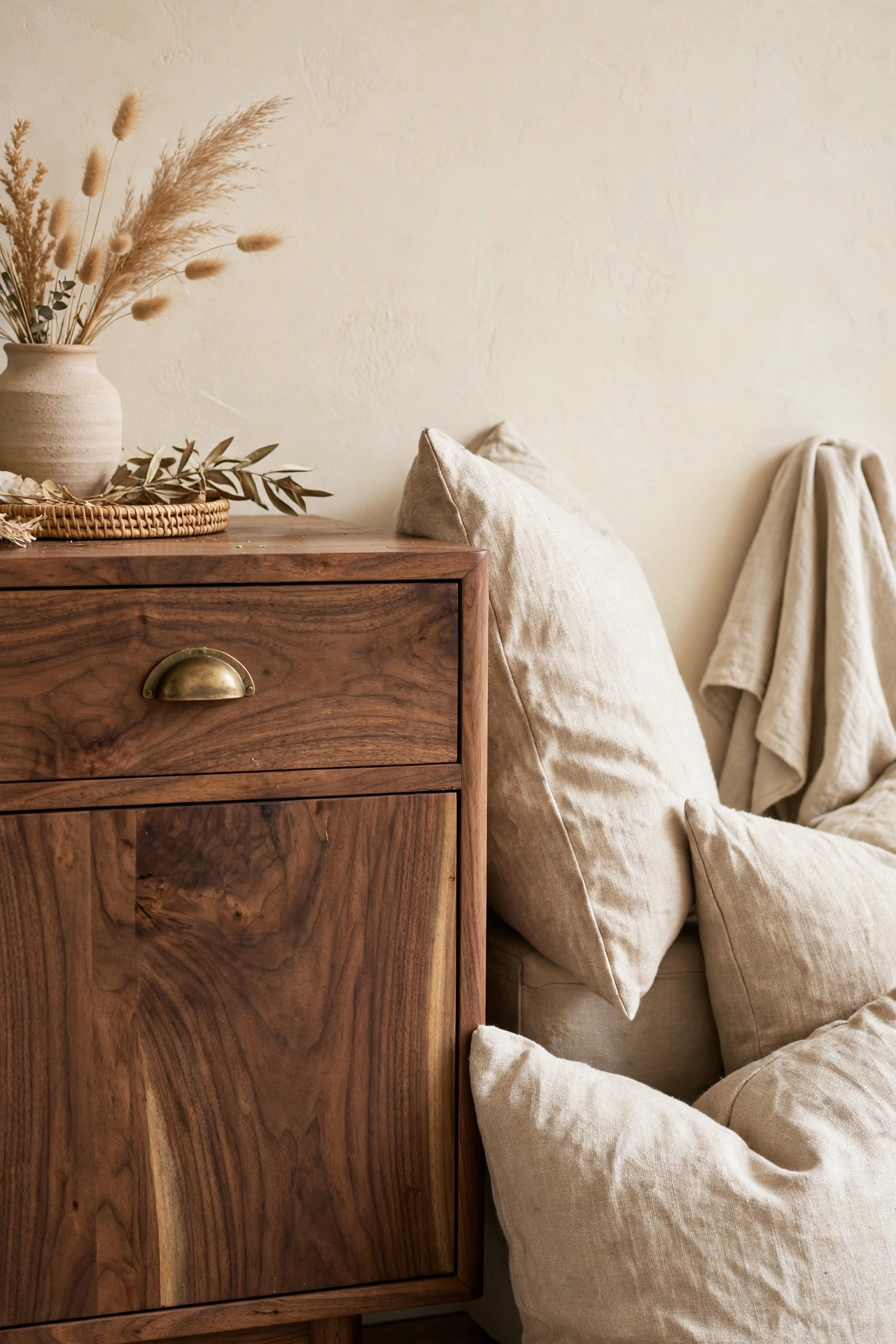
Walnut has a warm brown heart, and stark white walls make it look orange by contrast. The white is too cold and too bright, so the walnut has to shout to be seen, and the room ends up feeling like a showroom rather than a home. Warm neutrals do the opposite. Cream, oatmeal, soft mushroom and pale greige all share walnut’s warmth, so the wood settles into the room instead of standing apart from it.
Paint a test patch before you commit. A two-litre sample pot is enough for a patch the size of a cushion, and it costs less than a takeaway. Paint it on the wall beside the walnut piece, live with it for two days, and look at it in morning light and evening lamplight. If the patch looks grey at dusk, it is too cool. If it looks yellow at noon, it is too warm. The right neutral looks like the same colour in both lights, just softer in the evening.
| Walnut vs mahogany | Colour and grain | Best use | Pairs best with |
|---|---|---|---|
| Walnut | Warm chocolate brown, straight calm grain | Sideboards, coffee tables, bed frames, shelving | Cream linen, brass, boucle, pale oak |
| Mahogany | Deep red-brown, ribbon grain with a soft sheen | Dining tables, desks, traditional cabinets | Ivory, aged bronze, leather, deep green |
| Walnut veneer | Same look, thinner surface, lighter weight | Flat-pack pieces, doors, drawer fronts | Any of the above, with care around heat |
| Mahogany stain on other woods | Red-brown colour without the real grain | Budget dining sets, second-hand finds | Keep the rest of the room simple so the colour is the star |
Placement: Warm neutrals on the walls, walnut on the largest piece, and one deeper accent, a cushion or a throw, to stop the room going flat.
Colour: Cream walls, oatmeal sofa, walnut sideboard, and a single rust or olive cushion for depth.
Texture: Boucle or wool softens walnut’s smooth surface, while a linen curtain keeps the window light gentle.
Swap: If the walls are already stark white and repainting is off the table, hang a large piece of warm-toned art or a linen wall hanging behind the walnut piece. It breaks the white and warms the wood at once.
Try this: hold a piece of cream paper and a piece of bright white paper against your walnut piece in daylight. The cream paper will look like it belongs with the wood. The white paper will make the wood look darker and redder. That is what your walls are doing, so choose the cream family and the walnut will thank you.
3. A Mahogany Dining Table with Linen and Brass
 Save
Mahogany was made for dining rooms. Its deep red-brown tone and soft sheen look best when the table is dressed simply and used often, not when it is hidden under a plastic cloth and saved for best. A mahogany table with a linen runner, brass candlesticks and plain white plates is one of the most reliable looks in home decor, and it works for a Tuesday supper as well as a Christmas dinner.
Keep the centrepiece low. A long low bowl of greenery, a row of three small vases, or a single brass tray with two candlesticks leaves the sightline across the table clear, so people can actually see each other. Tall candlesticks belong at the ends of the table, not in the middle, and a tall flower arrangement belongs on the sideboard, where it can be admired without blocking anyone’s view. Linen is the right cloth for mahogany because it wrinkles softly and never looks stiff, and a runner shows off more of the wood than a full cloth does.
Placement: Runner down the centre, candlesticks at the ends, and nothing taller than 30 centimetres in the middle.
Colour: Ivory linen, warm brass, and the deep red-brown of the mahogany itself. Add deep green in the foliage for a quiet contrast.
Texture: Linen runner, woven placemats, and a soft wool throw over the back of one chair for cold evenings.
Swap: If brass candlesticks feel too formal, use a wooden bowl of fruit or a ceramic jug of branches. The table still reads as dressed, just in a more everyday way.
Try this: set the table with the runner and candlesticks, then sit in every chair and check the view. If you cannot see the person opposite without leaning, something is too tall. Move it to the sideboard and the table will feel generous instead of crowded. For more dining-room thinking, our leather banquette dining nooks show how dark wood seating can anchor a whole eating corner.
4. Mix Dark Wood with Light Wood, and Let the Dark One Win
 Save
The old rule said never mix wood tones. The old rule was wrong. A room with only dark wood feels heavy, and a room with only pale wood feels washed out. The mix is what makes both look good, as long as one tone clearly leads. Aim for roughly two-thirds light wood and one-third dark, so the dark piece reads as the accent and the light wood reads as the background.
The trick is to match the undertone, not the exact colour. Walnut and pale oak share a warm undertone, so they sit happily together. Mahogany and pale ash clash, because mahogany is red and ash is cool, and the eye keeps tripping between them. Hold a sample of each wood together in daylight. If they look like cousins, they will work. If they look like strangers, pick a different pairing. A pale oak floor with a walnut sideboard is the safest combination in this whole article, and it is the one to try first if you are nervous about mixing.
Placement: Dark wood on the biggest piece, light wood on the floor and the smaller pieces, chairs, shelves, side tables.
Colour: Keep the light wood pale and natural, and let the dark wood carry the colour. One dark piece plus one light floor is enough contrast.
Texture: Light wood reads as airy, dark wood reads as solid, so add a woven rug between them to join the two tones together.
Swap: If the floor is dark wood too, flip the ratio, use light furniture and pale textiles to lift the room, and keep the dark floor as the anchor instead of adding more dark pieces.
Try this: photograph the room in black and white on your phone. The dark wood should appear as one clear dark shape, and the light wood as one clear pale shape. If the photo is all mid-grey, the tones are too close and the mix will look muddy. Push the contrast further apart, darker dark or paler light, until the shapes separate.
5. Dark Wood in a Small Room Without Shrinking It
 Save
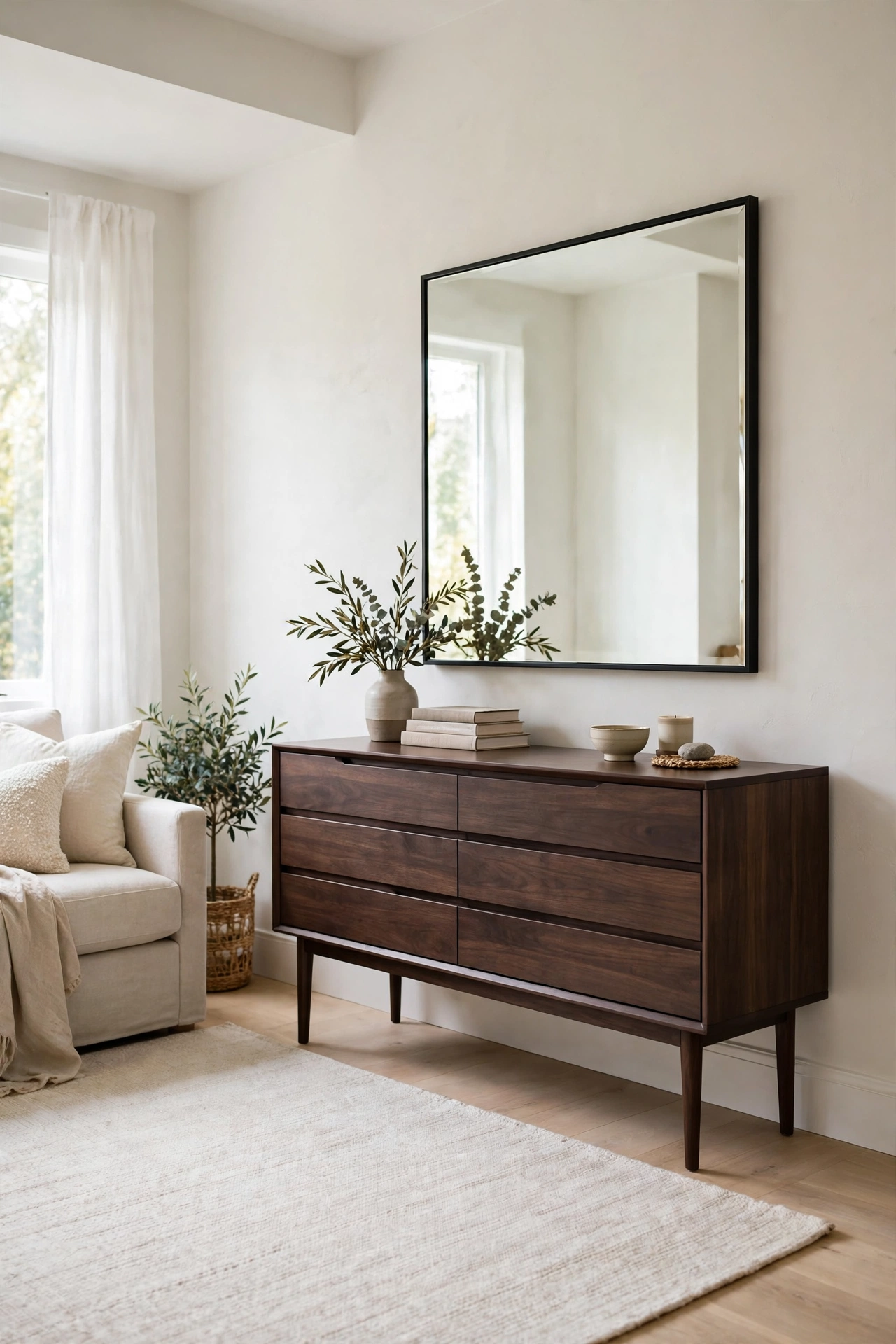
Small rooms and dark wood can get along, but only if the dark piece earns its floor space. A solid walnut sideboard that reaches the floor on all four sides will make a small room feel smaller, because it blocks the light at ankle height and reads as a wall. The same sideboard on slim legs, with a gap underneath, lets the floor show through and the room keeps its size. Legs are the single most important detail in a small room.
Scale matters just as much. A deep mahogany bookcase in a box room will dominate the wall and leave no room for anything else. A narrow walnut shelf, a slim console table or a single dark chair will give you the tone you want without taking the room over. Measure the wall, then subtract 30 centimetres from each end before you shop, so the piece has air around it. And keep the top of the piece clear, one lamp, one stack of books, nothing more, because a crowded top makes a dark piece look bigger than it is.
| Room | Dark wood piece that works | What keeps it light |
|---|---|---|
| Small living room | Slim-legged walnut sideboard | Pale rug, mirror above, one lamp only |
| Small bedroom | Walnut bed frame with legs | White bedding, linen curtains, open floor |
| Small dining corner | Round mahogany table | Light chairs, pale wall, low centrepiece |
| Hallway | Narrow dark console | Mirror above, pale runner, single vase |
| Home office | Walnut desk with open legs | White walls, light chair, desk lamp only |
Placement: Slim legs, a gap under the piece, and at least 30 centimetres of clear wall on each side.
Colour: Pale walls and a pale rug, so the dark wood is a single strong note in a light room.
Texture: A mirror above the piece doubles the light and makes the dark wood look like it is floating in a brighter room.
Swap: If the piece you love has no legs, raise it on small wooden blocks hidden behind the plinth, or choose a wall-mounted shelf in the same wood instead.
Try this: the one-week trial. Put the dark piece in place, live with it for a week, and take a photo of the room on day one and day seven. If the room still feels small on day seven, move the piece 15 centimetres away from the wall and clear everything off its top. That gap and that clear surface usually fix the heavy feeling without buying anything new.
6. Contrast Dark Wood with Pale Walls and Soft Textiles
 Save
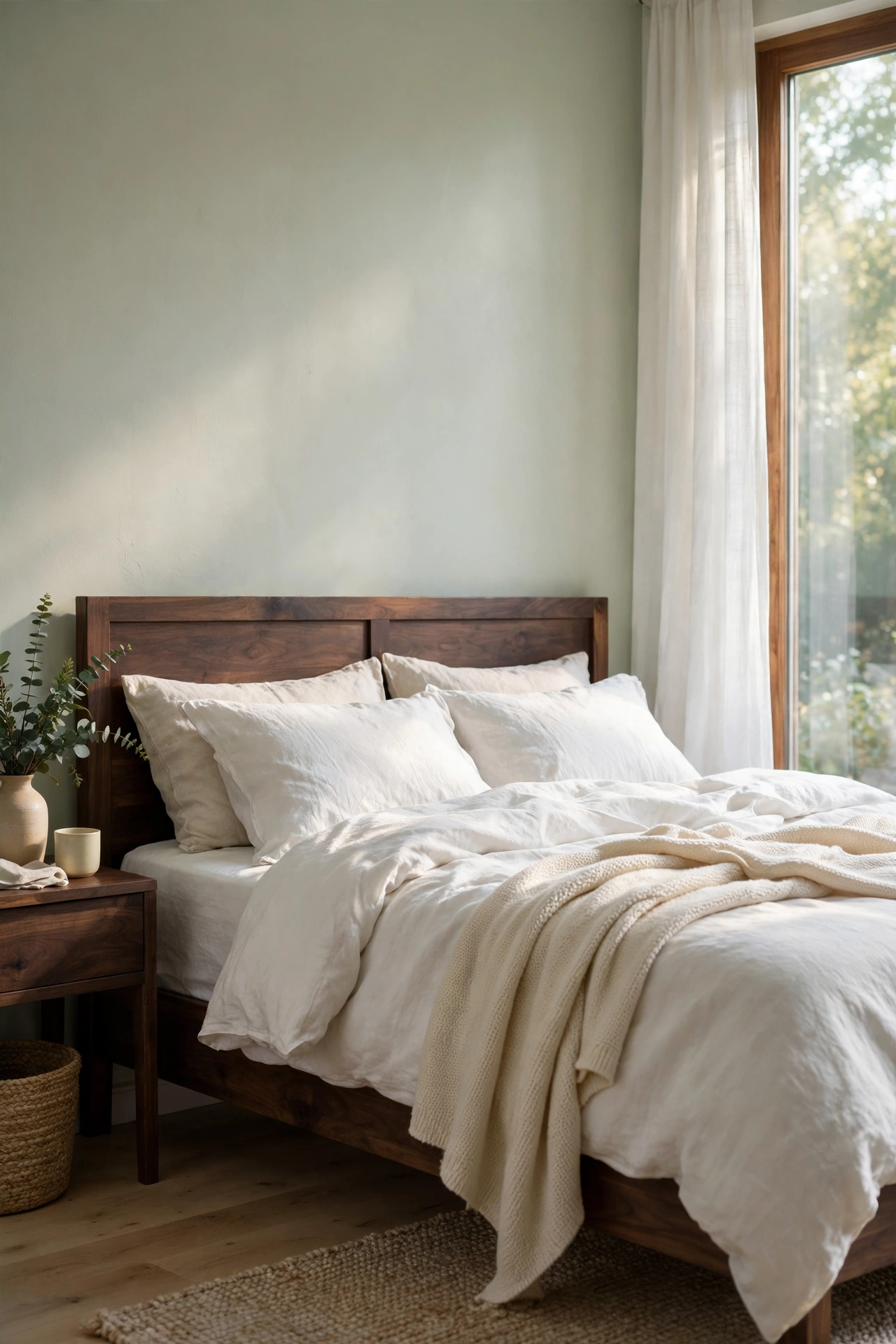
Dark wood needs something soft next to it, or it reads as hard and formal. A walnut sideboard against a pale wall with a linen curtain beside it looks warm. The same sideboard against a dark wall with leather chairs looks like an office. The contrast that works is dark wood against pale, soft things: cream linen, white bedding, a wool throw, a pale rug with a low pile. The soft things catch the light, and the dark wood gives them something to lean against.
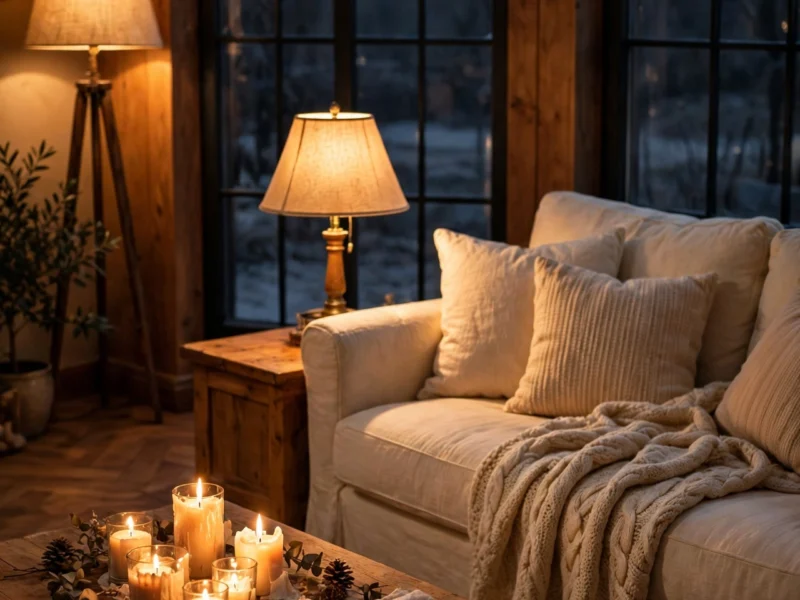
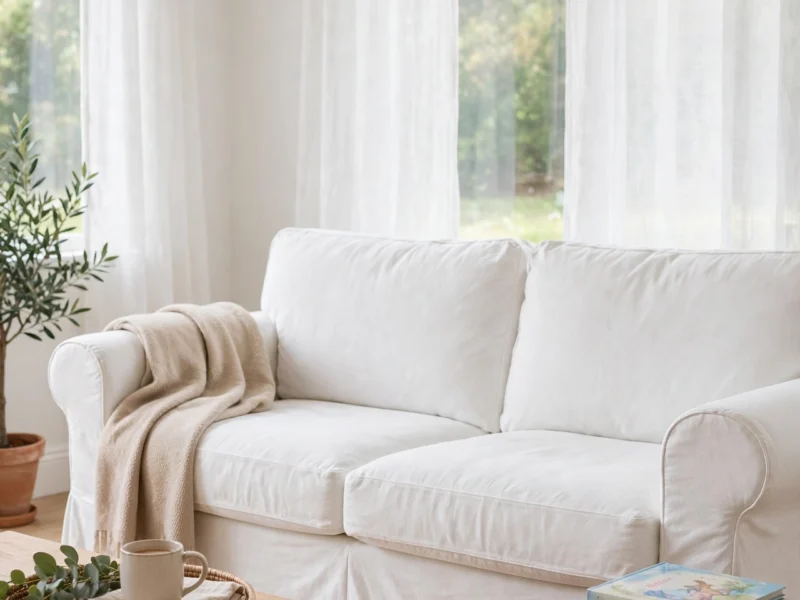
Start with the biggest soft surface in the room. In a living room that is the sofa, so choose a pale sofa, cream, oatmeal or light grey, and let the dark wood sit beside it. In a bedroom it is the bedding, so choose white or pale linen bedding and let a walnut bed frame do the anchoring. In a dining room it is the table linen and the chair cushions. One pale, soft surface per room is enough, and it stops the dark wood from making the room feel like a library after closing time.
Placement: Pale soft surface on the largest piece of furniture, dark wood on the second largest, so the two balance each other.
Colour: Cream, oatmeal, pale sage or soft grey against the warm brown of walnut or the red-brown of mahogany.
Texture: Linen, wool and cotton in pale tones, with one woven or knitted texture for depth.
Swap: If a pale sofa feels impractical with children or pets, choose a washable pale slipcover, or a mid-tone sofa with pale cushions and a pale throw. The contrast still works, it just sits on the cushions instead of the whole sofa.
Try this: drape a pale throw over the arm of the chair nearest your dark piece and step back. If the room suddenly looks finished, the dark wood was waiting for a soft neighbour. If it still looks hard, add a second soft thing, a cushion or a rug, and check again. For the full dark-wall version of this contrast, our moody neutral living room ideas show how dark tones and warm texture balance each other.
7. Style the Surface: Books, Brass and Greenery
 Save
A dark wood surface is a stage, and the objects on it are the performance. The mistake is to fill it. Three objects, at three different heights, look deliberate. Ten objects look like a jumble sale. A stack of two books, a small brass object and a green plant is the classic trio for a reason: the books give height, the brass catches the light, and the green softens the hard edge of the wood.
Greenery matters more on dark wood than on light wood, because the green is the one colour that lifts a dark surface without fighting it. A small potted plant, a trailing pothos, or a sprig of eucalyptus in a glass jar all work. Avoid dried flowers in dark rooms, they read as brown on brown and disappear. Brass matters too, because it is the one metal that shares walnut and mahogany’s warmth. Chrome and silver look cold against dark wood, while brass and aged bronze look like they grew up together. If brass feels too shiny, choose aged or brushed brass, which has a softer glow.
Placement: Three objects, low, medium and tall, grouped on one third of the surface, leaving the rest clear.
Colour: Green foliage, warm brass, and the natural brown of the wood. Keep everything else quiet.
Texture: A ceramic vase, a woven basket underneath, and a linen runner to stop the wood getting scratched by the objects.
Swap: If live plants keep dying, use a good faux eucalyptus stem in a ceramic vase. It gives the same lift with no watering, and nobody will notice from across the room.
Try this: take everything off the surface, then put back only three things you love. Live with it for three days. If you miss something, add it back, one object at a time, and stop the moment the surface looks full. Most people stop at four or five, and the surface looks better than it did with ten.
8. Care for Dark Wood So It Keeps Its Depth
 Save
Dark wood shows dust, fingerprints and water rings more than pale wood does, and that is the real reason people regret it. The care is simple, but it has to be regular. Dust once a week with a dry, soft cloth, always wiping along the grain, never across it, because wiping across the grain pushes dust into the pores and leaves fine scratches that show up in sunlight. For sticky marks, use a cloth wrung out in warm water with a drop of mild washing-up liquid, then dry the surface straight away. Never leave a damp cloth sitting on dark wood.
Water rings are the most common damage, and they are also the most avoidable. Use coasters under every glass and a mat under every hot mug, and keep a folded linen napkin on the dining table for the same job. If a pale ring does appear, it usually sits in the finish rather than the wood, and a gentle rub with a soft cloth and a little mayonnaise-free furniture oil, applied along the grain, will often lift it. For deeper scratches, a wax stick in a matching tone, rubbed in and buffed with a soft cloth, hides the mark well enough that nobody will find it unless they are looking. Sunlight is the quiet enemy: direct sun fades mahogany’s red tone over time, so pull the curtains across a south-facing window at midday, or move the piece a few centimetres out of the sun’s path.
Placement: Coasters on every surface, mats under hot dishes, and the piece a few centimetres away from radiators, which dry the wood out.
Colour: A matching wax stick for scratches, kept in the drawer of the piece itself, so it is there when you need it.
Texture: Soft cotton cloths only, never paper towels or scouring pads, which scratch the finish on the first pass.
Swap: If oiling feels like a chore, a good furniture wax applied twice a year does the same protective job with less fuss, and it gives the wood a soft glow that oil sometimes misses.
Try this: the cloth test. Wipe a small hidden corner with a dry soft cloth. If the cloth comes away grey, the piece needs a weekly dust. If it comes away clean, fortnightly is enough. Either way, put a coaster by every seat now, before the next cup of tea, because a ring prevented is worth more than any repair.
Test it first: before you commit to a dark piece, tape a walnut or mahogany sample — or a dark cloth — to the wall where the piece will stand and live with it for one evening under your lamps. If the room still feels warm and the piece reads as the clear hero, buy it. If the corner turns heavy or flat, lighten the wall behind it first.
Bringing It All Together
Dark wood is not a difficult material, it is a strong one, and strong materials need a light touch around them. One dark piece per room, warm neutrals on the walls, a pale soft surface nearby, and a little brass and greenery on top. That is the whole system, and it works with walnut, with mahogany, and with the dark-stained pieces you already own.
Start with the lead piece. Clear its top, give it a pale neighbour, and live with it for a week before you buy anything to go with it. The room will tell you what it needs next, a lamp, a rug, a mirror, and you will buy one thing instead of five. Dark wood rewards patience, and a room that was built slowly around one good piece will look better in a year than a room that was filled in a weekend.
Frequently Asked Questions
Is dark wood furniture out of style in 2026?
No, dark wood is firmly back, with walnut in particular showing up in 2027 trend forecasts as the warm anchor in pale, calm rooms. The look that dates is a room full of dark wood with nothing pale to balance it, not the wood itself. One dark piece against warm neutrals reads as current and classic at the same time.
Which is better, walnut or mahogany?
It depends on the room. Walnut suits modern and relaxed rooms, with its warm brown tone and calm grain, and it pairs easily with cream linen, brass and pale oak. Mahogany suits traditional and formal rooms, with its deep red-brown tone and ribbon grain, and it looks best with ivory, aged bronze and deep green. If you are choosing one piece for a light room, walnut is the safer first buy.
How do I stop dark wood making my room look small?
Choose pieces with slim legs and a gap underneath, keep at least 30 centimetres of clear wall on each side, and put a pale rug and a mirror nearby. Keep the top of the piece clear except for two or three objects. The legs, the gap and the pale surfaces do most of the work, and a small room with one dark piece usually feels cosier, not smaller.
Can I mix dark wood with light wood furniture?
Yes, as long as one tone clearly leads and the undertones match. Aim for roughly two-thirds light wood and one-third dark, and pair warm with warm, walnut with pale oak, mahogany with warm beech. Hold samples together in daylight first, and if they look like cousins they will work. A black-and-white photo of the room is a quick check: the dark and light shapes should separate clearly.
How do I remove water rings from dark wood?
A pale ring usually sits in the finish, not the wood. Rub it gently with a soft cloth and a little furniture oil, working along the grain, and it will often fade. For deeper marks, a matching wax stick rubbed in and buffed with a soft cloth hides the mark. Prevention is easier than repair, so use coasters under every glass and mats under hot mugs from today.
The Combination to Keep
The combination: one dark hero piece per room + warm neutral walls + one pale soft surface + brass and greenery on top + coasters everywhere. Choose the lead piece first, test it in your own light, and let the room grow around it slowly.
1 thought