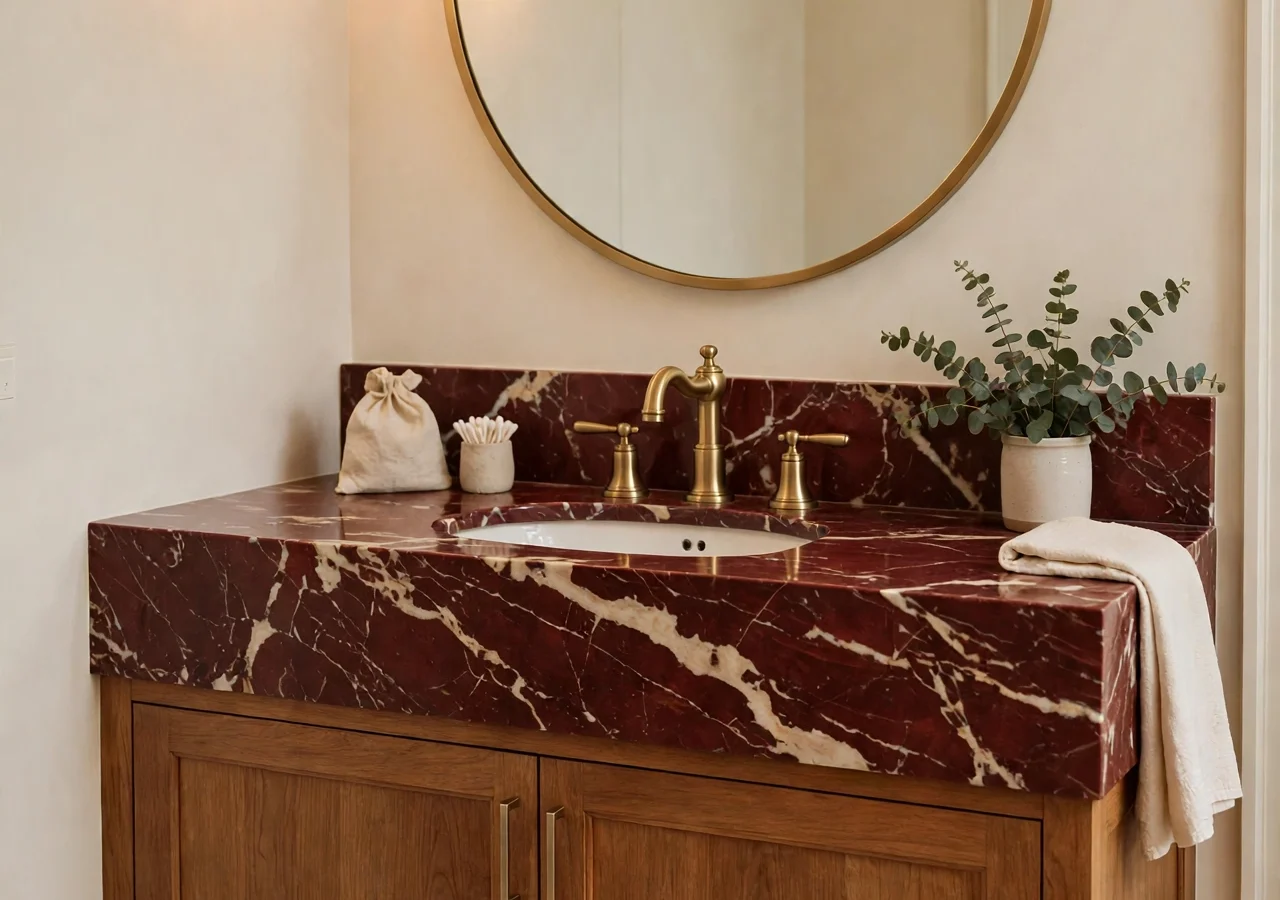
Most bathrooms play it safe. White tiles, grey grout, a chrome tap, and nothing that asks to be noticed. It works, in the way a plain white shirt works, but it rarely makes anyone stop and look twice. If your bathroom has started to feel like a room you pass through rather than a room you enjoy, that safe palette might be the reason.
Red marble changes the mood in one move. A slab of deep rosso with cream veining across a vanity, or a single wall of wine-toned stone behind a bath, turns an ordinary washroom into a space with real presence. It is warm where white marble can feel cold, dramatic without being loud, and surprisingly easy to live with once you know how much to use and what to pair it with.
This guide covers red marble bathroom ideas from the first slab to the last tap. You will find the tones worth choosing, the surfaces that suit them best, pairings that keep the room calm, and honest care advice, so you can bring this bold 2026 trend home without ending up with a bathroom that feels like a stage set.
Why Red Marble Works Right Now
 Save
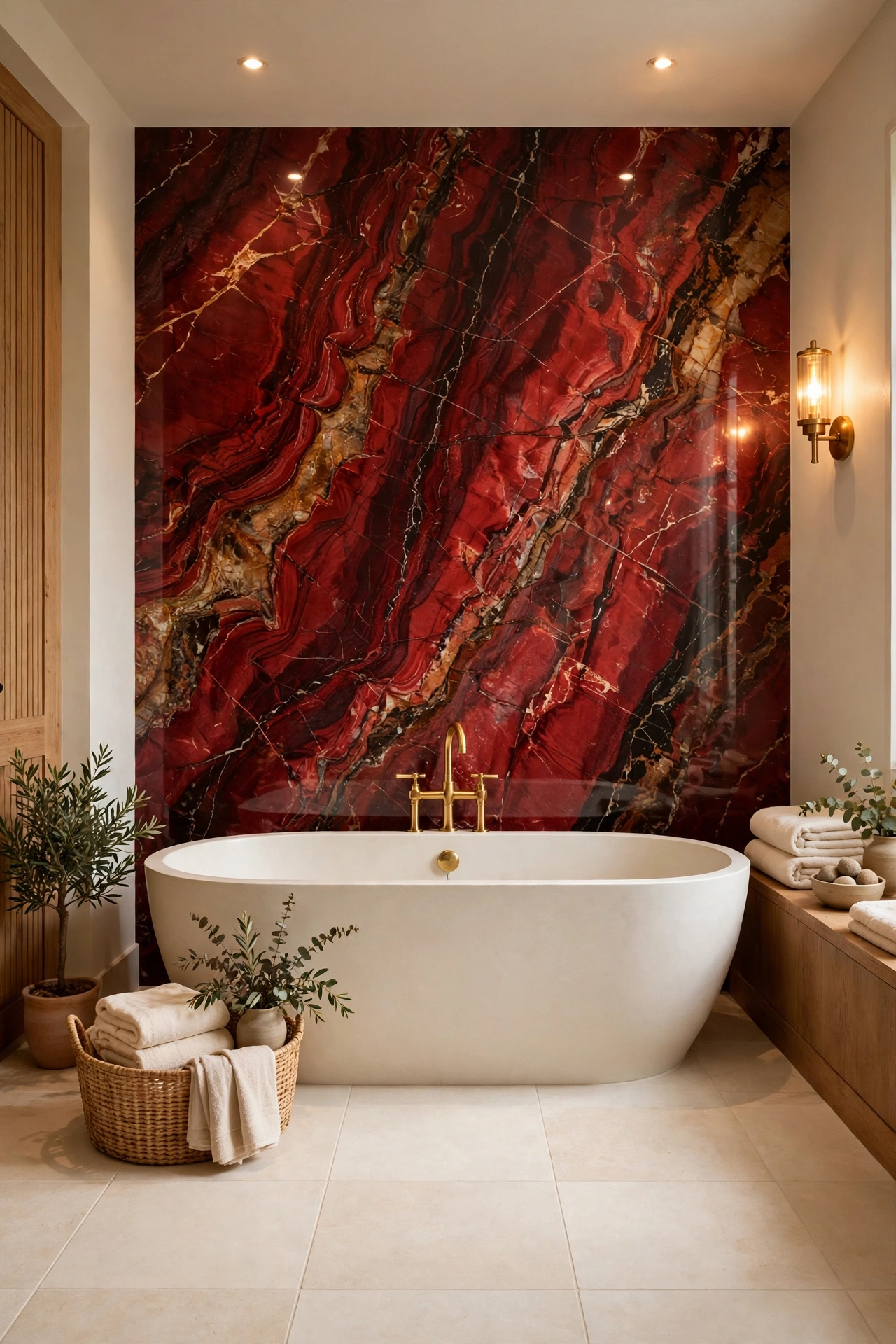
Red marble is not a new stone. It has lined hotel lobbies, old townhouses, and grand staircases for decades. What is new is where it shows up now: in normal homes, in normal-sized bathrooms, used in smaller, smarter doses. Instead of cladding a whole room floor to ceiling, designers are using one strong slab, one vanity top, or one tiled wall, and letting the rest of the room stay quiet.
That shift suits the current mood in interiors. After years of pale wood and soft grey, people want rooms with warmth and character again. Red marble gives both at once: base tones from brick and terracotta through to deep wine, so it reads as warm even in a north-facing bathroom, and veining in cream, gold, or pale grey that keeps a large slab from looking flat.
It also fits the wider return of rich, decorative styling. If you have been following the Neo Deco revival, you will recognise the family resemblance: bold stone, warm metal, curved shapes, and a touch of old glamour, softened for everyday living. A single red marble vanity in a plain white bathroom already carries the look, no full Deco scheme needed.
There is a practical reason too. Suppliers now cut thinner slabs and smaller-format tiles, so a red marble feature no longer needs a renovation-sized budget. A vanity top, a splashback, or a shower niche lined in red marble offcuts can give you the full effect for a fraction of a full-room job.
Designer note: Look at red marble in your own bathroom light before you commit. Showroom spotlights flatter every stone. Take a sample home, prop it against the wall, and check it in morning light, evening lamplight, and with the shower steam up. A tone that glows under a spotlight can turn muddy under a cool bathroom bulb.
Choosing the Right Red: Tones, Veining and Finish
 Save
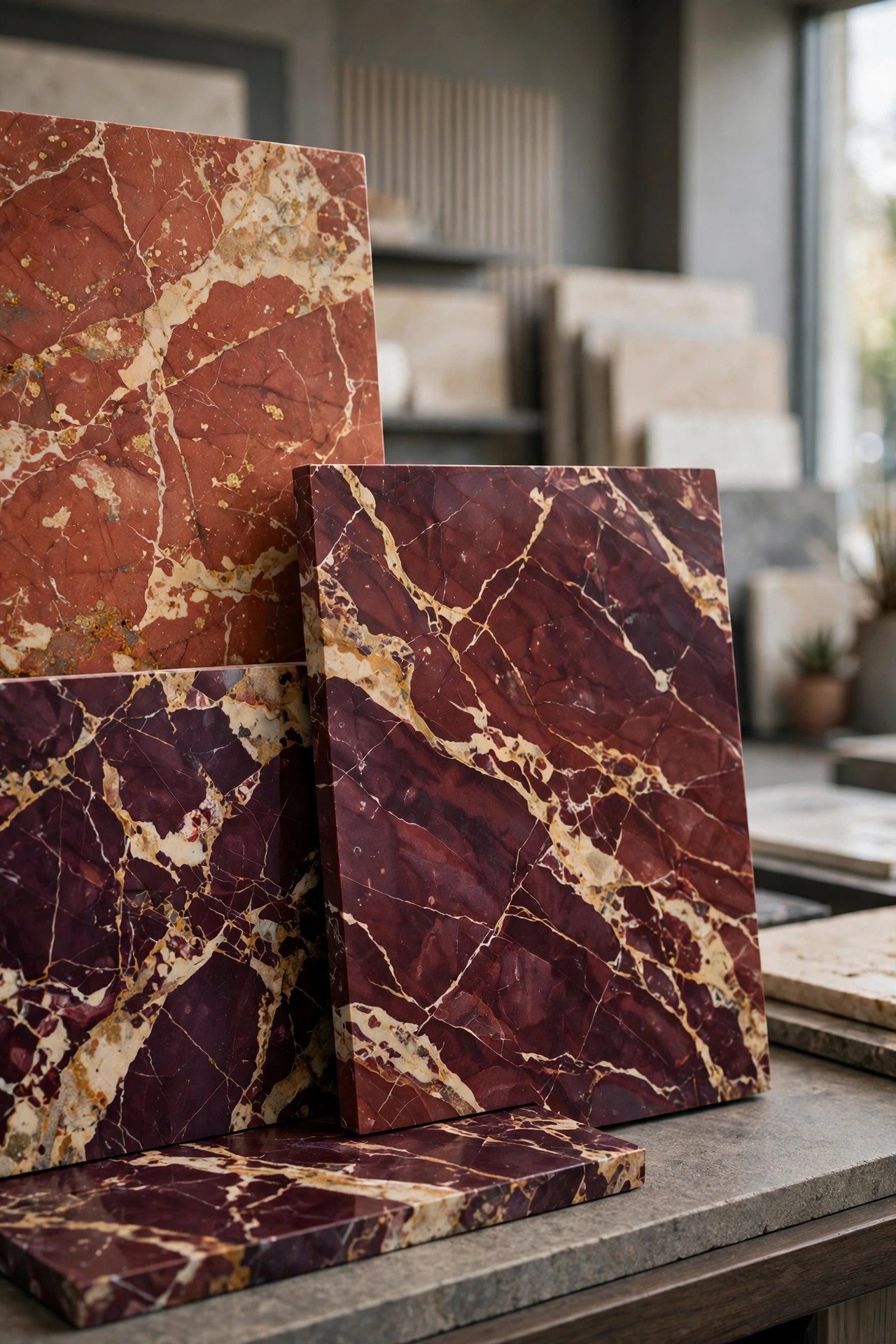
Not all red marble is the same, and picking the wrong tone is the fastest way to a bathroom you tire of. The main families are worth knowing before you order anything. Rosso Verona leans brick and terracotta, with soft cream and peach veining: the friendliest red, and a good first choice for warmth without drama. Rosso Levanto runs darker, a deep wine with white and gold veins, suited to a more formal, evening feel. Rosso Alicante sits between the two, with a busy, netted vein pattern that reads almost like lace from a distance. Near-burgundy stones, sometimes sold as rosso rubino, can look almost brown in low light and need warm lighting to show their red at all.
Veining matters as much as base colour. Bold, wide veins suit large, simple surfaces like a vanity top or a bath surround, where the pattern has room to breathe. Fine, busy veining suits smaller areas, a splashback or a niche, where a bold pattern would feel restless. Pick one vein scale per bathroom: mixing a bold-veined slab with a busy-veined tile in the same sightline makes both look noisy.
Finish changes the stone completely. Polished red marble shines, deepens the colour, and bounces light around a small room, a real help in a windowless bathroom. Honed marble, with its matte surface, looks calmer and hides water marks better. For floors, honed finishes are safer under wet feet; for a vanity top, polished is easier to wipe clean.
| Stone family | Tone | Best use | Watch out for |
|---|---|---|---|
| Rosso Verona | Brick, terracotta | Vanity tops, splashbacks, first-time red | Can read orange under cool light |
| Rosso Levanto | Deep wine, gold veins | Feature walls, bath surrounds | Needs warm light to avoid looking dark |
| Rosso Alicante | Mid red, netted veins | Tiles, shower walls, niches | Busy pattern, keep the rest plain |
| Dark rosso rubino | Near-burgundy | Small accents, shelves, trims | Looks brown in low light |
Styling tip: If you can only afford one slab, spend it where your eye lands first when you walk in. In most bathrooms that is the vanity wall, not the floor. A red marble vanity top with a plain mirror above it gives you the trend at its best angle, every single morning.
The Vanity as the Showpiece
 Save
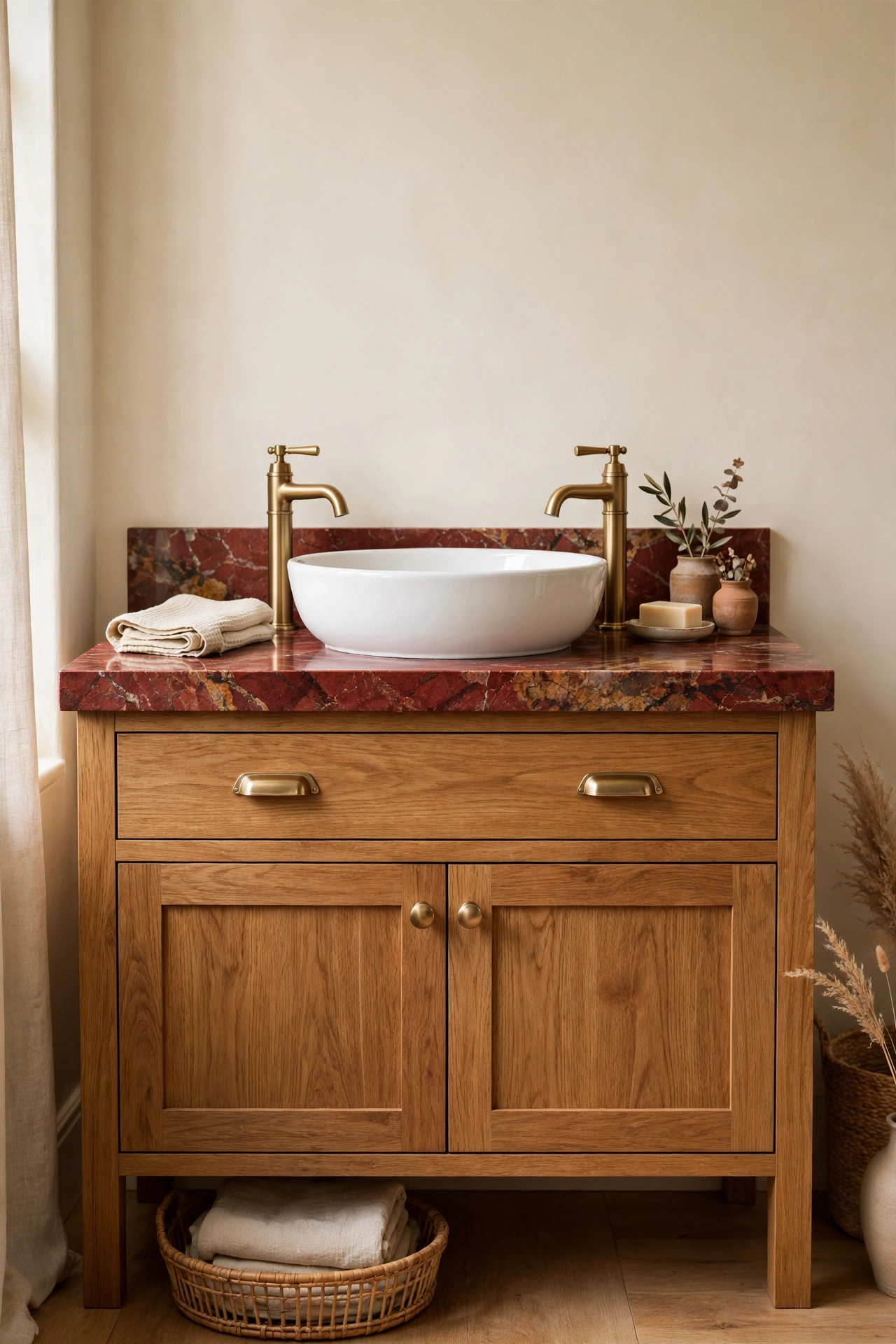
The vanity is the natural home for red marble, and it is where most people should start. A thick slab top, roughly 20 to 30 millimetres, over a simple cabinet gives the stone a proper stage. The cabinet underneath should stay quiet: flat-front doors in warm oak, walnut, or a soft cream lacquer, with no fussy mouldings competing with the veins.
Vessel basins work well here, but choose the basin with care. A plain white ceramic bowl lets the marble lead. A stone basin in the same red marble can look superb if it is cut from a matching offcut, but a basin in a different red will clash in a way that is hard to unsee. If matching is not possible, white ceramic is the safe, good-looking choice.
Taps deserve the same restraint. Brushed brass or aged bronze warms red marble beautifully, while polished chrome can feel cold against it, and matte black gives a sharper, more modern contrast that suits dark rosso tones. Whichever finish you pick, use it consistently across taps, shower fittings, and cabinet handles. Two metals in a small bathroom read as a mistake; one metal reads as a decision.
Storage matters more than it seems. A red marble top looks best when it is not buried under bottles, so keep daily items in a drawer or a small tray and leave at least half the top clear. A soap dispenser, a small plant, and a folded hand towel are plenty. The stone is the decoration here, and it needs breathing room.
If a full slab top is out of reach, a red marble tray, soap dish, or small shelf still brings the colour in, and layering a few small pieces on a plain white vanity is a good test run: live with the tone for a month before committing to a full top.
Walls and Floors: How Much Red Is Enough
 Save
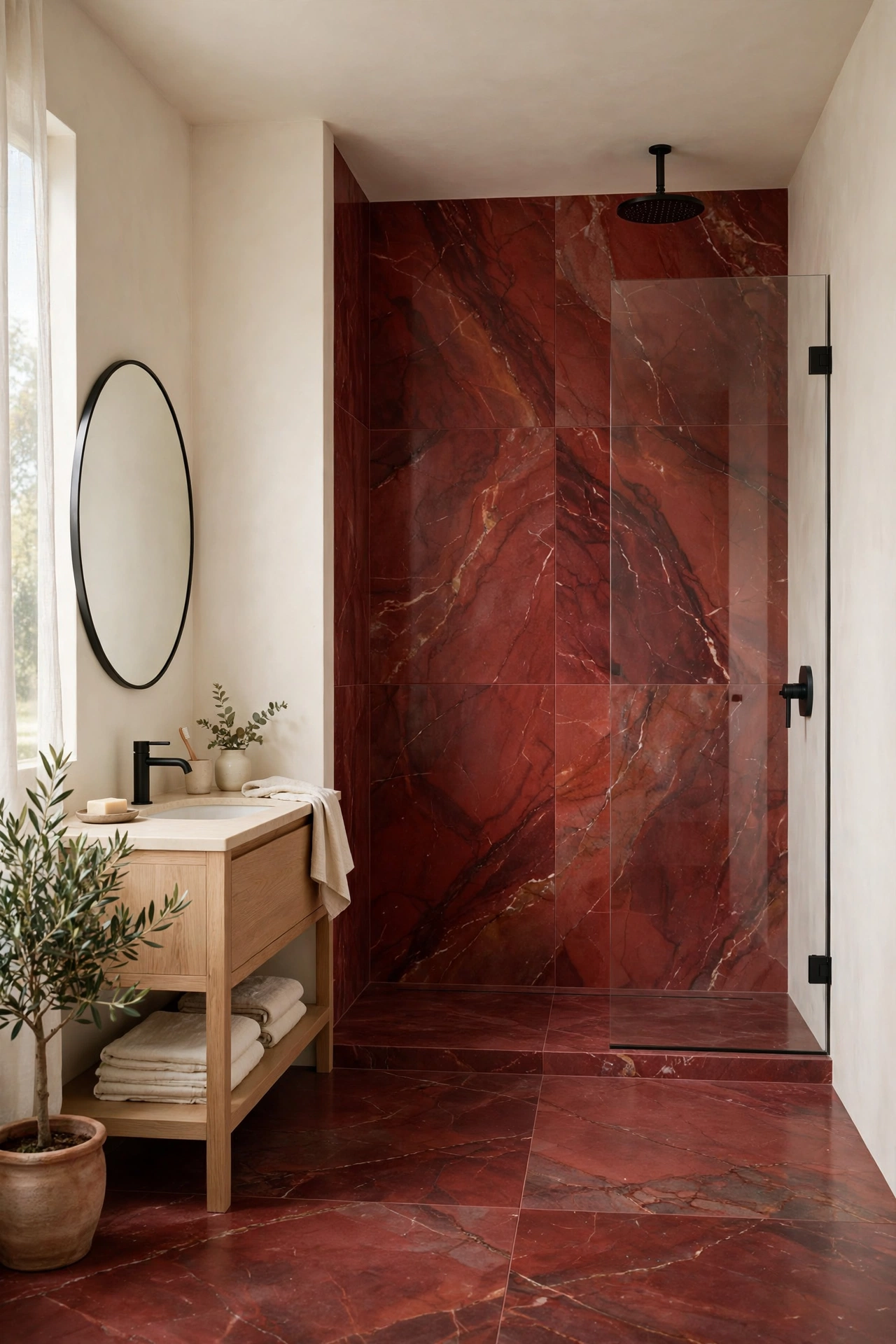
This is the question that decides whether a red marble bathroom feels luxurious or overwhelming, and the honest answer is: less than you think. A full room in red marble, walls and floor, can work in a large hotel bathroom with high ceilings and huge windows. In a typical home bathroom, it tends to close the space in and tire the eye fast.
A better rule is one strong surface plus one quiet echo. That could be a red marble wall behind the bath with a plain cream floor, or a red marble floor with plain plaster walls above a tiled dado line. The echo might be a red marble shelf, a window sill, or the shower niche, just enough to tie the room together without repeating the full pattern.
For shower walls, large-format tiles look far more expensive than small mosaics, because fewer grout lines break up the veining. Match grout to the stone’s base tone, a warm mid-brown or muted red-grey, rather than bright white, which turns a marble wall into a grid and fights the natural pattern.
Floors need a practical eye. Polished marble under wet feet is slippery, so choose honed tiles for the floor and keep polished finishes for walls and vanity tops. A large cream bath mat plus a honed finish solves most slip worries, and underfloor heating suits marble well, since stone holds warmth and releases it slowly.
For a wider look at how bold tile choices change a whole room, our guide to bold kitchen and bathroom tiles shows the same one-strong-surface thinking applied to kitchens and baths alike.
Budget swap: A single red marble feature wall can be faked convincingly with large porcelain tiles printed with a red marble pattern. Porcelain needs no sealing, shrugs off water, and costs far less than real stone. Use real marble for the vanity top, where you touch it daily, and porcelain for the wall, where you mostly look at it.
Brass, Black and Wood: Pairings That Keep It Calm
 Save
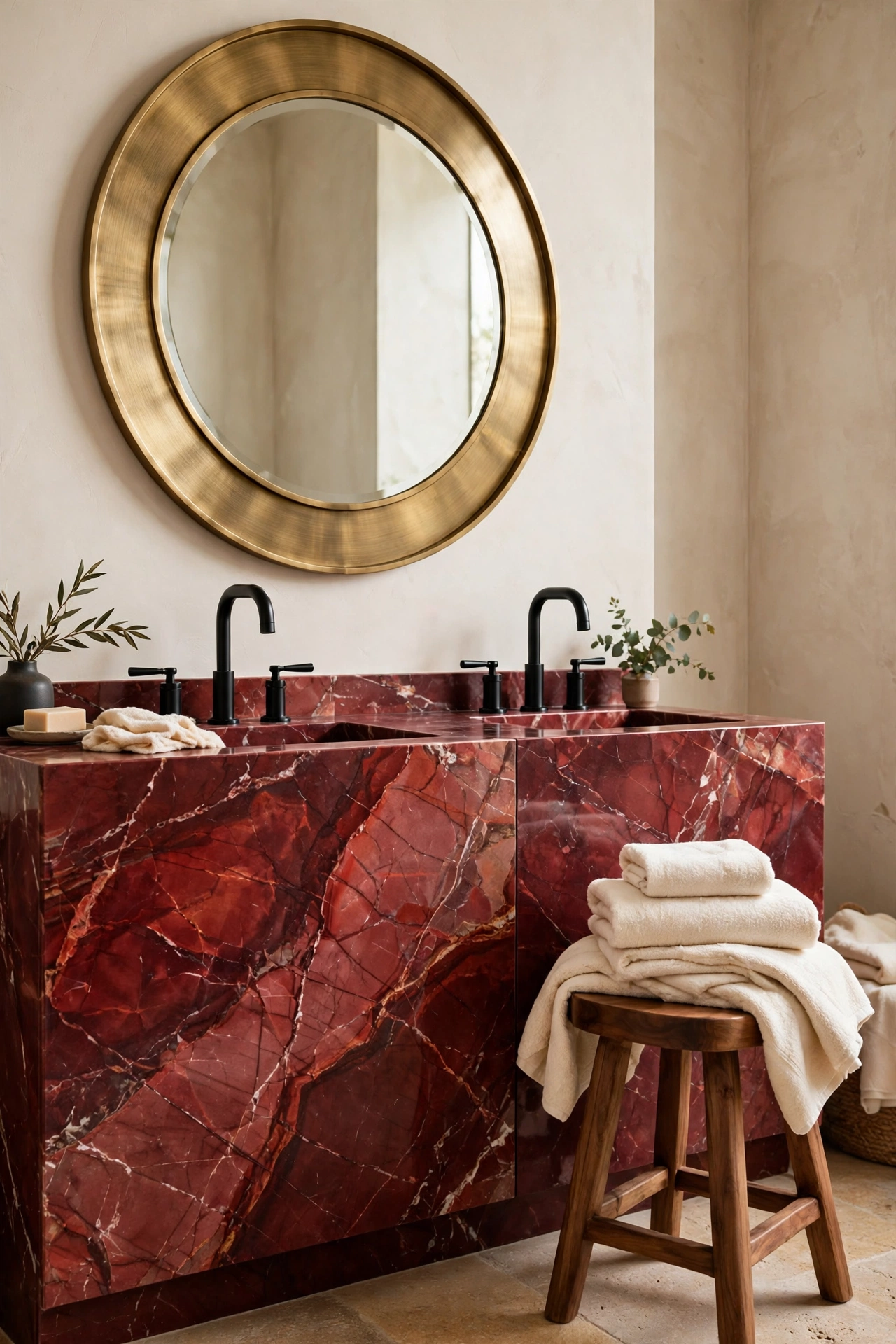
Red marble is a strong character, so the rest of the room needs to play supporting roles. The three pairings that work most reliably are brass, black, and warm wood, and each gives a different mood.
Brass is the classic partner. Brushed brass taps, a brass-framed mirror, and brass cabinet pulls pick up the gold veins in stones like Rosso Levanto and make the whole room glow. Keep brass brushed or aged rather than mirror-polished, which can look brash next to a busy stone. For more ideas on using warm metals without overdoing them, see our warm brass metallics guide.
Matte black is the modern partner. Black taps, black shower frames, and black cabinet handles sharpen red marble and stop it feeling old-fashioned. This pairing suits dark rosso tones best, and it works well in bathrooms with concrete, dark wood, or charcoal tiles elsewhere. Just keep black to fittings and frames, not large surfaces, or the room can turn heavy.
Warm wood is the softening partner. Oak shelving, a walnut stool, a wooden bath caddy, or a timber-framed mirror all calm red marble down and make it feel like part of a home rather than a hotel. Pale oak suits brick-toned Rosso Verona; darker walnut suits wine-toned Levanto. Avoid grey-washed or whitewashed wood here, which cools the palette and fights the stone’s warmth.
What to avoid is almost as useful. Cool grey tiles, stark white gloss cabinets, and large amounts of silver chrome all pull against red marble’s warmth. If your bathroom already has grey floor tiles you cannot change, warm them up with brass fittings, a wooden stool, and cream towels, and keep the red marble to the vanity, out of the direct sightline.
Towels are the cheapest way to tune the mood. Cream, oatmeal, and soft sage calm red marble; deep green leans into its drama. Bright white towels can make it look harsher, so fold a cream or rust hand towel on top to soften the contrast.
Small Bathrooms: Red Without the Shrink
 Save
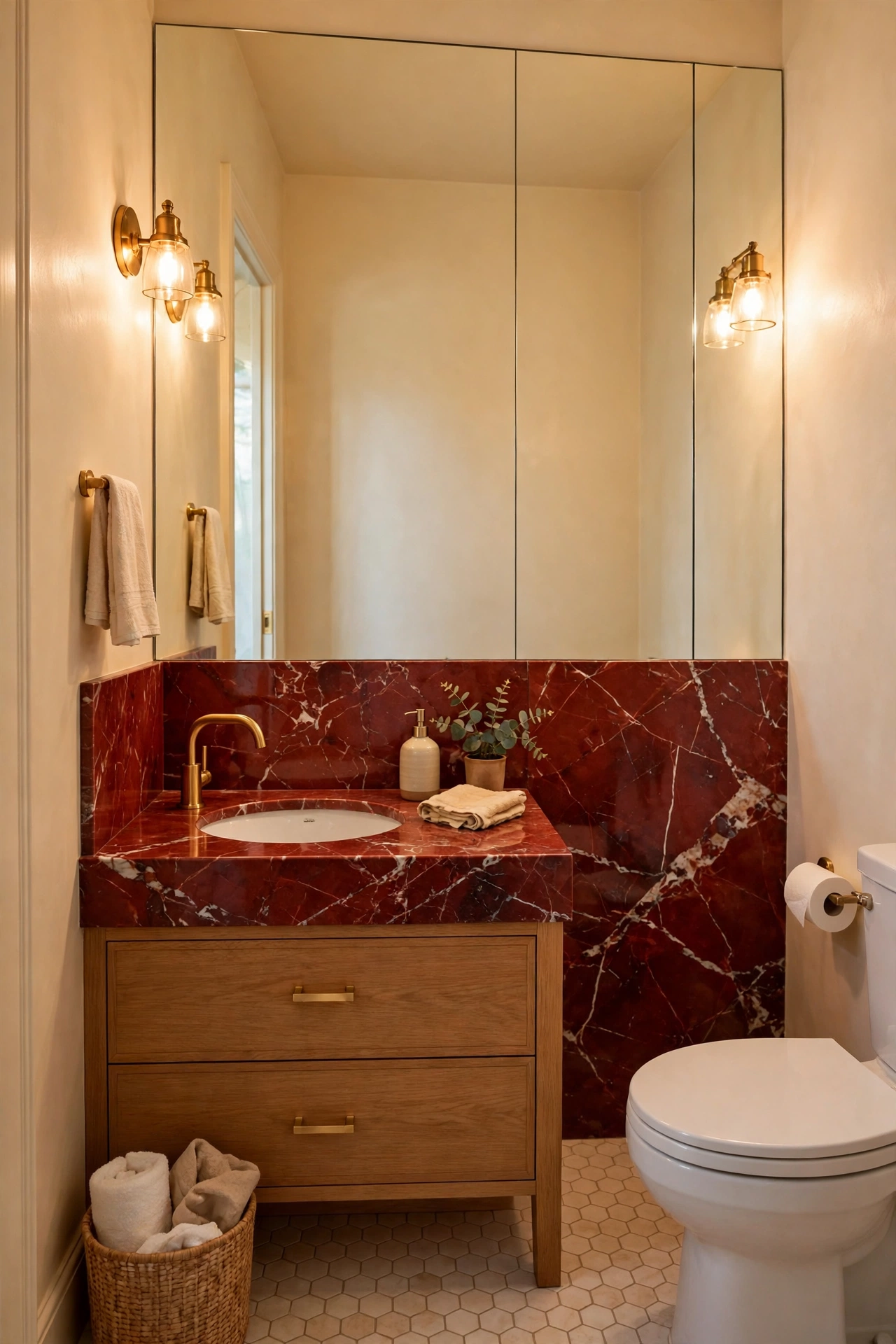
A small bathroom is no reason to skip red marble, but it is a reason to use it differently. The trick is placement: put the red where it draws the eye forward, not where it wraps around you.
A single vanity top in red marble, a splashback behind the basin, or a vertical strip of red marble tiles behind the bath all work in a compact room. What tends to shrink a small bathroom is red on every wall at once, or a dark red floor with dark walls above it. Keep at least two surfaces light: usually the ceiling and one wall, painted in warm cream or pale plaster.
Mirrors are your best friend here. A large mirror above a red marble vanity doubles the light and stops the stone feeling like a block. If you can, run the mirror wall to wall above the basin rather than using a small framed mirror. The extra glass costs little and changes how big the room feels.
Lighting needs thought too. One overhead light flattens red marble and casts hard shadows, so layer it: a warm ceiling light, wall lights or a lit mirror at the vanity, and a dimmable light over the bath for evenings. Warm white bulbs, around 2700K, suit red marble far better than cool daylight bulbs, which drain its warmth.
Storage should go vertical in a small red marble bathroom: a tall, narrow cabinet in warm wood, open oak shelves, or a recessed niche lined in red marble, all keeping the floor clear. A niche is a particularly good move, giving you the stone at eye level, in a small dose, exactly where you look when you shower.
If your whole room is one colour, you may find the same single-shade logic useful. Our guide to colour drenching technique explains how one strong colour can make a small room feel intentional rather than cramped, and the same discipline applies to stone.
Try this: Before you order, tape large sheets of red paper or fabric to the wall you plan to clad, and live with them for three days. If the room still feels good on day three, the real stone will feel even better. If you start avoiding the room, scale the red back to the vanity only.
Care, Sealing and Everyday Living
 Save
Marble has a reputation for being precious, and it is partly earned. It is a natural stone, softer than granite or porcelain, and it can stain and etch if it is not sealed and looked after. None of that should put you off, but it should shape how you use it.
Sealing is the first job. A good impregnating sealer, applied when the stone is installed and topped up every six to twelve months on a vanity top, fills the stone’s pores and buys you time to wipe up spills. It does not make marble stain-proof, but it turns a disaster into a quick wipe. Ask your installer which sealer they use, and keep the bottle for top-ups.
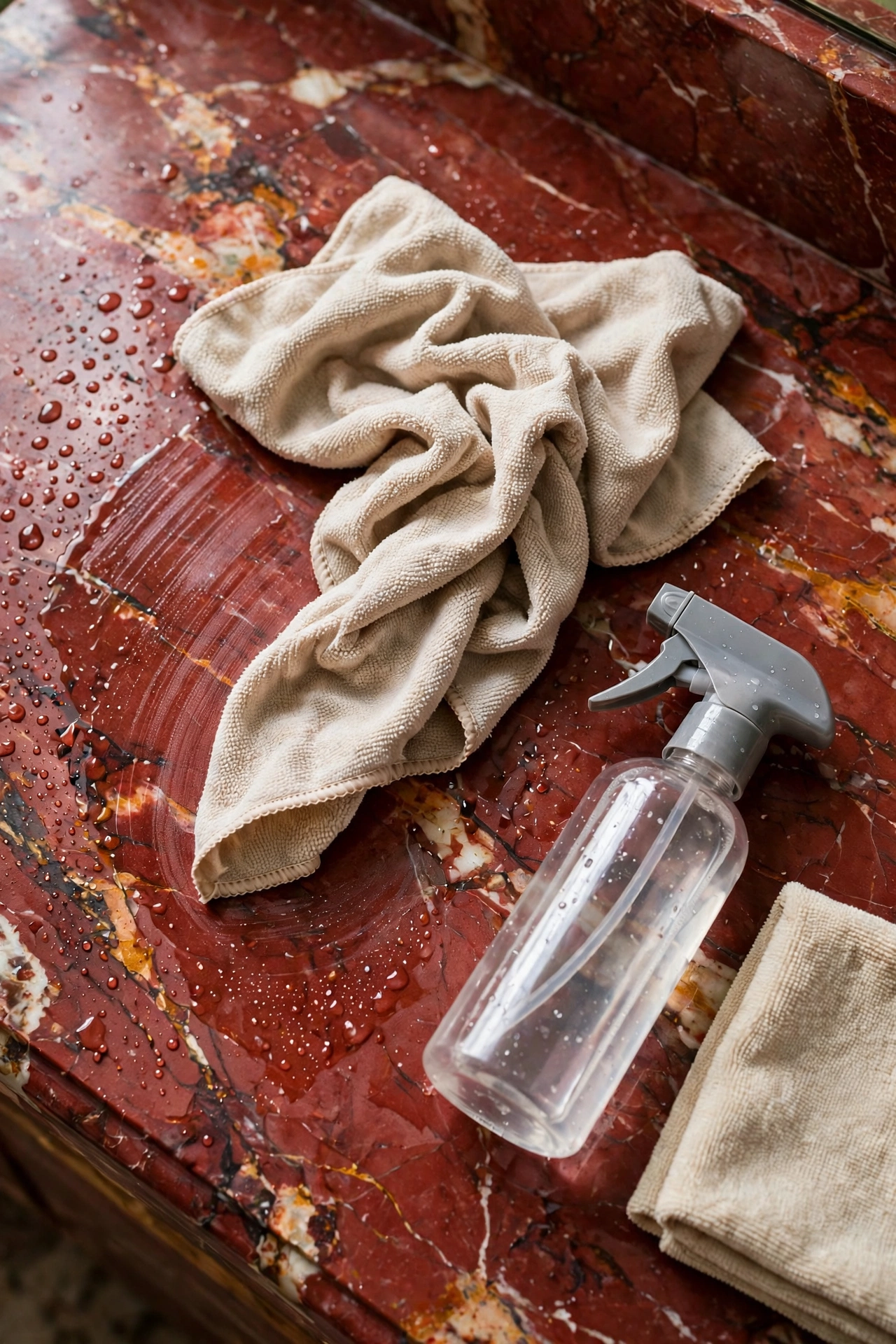
Daily care is simple: wipe the vanity after use, mop up standing water, and clean with a pH-neutral stone cleaner or just warm water and a soft cloth. Avoid vinegar, lemon-based cleaners, bleach, and abrasive scouring pads, all of which can dull or etch the surface. Toothpaste, hair dye, and fake tan are the usual culprits in a bathroom, so wipe them off promptly rather than leaving them to sit.
Etching, the dull marks left by acidic products, is the most common worry. Light etching on a honed finish is barely visible and often blends in over time; on polished finishes it shows more, one more reason many people choose honed marble for a busy family bathroom. If a mark bothers you, a stone professional can usually re-polish a vanity top in an afternoon.
For floors, a quick sweep and a damp mop with stone cleaner is enough, and avoid steam mops on sealed marble, since sustained heat can weaken the sealer. In the shower, a squeegee after use keeps water marks and soap scum from building up, and it takes about twenty seconds.
Styling tip: Keep a small, soft cloth in the vanity drawer and make wiping the top part of your evening routine. It becomes habit within a week, and it is the single easiest way to keep red marble looking new for years.
Bringing It All Together
Red marble earns its bold reputation, but the bathrooms that wear it best are not the loudest ones. They are the rooms where one strong stone surface gets quiet support: warm wood, brushed brass or matte black fittings, cream walls, and soft light. Start with the vanity, pick a tone that flatters your light, and let the rest of the room stay calm.
If you are still unsure, start small. A red marble tray, a shelf, or a splashback lets you live with the colour before you commit to a slab. And if you fall for it, as many people do, you can build the room around it one surface at a time. That slow approach is how a trend becomes a bathroom you still love in five years, not just a photo you liked in 2026.
Frequently Asked Questions
Is red marble too dark for a small bathroom?
Not if you use it in one place rather than everywhere. A red marble vanity top or splashback in a small bathroom adds warmth without closing the room in, especially when the other walls stay cream and the mirror is large. Avoid red on the floor and all four walls at once in a compact space.
Does red marble stain easily?
It can stain if it is unsealed and spills sit on it, but a good impregnating sealer and prompt wiping handle everyday bathroom use well. Wipe up toothpaste, hair dye, and coloured cosmetics quickly, clean with a pH-neutral stone cleaner, and re-seal the vanity top every six to twelve months.
What colours go with red marble in a bathroom?
Cream, oatmeal, warm white, sage green, and warm wood tones all calm red marble down. Brass fittings pick up its gold veins, matte black fittings give it a modern edge, and walnut or oak adds warmth. Cool grey tiles and large amounts of chrome tend to fight its warmth, so use them sparingly if at all.
Is real marble better than red marble-look porcelain?
Real marble feels cooler, has natural variation no print can fully copy, and suits surfaces you touch daily, like a vanity top. Porcelain is harder, needs no sealing, and costs less, so it suits large wall areas and busy family showers. Many good bathrooms mix the two: real marble where you touch it, porcelain where you look at it.
How much does a red marble bathroom feature cost?
It varies a lot by stone, size, and region, so get local quotes rather than trusting a single online figure. As a guide, a vanity top in red marble costs more than a standard quartz or ceramic top but far less than cladding a whole room, and offcuts or a porcelain feature wall can bring the look within a much smaller budget.