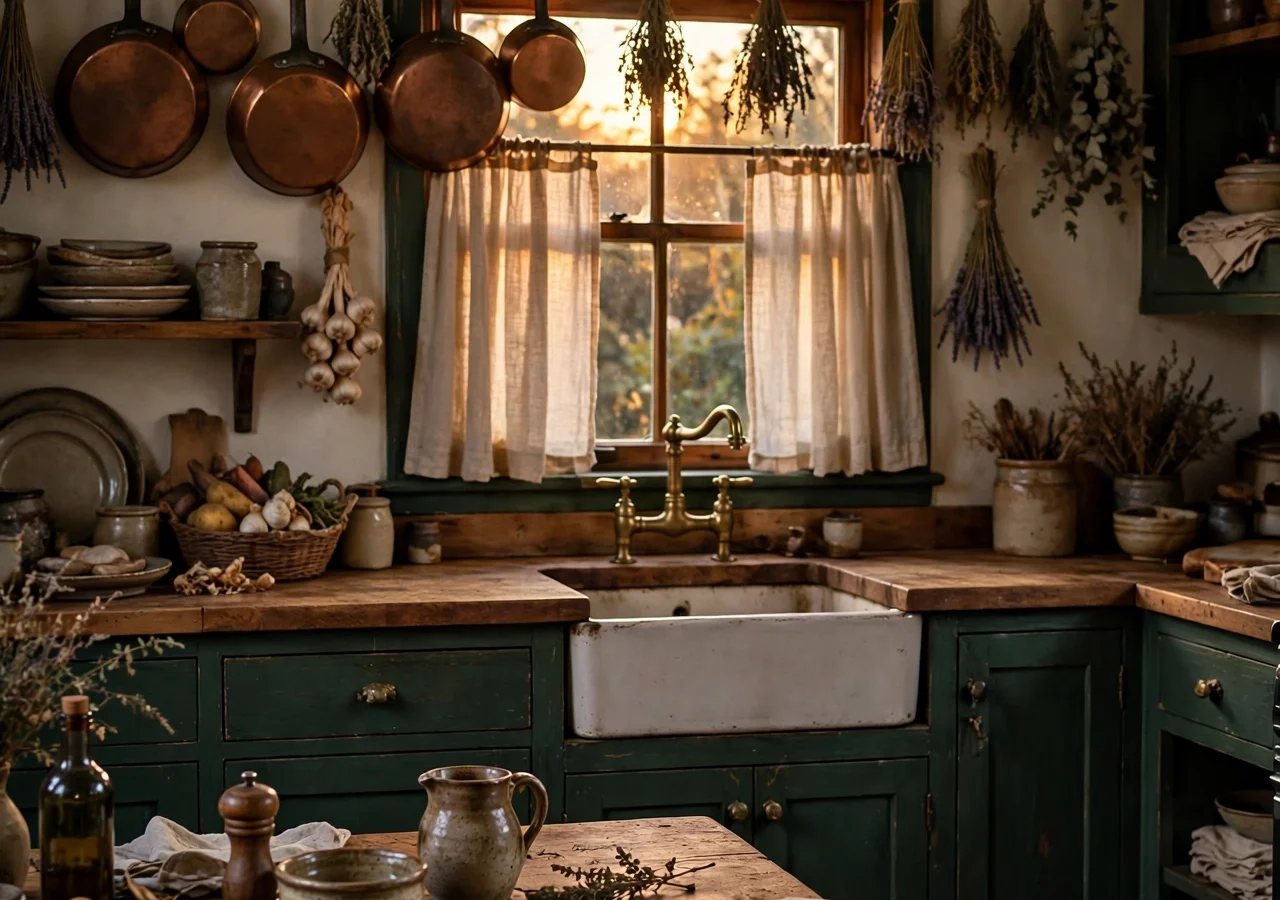
A cottagecore kitchen is supposed to feel like it has been loved for decades, and the dark version leans into that feeling even harder. Think deep green cabinets, worn timber, copper pots that have actually been cooked with, and light coming in soft through a linen curtain. Nothing shiny, nothing matchy, nothing that looks like it arrived in a flat pack last Tuesday.
The trouble is that dark can tip into gloomy fast. Paint everything charcoal, add black hardware and a black worktop, and the room stops feeling cosy and starts feeling like a cave. The trick is balance: dark colour on the big surfaces, warm wood and pale linen and brass to lift it, and plenty of texture so the eye always has somewhere soft to land.
These eight ideas work whether you are repainting a whole kitchen or just layering a few changes into the one you already have. Start with one, live with it for a week, then add the next. A room with soul is built slowly, and that is half the charm of dark cottagecore kitchen style.
Quick Tips Before You Start
Pick one dark anchor colour and repeat it three times, in three different materials. Test paint in the evening, when the room is at its darkest. Keep one pale surface, usually the worktop or the ceiling, so the dark has somewhere to rest. And buy second hand first: the best cottagecore pieces already have a past.
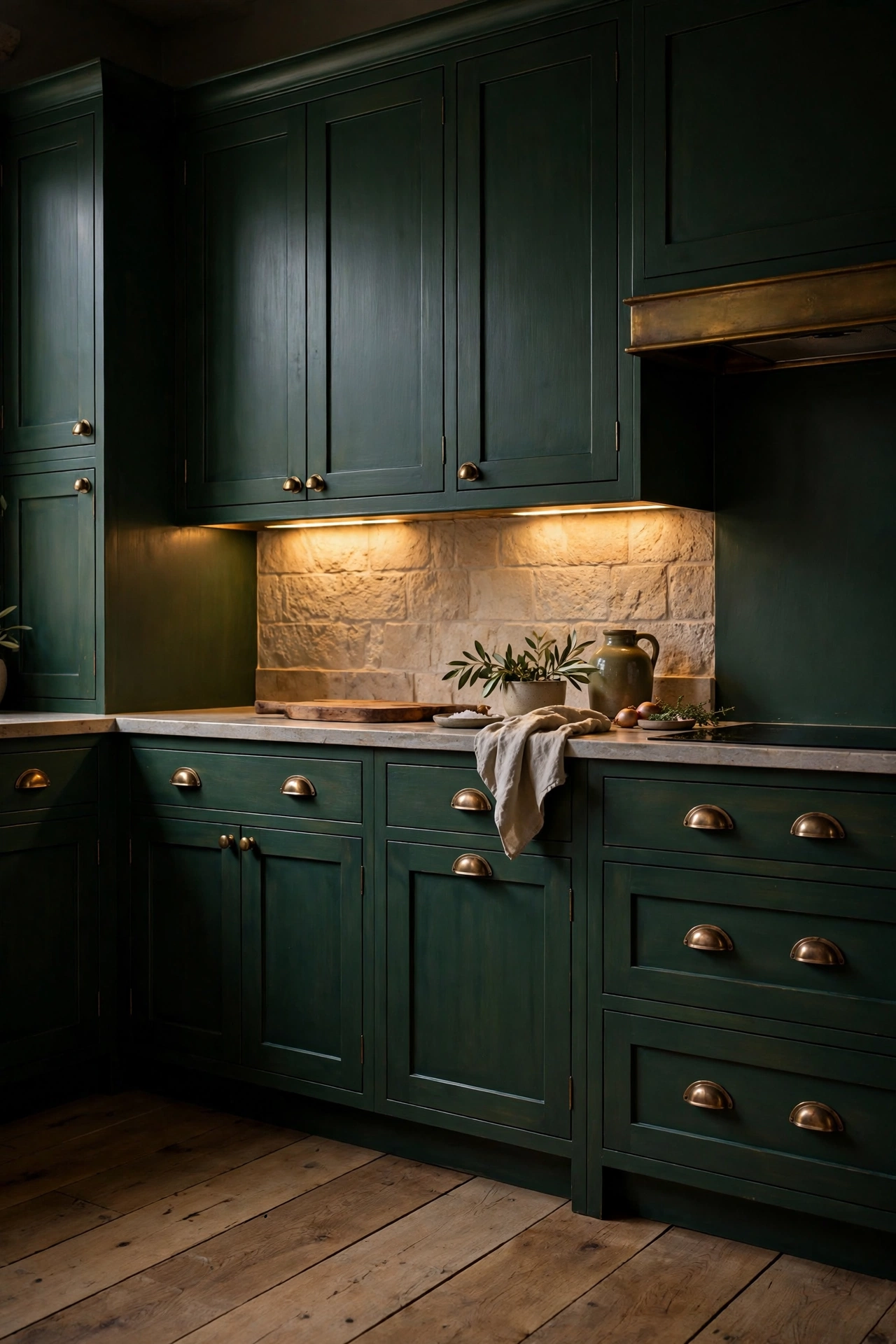
1. Paint the Cabinets a Deep, Earthy Green
 Save
Before you choose a colour, read the kitchen at its darkest hour. Note which way the window faces, since a north-facing kitchen needs a green with more yellow in it to hold its warmth. Note how much pale surface the room already has, since the ceiling and worktop must balance the dark cabinets. Note the timber already in the room, since the cabinet green must sit well beside the wood it will live with. Those three checks decide how dark you can go.
Nothing changes a kitchen faster than cabinet colour, and a deep green is the safest way into the dark cottagecore look. Forest green, moss, sage gone dark, even a green so deep it reads almost black in the evening, all sit beautifully against warm wood. The colour feels grown rather than painted on, which is exactly the mood this style wants.
Choose a paint with a soft sheen rather than a flat matt or a high gloss. A satin or eggshell finish wipes clean after cooking splashes and still catches a little light, so the cabinets look rich instead of flat. Paint the uppers and lowers the same colour for a calm, collected feel, or keep the uppers pale cream and let the lowers carry the dark. The two-tone version suits smaller kitchens, because the pale uppers keep the room feeling open while the dark base grounds it.
Match the cabinet approach to the size of the kitchen and how far you want to go.
| Kitchen | Cabinet approach | Why it works |
|---|---|---|
| A small kitchen | Pale uppers with dark lowers | Pale uppers open the room; dark base grounds it |
| A larger kitchen with good light | Uppers and lowers in the same dark colour | Gives a calm, collected feel |
| A rented kitchen, or a repaint that feels too big | Paint just the island or one run of lower cabinets | Full mood for a weekend’s work, one tin of paint |
Colour: forest green, deep moss, or a dark sage with warm undertones, never a cold blue green.
Texture: satin finish on the cabinets, with the wood grain faintly showing through on any timber doors.
Swap: if a full repaint feels too big, paint just the island or one run of lower cabinets and leave the rest cream. You still get the mood for a weekend of work and one tin of paint.
Styling tip: swap the hardware at the same time. Cup pulls in aged brass or blackened iron suit green cabinets far better than shiny chrome, and the whole kitchen reads more expensive for the price of a handful of handles.
Dark paint asks for good light, so check what yours does at night. A green that looks soft and leafy at noon can turn muddy under a single cold ceiling bulb. Warm bulbs, around 2700K, keep the green honeyed after dark, and under-cabinet strip lights stop the worktop falling into shadow. If your kitchen faces north, lean toward a green with more yellow in it, because it holds its warmth when the daylight is thin.
Test it first: paint one cabinet door, or a large board leaned against the cabinets, and look at it at noon and again in the evening under the lights you actually cook by. If the green stays leafy and warm after dark, the shade is right. If it turns muddy under the ceiling bulb, swap the bulb for a warm one before you blame the paint. If it still reads cold, pick a green with more yellow in it.
This is also the idea to pair with the rest of the room. Green cabinets next to pale plaster walls and a timber floor feel like a country kitchen that has simply always been there. For a deeper dive into the wider style, our grown-up cottagecore decor ideas show how the same layered, lived-in feeling works across a whole home.
2. Let the Wood Stay Dark and Honest
 Save
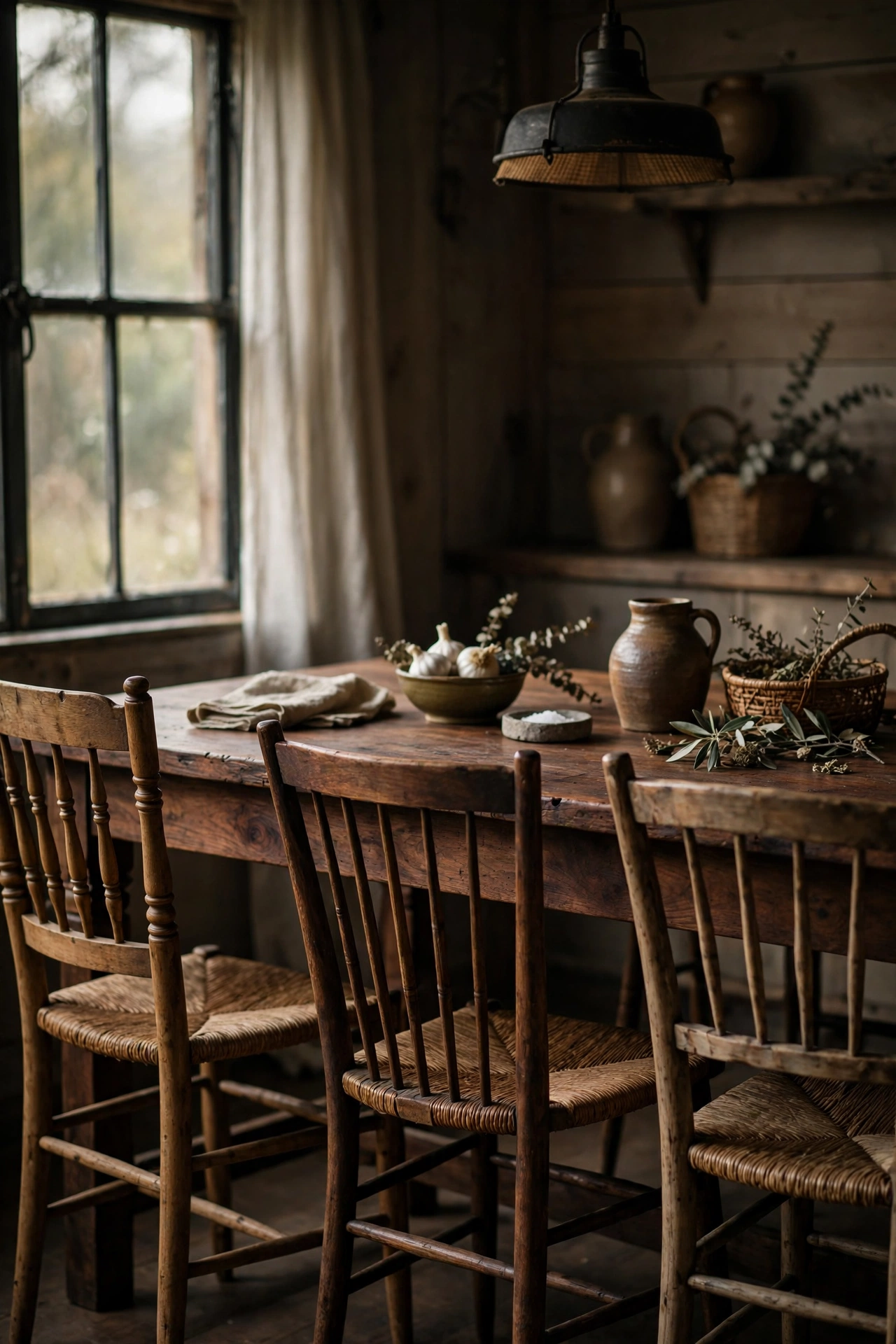
Dark cottagecore loves wood that shows its age. Walnut, mahogany, oak stained dark, even old pine that has gone honey brown with years of wax, all bring the warmth that stops a dark kitchen feeling stark. The rule is simple: let the grain show, and do not paint over good timber just because it looks old. Old is the point.
A dark wood table is the heart of this kitchen. It does not need to match the cabinets. In fact it should not. A walnut farmhouse table beside deep green cabinets, with chairs that do not match each other, reads collected over time rather than bought in a set. Add a rush seat here, a spindle back there, and a bench along one side for the days when everyone squeezes in.
Placement: put the table where the morning light hits it, even if that means turning it sideways to the window.
Colour: walnut, dark oak, mahogany, or old pine waxed to a deep honey brown.
Texture: visible grain, a waxed or oiled finish you can feel, and edges that are slightly worn rather than sharp.
Budget swap: a second-hand solid wood table, sanded lightly and re-waxed, costs a fraction of a new one and looks better for its scars. Check charity shops and local listings before you look at a showroom.
Open timber shelving works the same way. A single dark wood shelf holding everyday plates and bowls beats a wall of matching upper cabinets for character, and it costs far less. Keep the shelf shallow, about 25 centimetres deep, so plates sit in one row and nothing hides behind anything else. A shelf that is too deep becomes a dark cave where mugs go to be forgotten.
If the floor is timber, let it stay dark too, and warm it with a washable runner in a faded pattern. The runner protects the boards where you stand to cook, and the faded colours, rust, cream, faded blue, tie the whole palette together without any effort.
3. Open Shelves with Collected, Mismatched Pieces
 Save
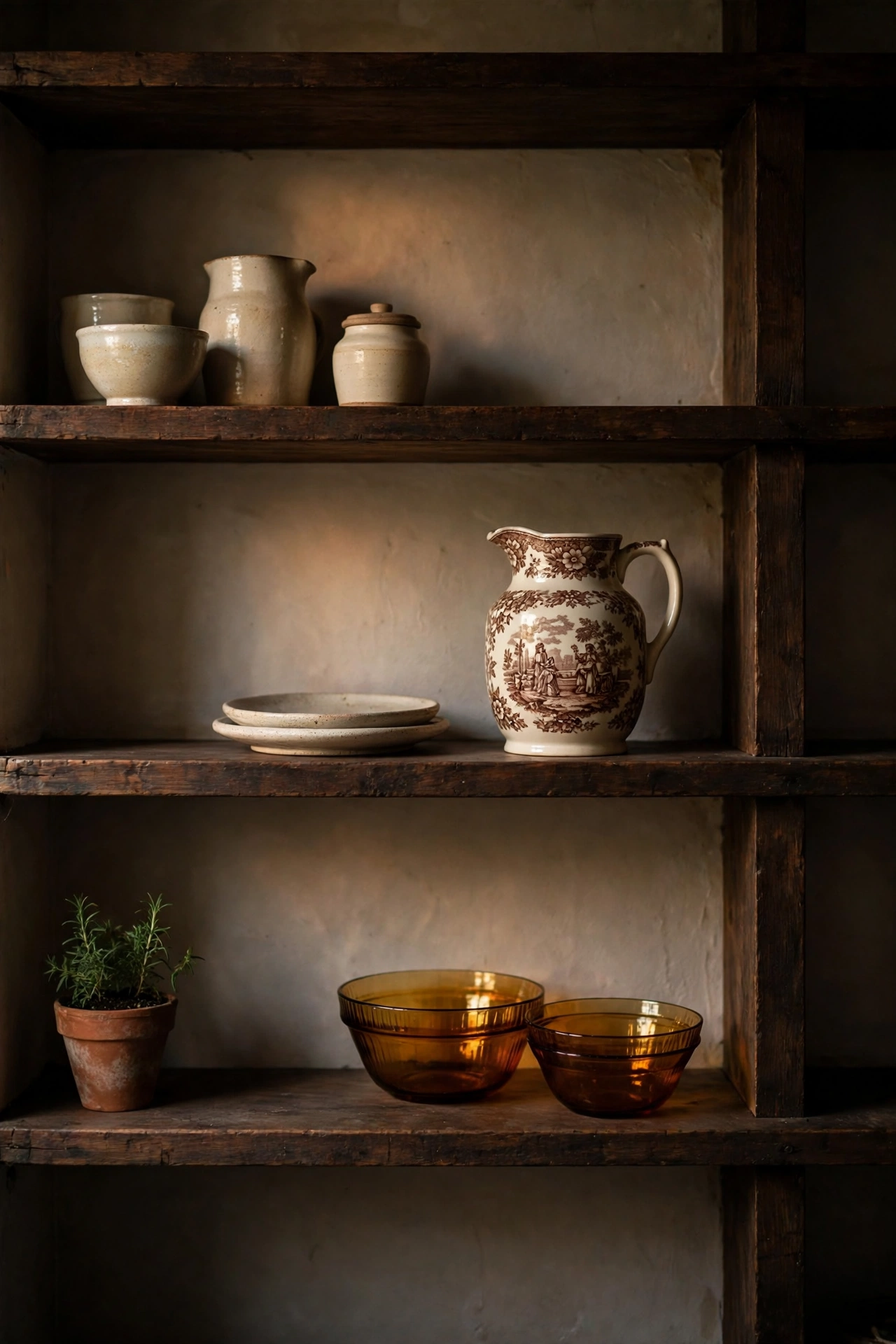
Open shelving is where a dark cottagecore kitchen earns its soul. The shelves themselves are simple, dark wood or painted to match the cabinets, but what sits on them should look gathered over years: cream stoneware, a brown transferware jug, amber glass, a stack of bowls in slightly different greens. Nothing in a set of twelve. Everything with a small story.
The trick is restraint. A shelf packed edge to edge looks like a shop, not a kitchen. Leave breathing room between groups, and repeat one colour, usually cream or soft white, across every shelf so the eye reads calm even when the shapes vary. Put the everyday pieces at hand height and the pretty, rarely used ones up high, where they can be admired without getting in the way of dinner.
Placement: one or two shelves where the upper cabinets would be, at a height you can reach without a step stool.
Colour: cream and soft white as the base, with amber glass and rust as the accents.
Texture: stoneware, glazed ceramic, cut glass, and one woven basket per shelf to soften the hard edges.
Try this: turn one shelf into a tiny herb shelf, with three small terracotta pots of basil, parsley and thyme. It smells wonderful when you brush past it, and it gives the shelves a living, working feel.
Dust is the honest drawback of open shelves, and it is worth saying so plainly. In a kitchen that cooks most days, a light wipe once a week keeps them fresh. Store the pieces you use daily on the open shelves, because constant use keeps them clean, and keep the rarely used serving dishes behind a closed door. That split gives you the look without the chore.
For more on dressing a window or wall beside open shelves, the half-length linen look in our cafe curtain ideas pairs beautifully with this kind of collected, unhurried shelving.
4. Hang Cafe Curtains in Washed Linen
 Save
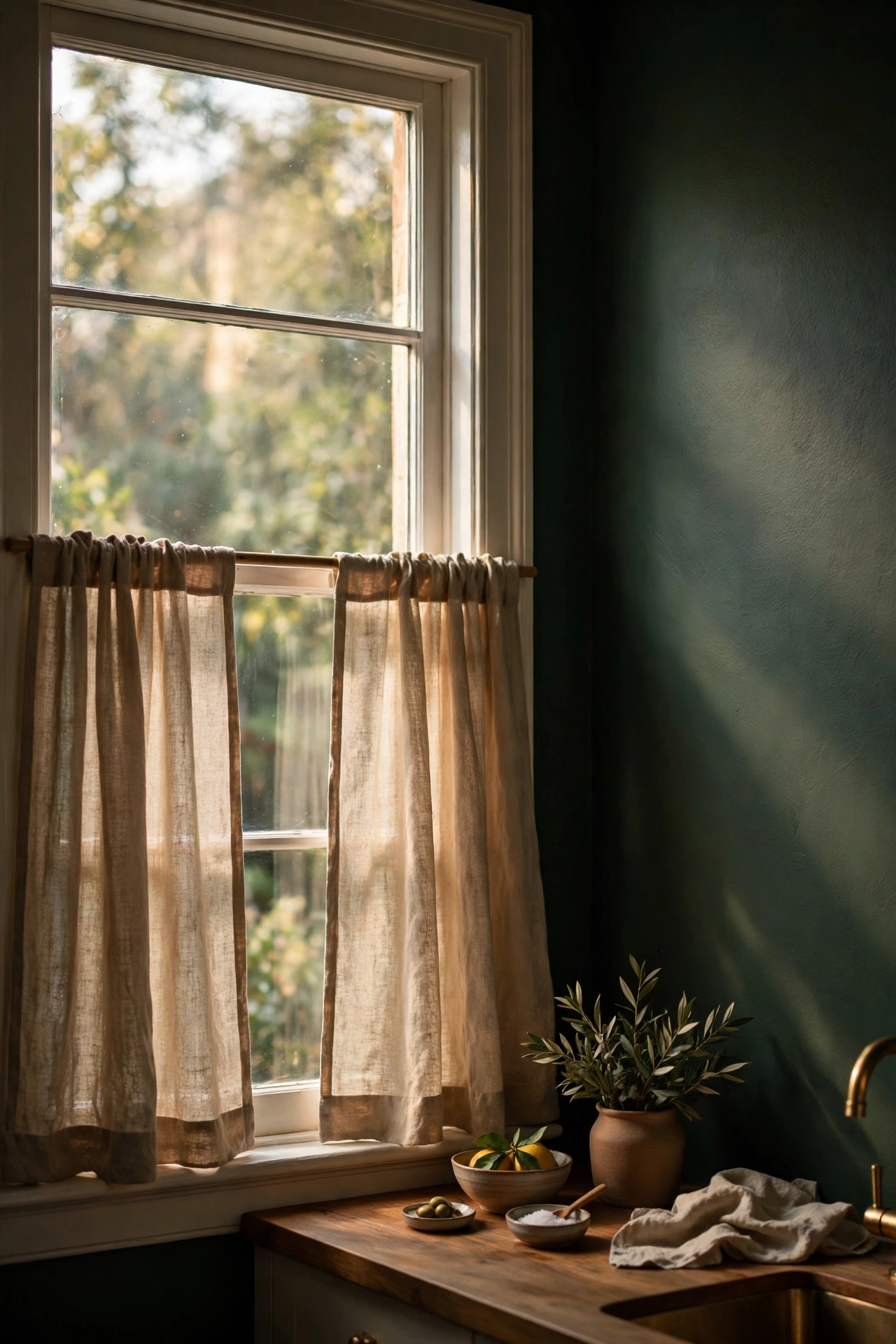
A dark kitchen needs soft light, and cafe curtains are the gentlest way to get it. The half-length linen panel covers the lower half of the window, gives you privacy from the street, and still lets the daylight pour in over the top. In a cottagecore kitchen, that soft filtered light is half the atmosphere.
Washed linen is the right fabric. It hangs with a relaxed drape, it softens with every wash, and its slightly crumpled texture suits the style far better than crisp cotton. Choose a pale colour, natural flax, soft cream, or a faded sage, so the curtain reads as a light patch against the dark walls. A dark curtain on a dark wall just disappears, and you lose the lift.
Placement: rod set at the halfway point of the window, with the panel ending just below the sill.
Colour: natural flax, soft cream, or faded sage, never bright white.
Texture: washed linen, with a simple rod pocket or clip rings in aged brass.
Budget swap: a single length of washed linen, hemmed top and bottom, costs very little and looks better than most ready-made sets. Clip rings hide a wobbly hem completely.
Hang the rod with a simple tension rod inside the frame if you rent, or a slim brass rod if you own the place. Either way, keep the hardware quiet. The curtain is the feature, not the rod. And leave the top half of the window bare. The view of sky and trees is part of the kitchen, and blocking it with fabric would waste the best light in the room.
If the window faces a wall or a neighbour, a sheer linen panel works instead of a solid one. It still softens the view and gives privacy, but it lets more light through. Either way, wash the linen twice before you hang it. The first wash takes out the factory stiffness, the second gives it the relaxed drape that makes it look like it has always been there.
5. Choose a Butcher Block or Worn Timber Worktop
 Save
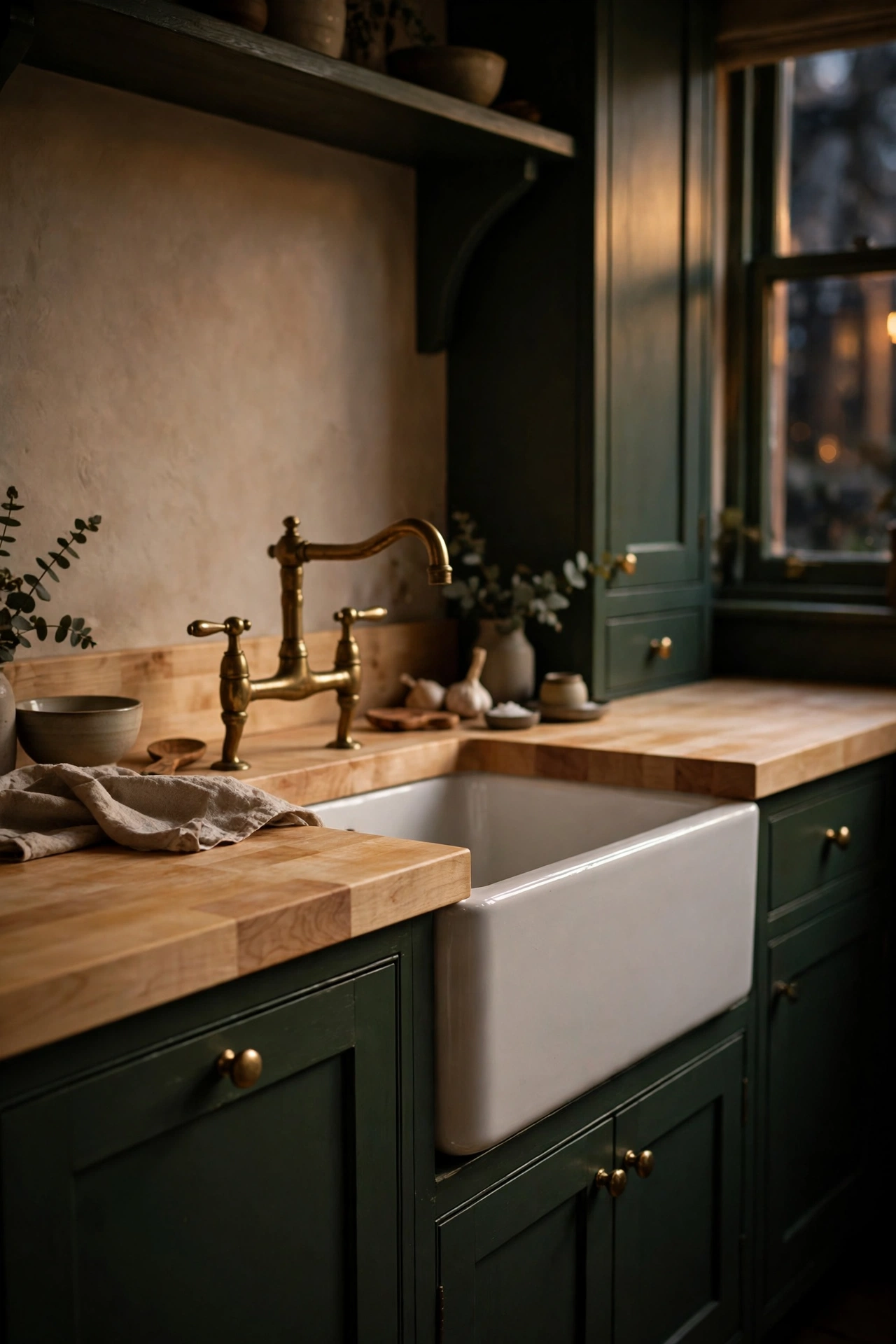
A dark kitchen needs one pale, warm surface to rest the eye on, and the worktop is the best place for it. Butcher block, a thick slab of joined timber, oiled rather than varnished, gives you that warmth and it ages gracefully. Knife marks and water rings do not ruin it. They become part of it, which is exactly how a cottagecore kitchen should behave.
Maple and beech stay pale and honeyed, oak goes a little deeper, and walnut runs dark, so pick the timber against your cabinet colour. Green cabinets love a pale maple or beech worktop, because the contrast keeps the room bright. If your cabinets are already dark brown or near black, a mid-tone oak stops the room from going flat. The worktop should be the lightest timber in the room, not the darkest.
Colour: pale maple or beech against green cabinets, mid oak against near-black cabinets.
Texture: oiled timber you can feel, with a soft matt finish and no thick varnish shine.
Swap: if a full timber worktop is out of budget, fit butcher block on the island only and keep the rest of the run in a pale stone or laminate. The island becomes the warm heart of the room.
Styling tip: oil the worktop once a month for the first year, then every few months after that. A ten-minute rub with food-safe oil keeps it water resistant and keeps the colour honeyed. It is the one bit of maintenance this kitchen genuinely needs.
Care is simple once you know the rules. Wipe spills promptly, use a board for chopping rather than cutting straight on the surface, and never put a hot pan down without a trivet. A scorch mark can be sanded out of solid timber, which is more than you can say for most stone, so do not panic if one happens. Sand the spot lightly, re-oil, and the worktop forgives you.
Pair the timber with a simple Belfast sink if the budget allows. The deep ceramic basin suits the style, it swallows big pots easily, and the white ceramic gives you another pale note against the dark cabinets. A bridge tap in aged brass finishes the picture without shouting about it.
6. Layer Brass, Copper and Candlelight
 Save
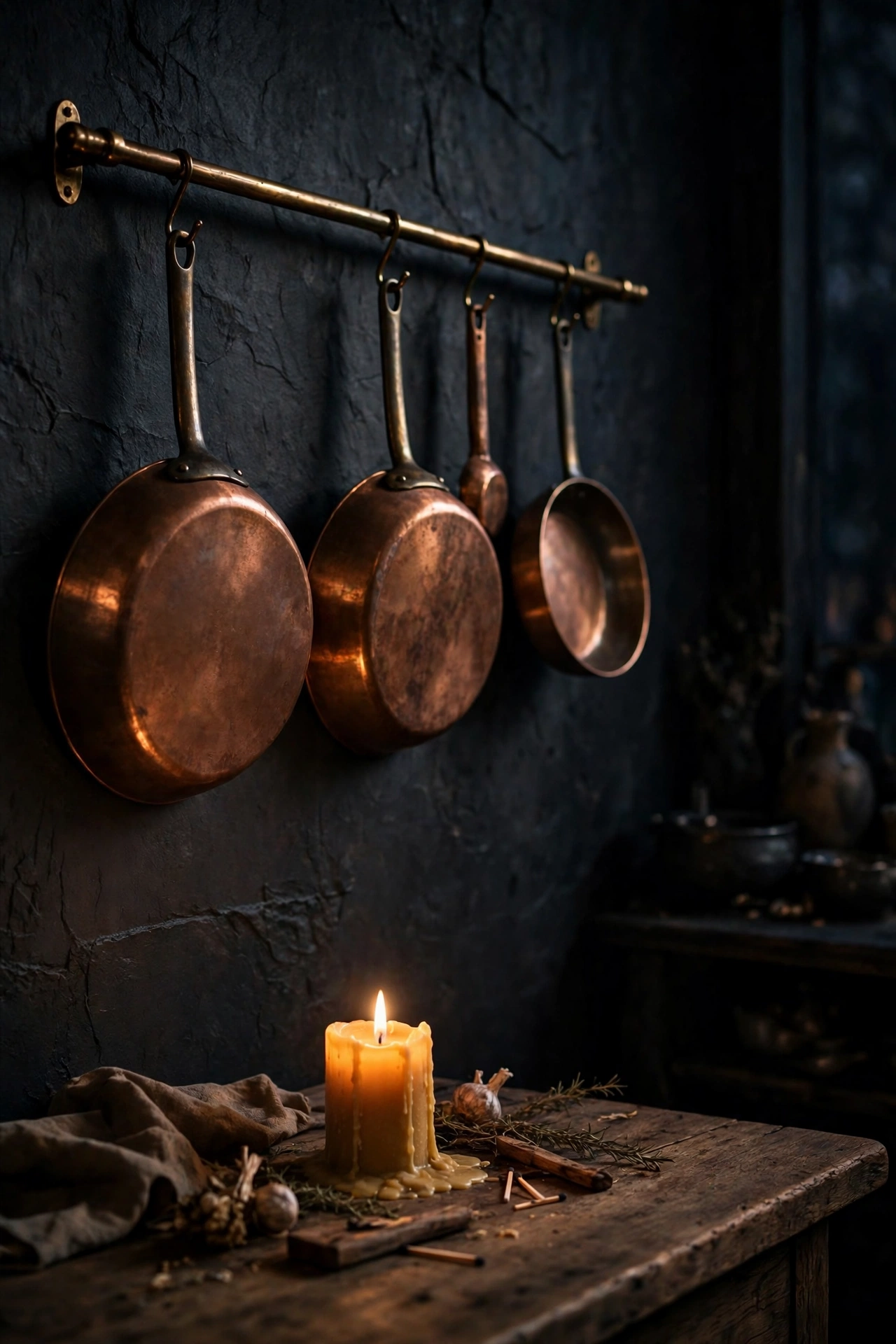
Dark rooms come alive in the evening, and in a cottagecore kitchen that life comes from warm metal and real flame. Brass taps, copper pans, a brass rail with hooks, and candles on the table turn a dark kitchen from dim into glowing. The metals pick up whatever light is in the room and throw it back, which is why they matter so much more here than they would in a white kitchen.
Copper pans hung on a rail are the classic move, and they earn their place. Hang the ones you actually cook with, not a decorative set bought for the wall. A row of used copper pans, with their patina and small dents, tells the truth about the kitchen, and the warm metal glows against a dark wall like nothing else. Keep the rail at a height you can reach easily, and leave space between pans so they do not clatter every time you take one down.
Placement: rail on the wall beside the cooker, hooks spaced so pans hang without touching.
Colour: aged brass and copper with a natural patina, never polished to a mirror shine.
Texture: hammered copper, brushed brass, and beeswax candlelight on the table.
Try this: one candle on the table at supper, every night, even on ordinary Tuesdays. It costs almost nothing and it changes how the whole room feels after dark.
Lighting needs a little thought in a dark kitchen. One cold ceiling light flattens everything, so layer it instead: warm bulbs in the ceiling, a small lamp on a shelf or the worktop, and under-cabinet strips for cooking. A tiny lamp in a kitchen sounds odd until you try it. A small ceramic lamp with a linen shade, tucked at the end of the worktop, gives the room a living-room softness that a ceiling light never will.
For the moody side of this palette, our dark romantic decor ideas show how deep colour and warm metal work together beyond the kitchen too, and the same rules about warm light apply there.
7. Build a Coffee Corner That Feels Like a Ritual
 Save
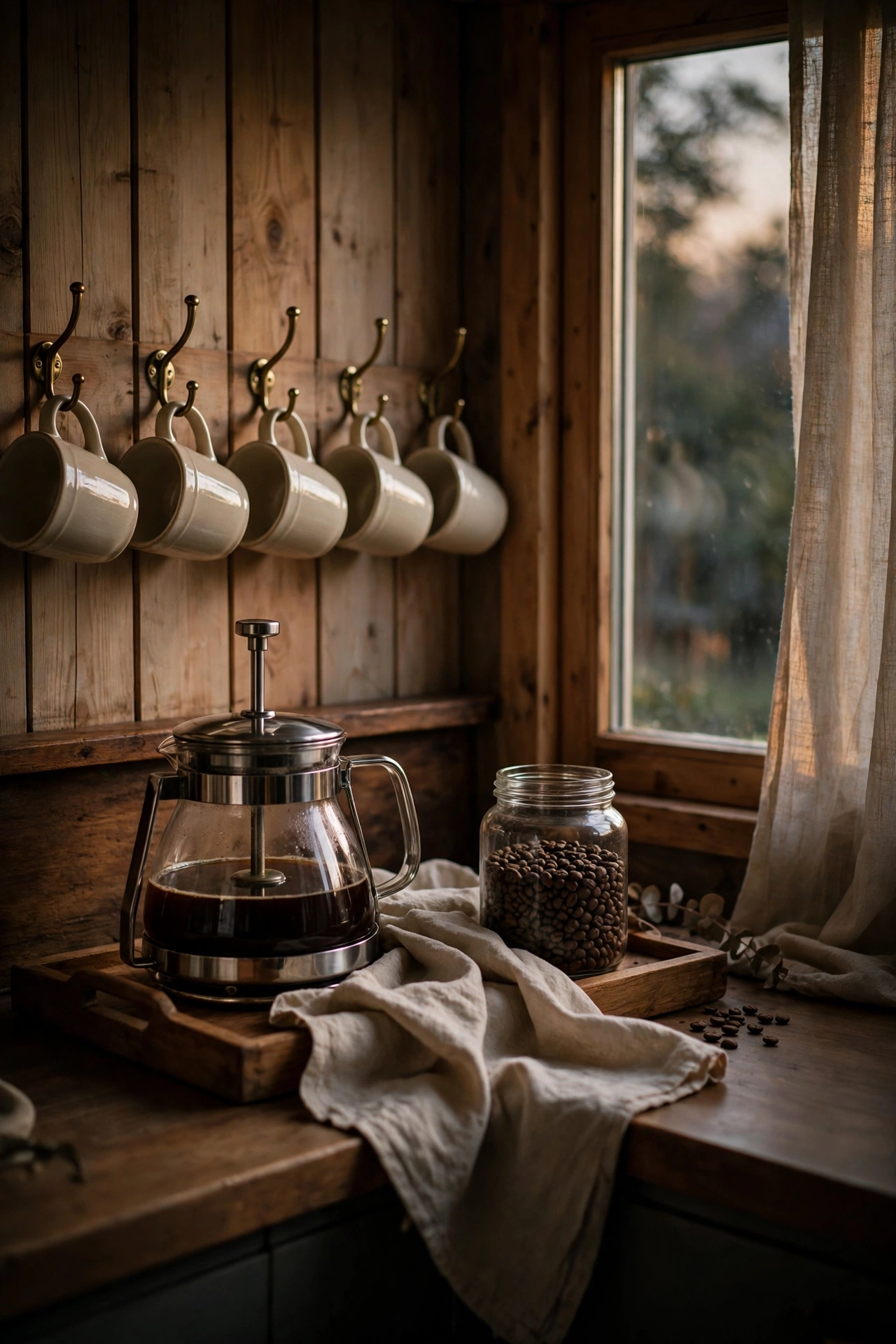
Every cottagecore kitchen needs one corner that is purely for pleasure, and a coffee corner is the easiest one to build. A small stretch of worktop, a kettle, a cafetiere or a pour-over set, two or three favourite mugs, and a jar of beans. That is all it takes. The point is not the equipment. The point is that making coffee becomes a small daily ritual instead of a rushed chore.
Keep it compact and honest. A wooden tray holds the whole setup together and stops it spreading across the worktop. Put the mugs on hooks underneath a shelf above, so they are in reach and they look charming at the same time. A small jar of sugar, a tiny jug for milk, and a linen cloth folded beside the tray finish it. Nothing plugged in that does not need to be, nothing in a matching set.
Placement: a quiet stretch of worktop away from the cooker, ideally near the window.
Colour: cream mugs, brown glass jars, and one dark accent, a walnut tray or a green tin.
Texture: glazed ceramic, cut glass, linen, and warm timber under it all.
Budget swap: a second-hand wooden tray and two charity-shop mugs give you the whole look for very little. The ritual is in the doing, not the buying.
If you do not drink coffee, the same corner works for tea. A teapot that stays on the tray, a tin of loose leaf, and a honey jar do the same job, and the steam from a fresh pot does the same soft work in a dark room. Either way, keep the corner for the drink you actually make every day. A corner built around a drink nobody makes is just clutter with a tray.
For more ways to style this little ritual corner, our coffee bar ideas walk through layouts for small and large kitchens alike, and the same tray-and-hooks logic works at any size.
8. Finish with Dried Herbs, Copper Pots and Lived-In Layers
 Save
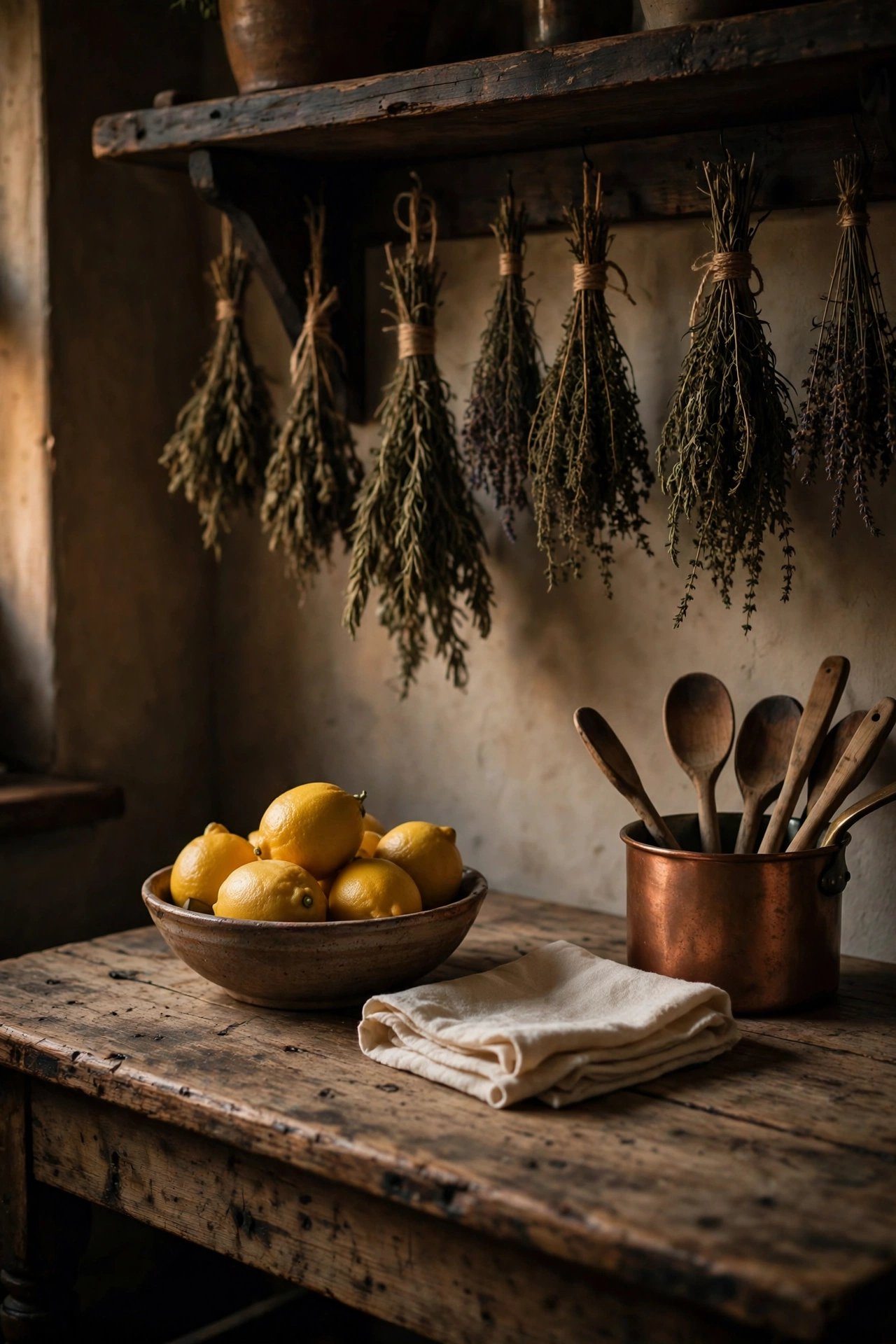
The last layer is the one that makes a dark cottagecore kitchen feel inhabited rather than decorated. Dried herbs hanging from a beam or a hook, a copper pot holding wooden spoons, a folded linen cloth over the oven handle, a bowl of onions on the table. These are working things, not ornaments, and that is why they work. A kitchen that is used looks loved, and a kitchen that looks loved is the whole point of this style.
Hang herbs where you can reach them but where they will not get splashed. A small bunch of thyme, rosemary and bay, tied with string and hung from a hook under a shelf, dries beautifully and smells faint as you cook. Replace them every few months, and use the dried leaves in cooking as they come down. Nothing here should be purely decorative. If it cannot be used, it does not earn its place.
Placement: herbs under a shelf or from a ceiling hook away from steam, spoons in a pot beside the cooker.
Colour: dried green and brown herbs, copper, cream linen, and the rust of a terracotta pot.
Texture: rough string, smooth copper, crinkled linen, and the papery skin of onions in a bowl.
Try this: keep one open bowl on the table at all times, with whatever is in season, lemons, apples, a few walnuts in their shells. It changes with the weeks, it costs nothing extra, and it stops the table ever looking staged.
Linen is the quiet hero of this last layer. A tea towel with a faded stripe, a tablecloth that is not ironed, a linen apron hanging on a hook by the door. Each one softens a hard edge and adds a pale note that lifts the dark around it. Wash them often, let them dry on the line when you can, and do not worry about creases. In this kitchen, a crease is not a flaw. It is proof the room is used.
Step back when you have added these layers and look at the room as a whole. The dark should feel like a warm coat, not a heavy blanket. If one corner still feels flat, it usually needs one more texture, a basket, a plant, a folded cloth, rather than one more colour. Add texture first. It is almost always the answer.
The combination: deep green lowers, pale timber worktop, washed linen at the window, and brass that catches the candlelight.
Bringing It All Together
A dark cottagecore kitchen is not a makeover you finish in a weekend. It is a room you build slowly, one honest material at a time, until it feels like it has always been yours. Start with the cabinets or the worktop, add the linen and the brass, hang the herbs, and let the room gather its own stories. The best compliment this kitchen can get is a guest asking how long it has looked like this, and you realising you no longer remember it any other way.
Frequently Asked Questions
Will a dark cottagecore kitchen make a small kitchen feel smaller?
It can, but only if every surface goes dark at once. Keep the ceiling pale, choose a light timber worktop, and let one wall stay cream, and a small kitchen will feel cosy rather than cramped. Good warm lighting matters more than the paint colour, so add under-cabinet lights before you judge the result.
What is the best cabinet colour for a dark cottagecore kitchen?
Deep green is the most forgiving choice, because it sits well with both warm wood and brass, and it still reads as green in low light. Dark charcoal and near-black work too, but they need more warm timber and more light to stop the room feeling flat. Test any colour on one door first, and look at it in the evening before you commit.
Can I get the look in a rented kitchen?
Yes, and most of it needs no permission at all. Cafe curtains on a tension rod, a butcher block board over the existing worktop, open shelves on a leaning rail, copper pans on hooks, and linen everywhere will change the room completely. Paint is the only piece that needs a landlord’s agreement, and a dark island or a painted dresser can stand in for painted cabinets.
How do I keep open shelves clean in a kitchen that cooks daily?
Put the pieces you use every day on the open shelves, because constant use keeps them clean, and keep rarely used serving dishes behind a closed door. A quick wipe once a week is enough for most kitchens. If you fry food often, keep the shelves away from the cooker, where grease settles fastest.
Does dark cottagecore work with modern appliances?
It does, as long as the appliances are quiet about it. A stainless steel fridge or a black oven fades into a dark kitchen far more easily than it would into a white one. Hide the small appliances in a cupboard when they are not in use, and let the timber, linen and copper do the talking. The style is about the feeling of the room, not about pretending the modern world does not exist.