
That awkward week after New Year’s Eve is when the front porch starts looking tired. The fairy lights have been boxed up, the garland is drooping, and the whole entry suddenly feels like the house has taken down its smile. Most people either rush a few red berries back out and call it done, or they strip everything and leave the porch looking bare until spring.
Both reactions miss the point. January and February are the months your front porch works hardest: it is the first thing you see on grey mornings, the view guests get when they arrive, and a small daily signal that the house is cared for even when the garden is asleep. A winter porch does not need twinkle lights or a wreath full of baubles to earn that. It needs texture, weight, and a palette that looks at home against frost.
The good news is that winter porch styling is simpler than holiday styling, and in many ways it lasts better. Natural materials, cool-tone greenery, and a few well-placed warm accents carry from early January right through to March with almost no maintenance. Here is how to make the transition once the holidays come down, and keep the porch looking intentional all winter long.
Ease Out of the Holidays, Don’t Just Strip Them
 Save
The biggest mistake after the holidays is the all-at-once clear-out. One day the porch is dressed, the next it is a concrete slab with a lonely doormat, and for the rest of winter every arrival feels like coming home to a house that has given up. The fix is a two-stage transition that takes about fifteen minutes.
Start by removing only what reads as “Christmas”: red ribbon, baubles, fairy lights, anything with glitter or pinecones sprayed gold. Leave the evergreen garland, the bare branches in the urns, the lanterns, and the heavy planters exactly where they are. Then step back and look at what is left. Usually the bones are already winter-appropriate; they were simply drowned out by the festive layer.
Designer note: Take a photo of the porch before you remove anything, then compare it with a photo taken after the second stage. It stops you from over-editing, which is the most common way people end up with a porch that feels emptier than it needs to be.
The second stage happens a few days later: replace what you removed with winter versions. Swap the red bow on the urn for plain jute twine. Exchange the glittery pinecones for unscented natural ones gathered in a low basket. Trade the fairy-light strings for two battery-operated pillar candles in your lanterns. This staged approach means the porch never has a bleak in-between phase, and it gives you time to notice which spots actually need something new. If your winter style leans neutral, our guide to white Christmas decor ideas shows how an all-neutral holiday look eases straight into January without a single change, which is worth knowing for next year.
Choose a Palette That Belongs to Winter
 Save
A winter porch needs its own colour story, separate from both the holiday reds and the spring pastels that will come later. The most successful schemes are built from what the season already provides: the deep green of hardy foliage, the warm brown of bark and branches, the grey of stone and slate, and one accent that brings life when everything else is muted.
A classic formula that works on nearly any house colour: two parts evergreen, one part natural wood tone, one part warm light (candle glow, an amber-tinted lantern panel), and a single soft accent like dusty blue, faded sage, or winter white. Styling tip: Pick your accent from a colour already on the house: a blue-grey front door, a sage window box, or even the trim, so the porch looks designed rather than decorated.
What to avoid: anything that still reads festive at a glance. Bright red and gold now look like leftovers, not choices. If you loved the warmth of this year’s holiday scheme, keep the warmth but shift it darker and quieter: think cocoa-brown ribbons instead of red, unpolished brass instead of gold. The chocolate brown and terracotta palette from autumn translates surprisingly well into winter when you pair it with grey-green foliage, so nothing you bought in November has to go into storage yet.
Greenery That Looks Good Until March
 Save
Fresh greenery is the backbone of a winter porch, but not all of it survives the season. Fir and pine boughs brown out by February on an exposed porch, while boxwood, holly, and ivy stay handsome for months. When you are buying or cutting, choose for longevity over initial fullness.
Boxwood is the workhorse: it holds its shape, its colour deepens rather than fades in cold, and a boxwood wreath hung on the door in January looks as good in March as it did on day one. Pair it with hardy accents that add winter character: curly willow branches for height, birch logs for structure, dried grasses for movement, and one low-maintenance star like a small potted conifer that you can move indoors later.
Try this: Build one “anchor planter” per side of the door using the thriller-filler-spiller idea: a birch branch bundle or curly willow as the thriller, a boxwood or dwarf conifer as the filler, and trailing ivy or draped eucalyptus as the spiller. Two matching anchors flanking the door instantly make a porch look finished, and you only had to style two pots.
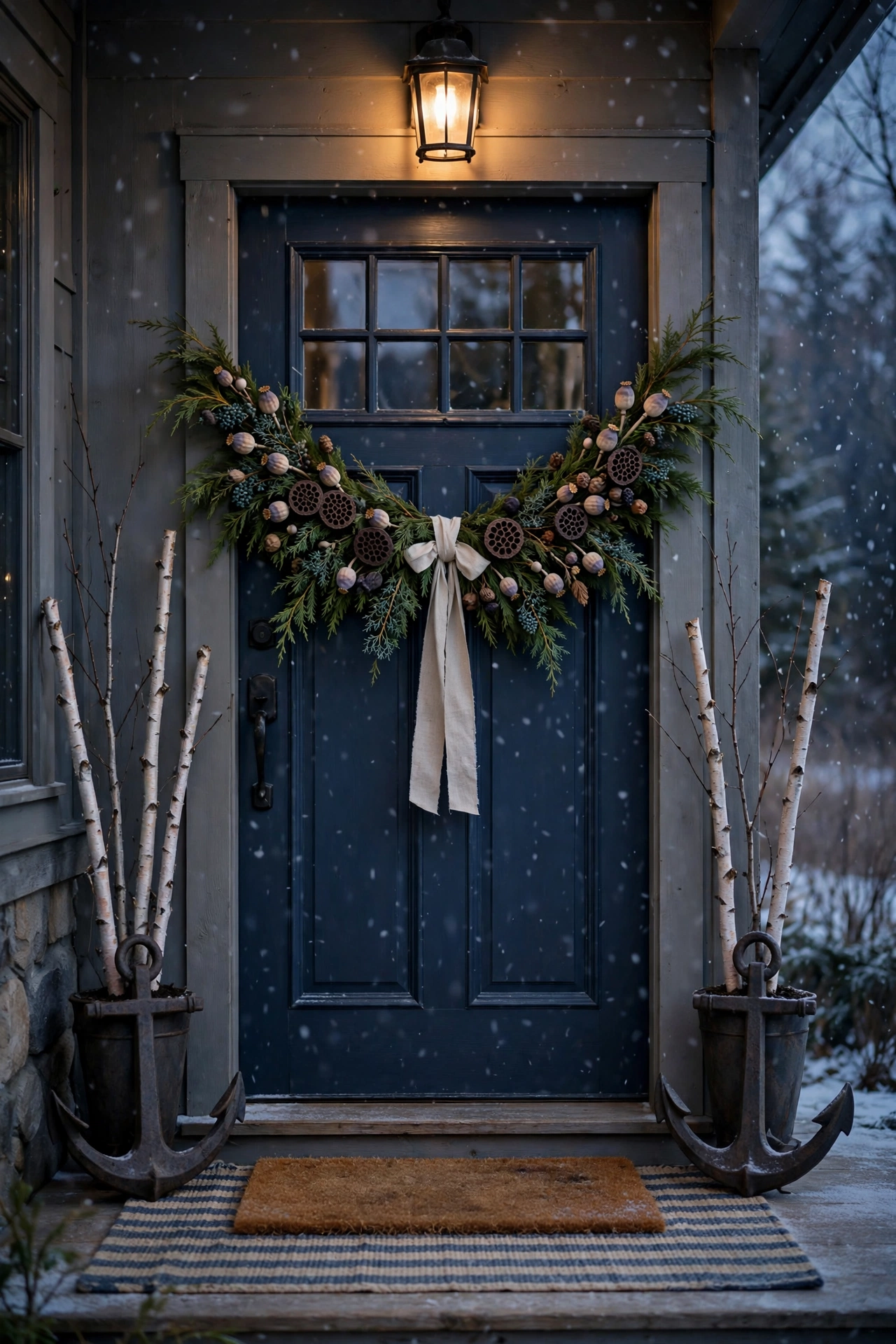
For hanging, a simple winter swag on the door outperforms a fussy wreath. Gather cedar or juniper branches, a few dried seed pods, and a length of plain linen ribbon, and bind them into a loose downward spray. It looks gathered rather than manufactured, it costs almost nothing, and when it sheds a little it still looks intentional. Our woodland fawn-inspired fall styling leaned on this same gathered-not-manufactured feeling, and the approach carries through winter perfectly.
Warmth You Can See (Without a Fire Pit)
 Save
A winter porch feels cold even when it looks good, so visible warmth is doing half the styling work. Real flame is the fastest route: two or three lanterns with pillar candles at different heights create the glow that makes people want to linger at the door instead of hurrying inside.
Lantern placement matters more than lantern size. Group them in an odd-numbered cluster on the largest step or at the base of one planter, keeping the flames at staggered heights so the glow reads as layered rather than lined up. Wind guards matter too: a glass-fronted lantern that keeps a candle lit through a January gust is worth more than a pretty open one that blows out by teatime. LED pillar candles with a flicker setting are a genuine alternative now, and they make sense anywhere wind is a constant.
Budget swap: If new lanterns are not in the budget, cluster what you already own: a tall floor lantern from inside, two smaller ones borrowed from the dining table, and spend instead on one bag of LED tea lights with a timer. Uniform warm light across mismatched lanterns reads more expensive than mismatched light in matching lanterns.
Textiles add the other kind of warmth. An outdoor-rated throw folded over the back of a porch bench, a weather-resistant cushion in a deep weave, and a coir doormat layered over a larger flat-weave rug all signal comfort before anyone touches them. Coir does the heavy lifting in winter: it scrapes boots, handles slush, and its natural texture sits perfectly against a frosty palette. The layering trick from our cosy home checklist (rug under mat, textiles over hard edges) works on the porch exactly as it does indoors.
Make the Door the Focal Point
 Save
Every porch has one place the eye lands first, and it is always the door. When the door is dressed well, the whole porch reads as styled even if everything else is minimal. When it is neglected, no amount of planters rescues the impression.
Start with the door itself. A fresh winter wreath or swag, hung slightly lower than you think (eye level, not above it), makes the entry feel welcoming rather than formal. Flank it with the anchor planters from the greenery section, and check the sightline from the street: the door, the planters, and the mat should form one clear vertical composition. If anything breaks that line (a bin, a bag of grit, a forgotten parcel), move it out of view before you add a single decoration.
The doormat is the finishing touch most people get wrong by choosing one that is too small. Measure your door’s width and buy a mat at least three-quarters as wide; then layer it over a larger outdoor rug in a simple pattern like stripes or a bordered weave. The layered look borrows from interior styling and immediately makes a basic concrete step look considered. Styling tip: Swap the mat’s message for winter: a plain coir mat with no words reads cleaner and lasts longer than a cute seasonal phrase that dates by February.
Lighting around the door deserves attention too. Clean the wall lanterns or the porch light fixture: a winter’s worth of grime dims more light than you realise, and check the bulb colour. A warm-white bulb (around 2700K) flatters every winter palette; a cool white one makes the same porch look like a car park.
Small Porch? Go Taller, Not Wider
 Save
A narrow stoop or a tiny landing cannot take two planters and a lantern cluster, and it should not try. Small porches style better vertically than horizontally: one tall element beats three small ones every time.
A single tall planter with birch branches or curly willow draws the eye up and makes the space feel larger than it is. Hang the winter swag on the door and add one wall-mounted lantern beside it at shoulder height, and you have a complete composition in a footprint barely wider than the door itself. Wall space is free styling real estate on a small porch: use it.
Try this: If there is genuinely no floor space, mount a small wall basket under the porch light and fill it with boxwood sprigs and dried grasses. It catches the light beautifully at night and costs less than a takeaway.
Storage is the quiet problem on small porches: winter means boots, grit bins, and parcels, and there is nowhere to hide them. A slim bench with a lift-up seat solves it and doubles as a styling surface: fold a weatherproof throw over it, and the practical box becomes part of the decor. Keep the bench close to the wall and the walkway clear; a small porch that is easy to cross feels bigger than a decorated one you have to sidle past.
Bringing It All Together
A January porch does not ask for much: clear the festive leftovers in stages, settle on a quiet winter palette, invest in greenery that survives the season, add visible warmth with lanterns and layered textiles, give the door its moment, and if the space is small, think tall. None of these steps costs much, and most of them use things you already own.
The real payoff is daily. You will see this porch every morning and every evening until spring, and a porch that looks intentional in February changes how the whole house feels. Start with the door and one good planter; the rest can follow on the next dry weekend.
Frequently Asked Questions
When should I take down Christmas porch decorations?
Take the overtly festive pieces down within the first two weeks of January, but do it in two stages: remove ribbons, baubles, and fairy lights first, then replace them with winter pieces a few days later. Evergreen garlands, bare branches, and lanterns can stay up straight through winter: they are seasonal, not festive.
What greenery lasts longest on a winter porch?
Boxwood, holly, ivy, and dwarf conifers hold their colour and shape for months in cold weather. Fir and pine boughs look full at first but brown out faster on exposed porches. Curly willow and birch branches are not alive, so they last the entire season and add height cheaply.
How do I stop my porch decor from looking bare after the holidays?
Do not strip everything at once. Remove only the Christmas-specific items first, keep the evergreen bones in place, and add winter replacements within the same week. Two matching planters flanking the door and one lantern cluster are enough structure that the porch never has an empty phase.
What is the best winter door mat setup?
Layer a coir doormat (at least three-quarters the width of your door) over a larger flat-weave outdoor rug. Coir handles winter boots and slush better than fabric mats, and the layered look makes even a plain step feel styled. Avoid seasonal phrases that date quickly; plain texture lasts all winter.
Can I use the same lanterns indoors and outdoors in winter?
Yes, and it is a good budget move. Metal and glass lanterns move freely between porch and living room; just use LED candles outdoors where wind is an issue and keep real flame for sheltered spots. Uniform warm light across the lanterns matters more than matching the lanterns themselves.

3 thoughts