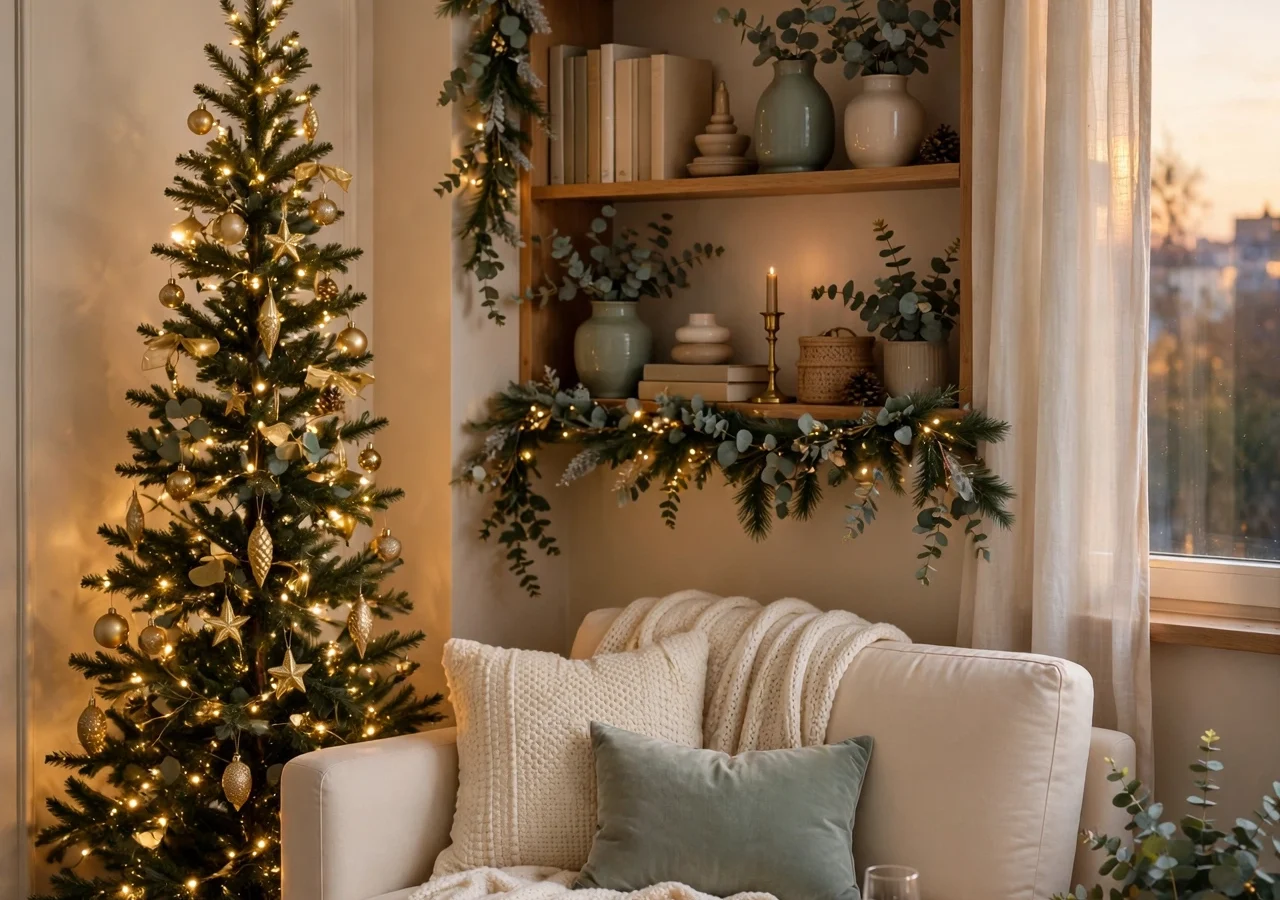
There’s a specific kind of December heartbreak that only small-apartment dwellers know. You open Pinterest, and every glowing living room has fourteen-foot ceilings and a tree the size of a minor redwood. You look around your 600-square-foot flat, where the “dining room” is a table wedged against the wall, and you do the math on where a tree could possibly go. The answer, depressingly, is usually “on top of the other furniture.”
So most years you either skip decorating entirely, and December feels oddly flat, like the month never quite started, or you go all in and spend three weeks squeezing sideways past a tree to reach the kettle. Neither is the Christmas you wanted.
Here’s the reframe that changes everything: with small apartment Christmas decor, you decide where the holiday lives (the walls, the light, the scent, the textiles) and let the floor stay walkable. You can have a home that smells like pine and glows like a snow globe without sacrificing a single square foot you actually need. Here’s how.
Rethink the Tree: Go Slim, Half, or Flat
 Save
The tree is the elephant in the room, literally the largest object you’re asking your apartment to absorb. A standard 7-foot tree with a 4-foot base diameter eats roughly twelve square feet of floor. In a studio, that’s your entire reading corner gone. But the tree is also the emotional anchor of the holiday, so “just skip it” feels like a loss. The answer is picking a tree shape built for tight footprints instead of cramming a full-size tree where it will never fit.
Slim or “pencil” trees are the easiest win: same height, about half the width. A 6-foot pencil tree needs roughly two square feet of floor, less than a laundry basket, and once it’s decorated, nobody registers the narrower silhouette. Half trees go further: flat on one side, designed to sit flush against a wall or in a corner, giving you the full decorated front for half the depth. And if even that feels like too much, wall trees take zero floor space and photograph beautifully: just a strand of garland and lights arranged in a triangle on the wall, anchored with removable hooks.
| Tree type | Floor footprint | Best for | Price range |
|---|---|---|---|
| Slim/pencil tree (6 ft) | ~2 sq ft | Corners and narrow gaps | $60–$120 |
| Half tree (6 ft) | ~4 sq ft, flat back | Against walls, behind sofas | $80–$150 |
| Wall tree (garland + lights) | 0 sq ft | Renters, studios, hallways | $20–$40 |
| Tabletop tree (2–3 ft) | Lives on furniture | Desks, consoles, side tables | $15–$45 |
Styling tip: whatever tree you choose, decorate only the front and the visible sides. The back of a corner tree is doing emotional labour nobody will ever see, so save those ornaments for next year’s mantel garland.
On a budget, a $25 faux-pine garland, two packs of removable wall hooks, and a string of warm fairy lights arranged in a loose tree shape gives you 80% of the tree feeling for under $40, and it stores in a shoebox. If you want the full planner’s-eye view, our Christmas decor ideas to plan right now breaks down the whole season room by room.
Push Your Decor Up the Walls
 Save
When floor space is precious, the walls are free real estate you’ve been ignoring. Small apartments usually have plenty of vertical surface. Right now it’s holding nothing but a framed print and a smoke detector. December is the month to put every inch of it to work.
Start with the highest-impact, lowest-effort move: a garland along the top of a bookshelf, a doorframe, or a curtain rod. One good faux-cedar garland, draped rather than stretched tight, instantly reads as “decorated for Christmas” from across the room, and it occupies airspace you were never going to use. Don’t save wreaths for the front door alone. One hung on a bedroom door or a large mirror gives you twice the greenery without touching a single floorboard. And stockings don’t need a mantel: hang them from a floating shelf, a wall-mounted coat rack, or even the rungs of a leaning ladder shelf.
Windowsills are another underused stage. A row of small bottle-brush trees, a few pillar candles, or a short string of fairy lights along the sill turns the window into a glowing vignette that’s visible from the street (free curb appeal) while using a surface that was already there. If you’re a renter, removable adhesive hooks and putty are your entire installation kit; everything on this list comes down in January without a trace.
Styling tip: keep the wall decor to one or two “moments” per room. Three garlands, two wreaths, and a wall tree in a 200-square-foot living room crosses from festive into visually loud. Pick your strongest walls and leave the rest calm.
Layer Light Instead of Stuff
 Save
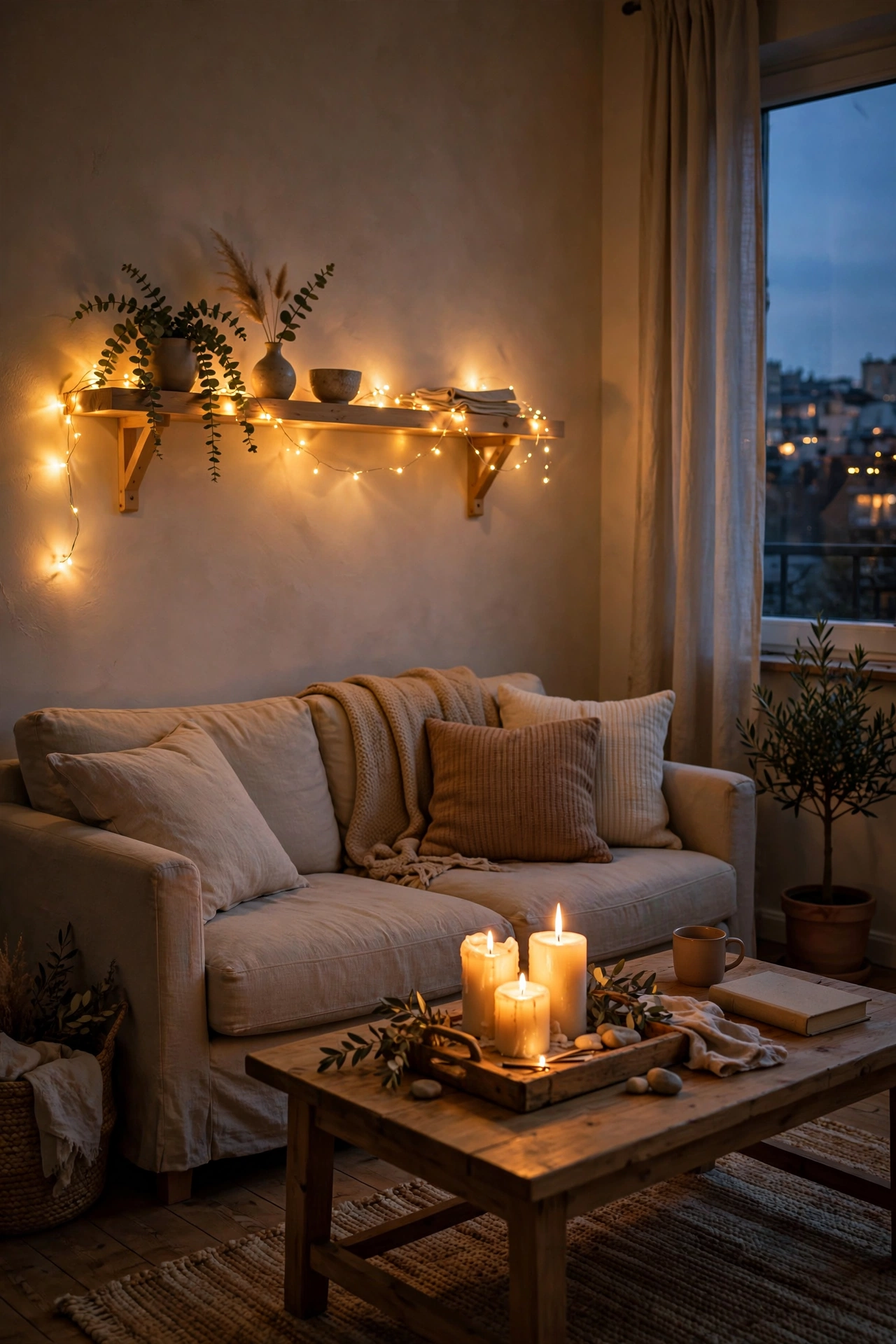
Here’s the secret that professional stylists use in small spaces: in a compact room, *glow* reads as decoration far more powerfully than *objects*. A room with warm light pooling in three spots feels finished and festive even with barely any ornaments in it. A room stuffed with figurines under flat overhead lighting just feels crowded.
Build your light in layers, all warm white (2700K or lower: that golden, candlelight tone, never blue-white). Start with a long string of fairy lights woven through your garland or along a shelf. Add a second source at a different height: a cluster of pillar candles on a tray, or a small lamp with a warm bulb moved to a dark corner. If you have a real candle allergy to open flames around garlands, flameless LED candles have become genuinely convincing. Buy the flicker ones, not the static ones.
Restraint with color matters most here. Multicolor flashing lights in a small room feel chaotic because there’s nowhere for your eye to rest. Warm white everywhere, with maybe one accent, a soft gold or deep red, keeps the whole apartment feeling cohesive instead of carnival-like.
Don’t forget the hallway and the bathroom, by the way: the two rooms everyone skips. A single short string of fairy lights along a hallway console, or a small flameless candle on the bathroom shelf, costs almost nothing and makes the whole apartment feel considered rather than half-decorated. Guests notice the rooms you remembered.
Put your fairy lights on a timer plug (about $10) set for 4–11 PM. Coming home to an apartment that’s already glowing is the single highest-joy-per-dollar move on this entire list.
Pick One Palette and Actually Commit
 Save
Visual noise makes small rooms feel smaller. That’s not a design opinion, it’s how perception works. Every new color your eye has to process is another boundary, another visual “stop,” and in a compact apartment those stops pile up fast. The single most effective thing you can do for a spacious-feeling holiday home is choose one palette and commit to it in every room.
Two to three colors, maximum, carried through the tree, the textiles, the wrapping paper, and the table. Some combinations that consistently look expensive in small spaces: champagne gold + eucalyptus green + cream; all-white with natural pine and raw wood; deep red + forest green + brass for traditionalists with discipline. What matters isn’t which palette you pick. It’s that the throw on the sofa, the ornaments on the tree, and the candles on the shelf are all speaking the same language.
This is also where natural materials earn their keep. Pinecones, cedar sprigs, dried orange slices, and plain wooden ornaments add texture without adding visual weight, and they bridge beautifully between your everyday decor and the holiday layer. If you lean toward that organic look, our woodland fall styling guide shows how natural textures carry a whole season, and the same thinking works for a quiet, nature-led Christmas.
Before you buy anything new, try this: pull every red, gold, green, and white thing you already own onto the bed. You’ll usually discover you already own 70% of a coherent palette. You’re just missing the discipline of leaving the other 30% in the box this year.
- Audit first: gather, don’t shop
- Choose 2–3 colors and write them on your phone
- Every new purchase must match the list
- Repeat the palette in at least three spots per room
Make Everyday Pieces Pull Double Duty
 Save
The cruelest part of small-apartment decorating is the storage math: everything festive you buy has to live in a closet for eleven months. The way out is choosing holiday pieces that are secretly just *winter* pieces: things that earn their shelf space year after year because they’re useful, not just decorative.
Textiles are the champions here. A chunky knit throw in cream or deep green lives on your sofa from November through March and reads as Christmas the moment the tree goes up. Swap your everyday cushion covers for velvet or cable-knit ones in your palette. They take up zero extra storage because they replace what’s already there. A beautiful wooden serving board with a sprig of cedar on it is December decor on the counter and a cheese board the other eleven months. Holiday mugs lined up on open shelving are storage-free decoration that you also drink from.
Think in terms of swaps, not additions. The wreath goes *on* the mirror instead of beside it. The festive runner replaces the everyday runner. The pine-scented candle replaces the unscented one. When every holiday item displaces something rather than joining it, your surfaces stay exactly as clear as they were in October, just more seasonal. We used the same layering logic in our cosy home checklist, and it translates directly: comfort that doesn’t demand new square footage.
Budget swap: a $15 set of cushion covers transforms a sofa more dramatically than $60 of small ornaments scattered around the room. Textiles are the highest visual impact per cubic inch of storage in existence.
Scent Is Decor That Takes Zero Square Feet
 Save
If I could only give small-apartment dwellers one decorating strategy, it would be this: scent. Smell bypasses the eyes entirely and goes straight to the part of your brain that decides whether a place *feels* like Christmas. A studio that smells of pine, cinnamon, and clove feels more festive than a decorated-but-odorless three-bedroom, and scent takes up literally no space.
The classic move is the stovetop simmer pot: water, orange slices, cinnamon sticks, whole cloves, and a few sprigs of rosemary or pine, kept at the barest simmer. It costs almost nothing, and within twenty minutes your whole apartment smells like a Christmas market. For everyday background scent, one good pine or balsam candle in the living area does the work. You don’t need one in every room; scent travels in small spaces, which is one of the few advantages of compact living.
Fresh greenery doubles as visual decor and scent. A small vase of eucalyptus or cedar sprigs on the bathroom counter, a rosemary plant on the kitchen sill that you can also cook with. Even hanging a small wreath *inside* the front door means every arrival home starts with that hit of pine. No floor space, no storage, no visual clutter — just atmosphere.
One caution from experience: simmer pots need babysitting. Never leave one on an unattended stove. Set a timer, keep the water topped up, and switch to a candle warmer or an ultrasonic diffuser with pine essential oil when you leave the house. The diffuser route is also the renter-friendly answer for apartments where open flames aren’t allowed.
Layer two scents max. Pine plus cinnamon reads as Christmas; pine plus cinnamon plus vanilla plus “Winter Berry” plus sandalwood reads as a candle shop having an identity crisis. Restraint applies to noses too.
Bringing It All Together
A small apartment doesn’t need a smaller Christmas. It needs a smarter one. A slim tree in the corner, garland riding high on the walls, warm light in three places, one disciplined palette, textiles doing double duty, and pine in the air: that’s a complete holiday home, and none of it blocks the path to the kettle. The apartments that feel most magical in December aren’t the biggest ones. They’re the ones where every choice was intentional.
Frequently Asked Questions
How do you decorate a small apartment for Christmas without it looking cluttered?
Choose one color palette and stick to it, decorate vertically (walls, shelves, doors) instead of adding floor pieces, and swap everyday items for festive versions rather than adding new ones. Warm lighting does more visual work than objects in compact rooms.
What size Christmas tree actually fits in a small apartment?
A 6-foot slim or pencil tree needs only about two square feet of floor space and suits most apartments. In a true studio, a half tree against the wall or a wall-mounted garland tree takes even less, or nothing at all.
How can I hang garland and lights without damaging rental walls?
Removable adhesive hooks (the medium picture-hanging size) hold garlands and light strings securely and remove cleanly. For curtain rods and shelves, just drape. No hardware needed. Avoid nails, screws, and anything that needs patching in January.
When should I start decorating a small apartment for Christmas?
Because small spaces decorate faster, you can start later than big-house friends. The weekend after Thanksgiving is plenty. The one exception: order slim trees and adhesive hooks online by mid-November, since the good narrow trees sell out first.
Where do I store Christmas decor in a small apartment with no storage?
Choose decor that doesn’t need storing: textiles that replace everyday ones, a wall tree that fits in a shoebox, scent-based decor, and multipurpose pieces like serving boards. For the rest, one flat under-bed box holds a surprising amount of garland and ornaments.
1 thought