
A big empty wall can make an otherwise finished room feel unfinished. You have the sofa, the rug, the lamps, and still your eye lands on that stretch of blank plaster and stalls. Small frames scattered across it tend to make the problem worse, because they leave the wall looking busy in the wrong places and bare everywhere else. One large piece changes the balance in a single move.
That is the real appeal of oversized wall art. It is not about buying the biggest canvas you can find and hoping for the best. It is about choosing a scale that matches the wall, the furniture below it, and the way you actually live in the room. Get those three things right and the wall stops being a problem and starts being the point of the room.
This guide walks through eight practical ways to use oversized wall art, from a single statement canvas to a lean-and-layer arrangement that renters can live with. Each idea includes sizing, placement, and colour guidance you can use in a real room, not just admire in a photograph. The thread running through all of them is simple: let the art do the work, and keep everything around it calm enough to let it breathe.
Quick Tips Before You Start
- Measure the wall first, then shop. Art should span roughly two-thirds to three-quarters of the furniture below it.
- Hang the centre of the piece at about 57 inches from the floor, or 6 to 8 inches above a sofa or console.
- One strong piece beats a crowded cluster when the wall itself is the feature.
- Test the size with painter’s tape on the wall before you commit to a purchase or a nail.
1. One Statement Canvas Above the Sofa
 Save
Before you shop for any piece, measure the wall and the furniture below it, and note where daylight falls across the wall through the day. The width of the sofa or console sets the art width, the wall height sets the hang height, and strong direct sun rules out prints that would fade or glare. Every sizing choice in this guide starts from those three facts about your wall.
Start with the classic for a reason: a single large canvas above the sofa anchors the whole seating area. It gives the eye somewhere to land, it pulls the sofa, rug, and cushions into one arrangement, and it needs nothing else on that wall to feel complete. Choose an abstract landscape, a soft colour-field piece, or a photographic print with a clear focal point, and keep the frame simple so the image carries the room. For a different kind of large-scale wall statement, see our bold African wall art.
| Your wall | Best format | Why |
|---|---|---|
| Standard wall above a sofa or bed | One statement canvas | Anchors the seating with one clear shape |
| Very wide wall, long console | Diptych | The pair stretches across the width |
| Long hallway or landing | Triptych | Three panels carry the eye along the wall |
| No drilling allowed | Leaned canvas | No nails, and easy to rearrange |
Placement: Centre the canvas over the sofa, not over the wall as a whole, and leave 6 to 8 inches between the top of the sofa back and the bottom of the frame. That gap keeps the two pieces connected instead of floating apart.
Colour: Pull one muted tone from the artwork into a cushion or throw, and leave the rest of the palette neutral. The art should be the loudest thing in the room, even when its colours are quiet.
Tip: If your sofa is longer than 84 inches, look for a canvas at least 48 inches wide, or the piece will read as small no matter how tall it is.
2. A Diptych That Stretches the Wall
 Save
A diptych, two panels hung as a pair, suits walls that feel too wide for one canvas and too awkward for a gallery cluster. The gap between the panels becomes part of the composition, so the pair reads as one wide piece with a breath in the middle. It works well over a long console, a dining sideboard, or a bed with a wide headboard.
Placement: Hang the panels 2 to 4 inches apart, with the outer edges roughly aligned to the furniture below. Keep both panels at the same height, and measure from the outer edge of one to the outer edge of the other when you check the two-thirds rule.
Colour: Pairs work best when they share a palette but are not identical. A shared background colour or a repeated shape ties them together without making the wall feel like a duplicated print. A confident colour backdrop helps a pair sing, as our bold colour ideas show.
Tip: Photograph the pair on your phone from the doorway before you hang them. A small screen shows alignment problems your eyes miss at close range.
3. A Triptych for a Long Hallway Wall
 Save
Three panels suit the longest walls in the house, especially hallways, stair landings, and open-plan dining walls. The rhythm of three repeated shapes stops a long wall from feeling like a tunnel, and the sequence gives you a reason to walk the length of it. Landscapes split across three panels, botanical studies, and abstract colour progressions all translate well to this format.
Placement: Space the panels evenly, usually 2 to 3 inches apart, and centre the middle panel on the wall or on the furniture below. In a hallway, hang the centre of each panel at eye level, around 57 inches, so the sequence reads naturally as you walk past.
Colour: Let one panel carry the strongest colour and the other two echo it in softer tones. That hierarchy keeps a three-panel arrangement from shouting from every direction at once.
Tip: In a narrow hallway, choose panels with lighter backgrounds and slim frames. Dark, heavy frames on three panels can close in a space that is already tight.
4. A Large Photograph in a Slim Frame
 Save
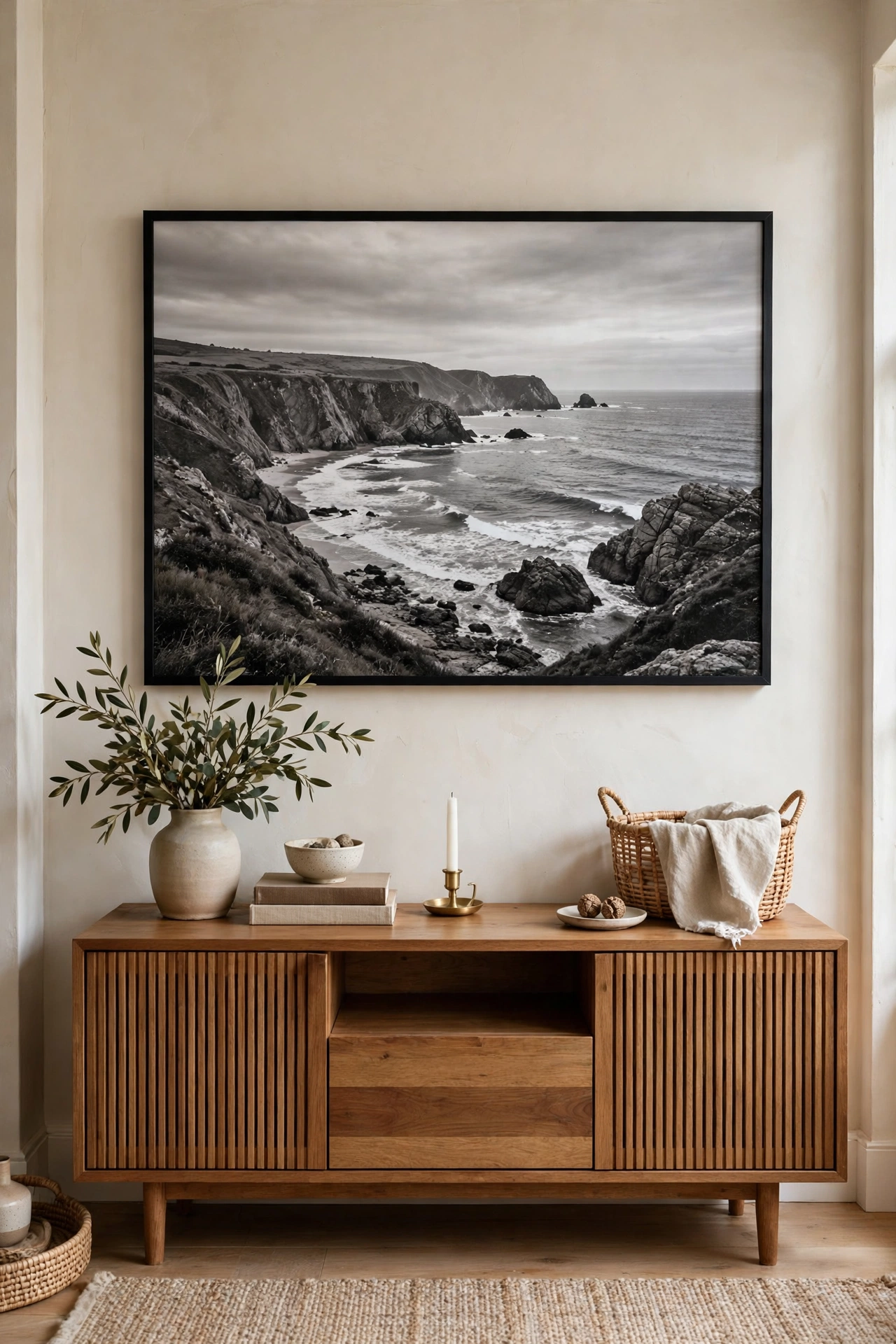
Photography is often the easiest way into oversized art, because a familiar subject makes a big scale feel less risky. A misty coastline, a desert road, a forest canopy, or a city skyline at dusk all hold up at large sizes, provided the image itself is sharp enough. Look for prints made for large formats, and ask the seller for the native resolution before you order anything wider than 40 inches.
Placement: A slim black, white, or natural wood frame keeps the focus on the photograph. Hang it where daylight reaches it indirectly, since direct sun will fade a print over time and glare will fight the image all afternoon.
Colour: Black-and-white photography suits rooms that already have a strong colour story elsewhere, while a muted colour photograph can carry a quiet room on its own. Either way, keep the frame colour to one note.
Tip: Order a small test print first if the seller offers one. Colour on a screen is never a reliable promise of colour on paper.
5. Textile Art for Warmth and Texture
 Save
Not every oversized piece needs to be a painting or a print. A large woven wall hanging, a block-printed textile, or a quilted panel brings texture that flat art cannot, and it softens rooms that feel hard: tiled floors, leather seating, glass tables. Textile art also forgives imperfect walls, since its surface has movement of its own.
Placement: Hang textiles from a slim wooden dowel or a discreet rod, and let the bottom edge hang free rather than pinning it flat. A little movement is part of the charm, and it keeps the piece from looking like wallpaper.
Colour: Natural fibres in cream, rust, ochre, and charcoal sit comfortably in most rooms. If the textile is patterned, pull its quietest colour into the room’s soft furnishings and let the pattern do the talking. If you prefer texture built into the wall itself, our fluted wall panels offer a similar warmth in a more permanent form.
Tip: Steam or press a textile before hanging it, and check the back for a hanging sleeve. A sleeve distributes the weight evenly and stops the piece from sagging in the middle over time.
6. A Leaned Canvas for a Relaxed, Renter-Friendly Wall
 Save
If you cannot or do not want to drill, a large canvas leaned against the wall is a genuine solution, not a compromise. It suits renters, people who like to rearrange often, and rooms where the wall itself is beautiful enough to keep visible. The casual angle of a leaned piece also relaxes a formal room, which is why it appears in so many well-styled living rooms.
Test it first: set the leaned canvas in place, then press the top edge gently toward the wall and let go. If it rocks or slides, add a non-slip pad at the base and a small bumper where the frame meets the wall. Then walk past it at normal speed and brush it lightly with your shoulder. If it shifts, it needs a proper hook or a heavier base. A leaned piece should stay put through everyday bumps, not just stand still when nobody is near.
Placement: Lean the canvas on a console, a low bench, or directly on the floor against the wall, with the bottom edge a few inches out from the skirting board. Anchor it with a small piece of museum putty or a non-slip pad at the base so it cannot slide.
Colour: A leaned piece works best with a simple palette and a strong shape, since you see it at a slight angle. Busy detail gets lost when the canvas tilts back, so choose bold composition over fine detail.
Tip: Never lean a heavy framed piece above a bed or a child’s play area. If it could fall on someone, it belongs on a proper hook, not on a lean.
7. Oversized Art in a Small Room
 Save
Counterintuitive as it sounds, a small room is often where oversized art works hardest. A large piece tricks the eye into reading the wall as larger, because it fills the field of vision and leaves less blank wall to measure against. The trick is proportion: the piece should suit the furniture it sits over, not the room’s total square footage.
Placement: In a small bedroom, one wide piece above the bed replaces a headboard cluster and keeps the wall calm. In a compact living room, a single canvas above a loveseat beats four small frames that chop the wall into pieces.
Colour: Pale backgrounds and airy subjects keep a small room feeling open, while a dark piece can work if the rest of the wall stays clear. What shrinks a small room is clutter around the art, not the art itself. A removable backdrop can help too, and our renter-friendly wallpaper ideas show how to change a wall without paint or nails.
Tip: Leave at least a hand’s width of clear wall on each side of the piece. Art that touches the ceiling, the corner, or the furniture edge on both sides will feel squeezed rather than generous.
8. A Gallery Wall Built Around One Large Piece
 Save
If you love a gallery wall but hate how scattered they can look, build one around a single oversized anchor. Hang the large piece first, slightly off-centre if you like, then add two or three smaller frames around it in a loose cluster. The big piece gives the arrangement its centre of gravity, and the smaller frames become supporting players instead of competing voices.
Placement: Start with the anchor at eye level, then add smaller pieces to one side and slightly above or below it, keeping 2 to 3 inches between frames. Step back after each addition. A gallery wall is finished when it feels balanced, not when every gap is filled.
Colour: Keep the frames in one family, either all wood tones or all black, so the cluster reads as a set. Mixed frames can work, but they need a shared colour or subject to hold them together.
Tip: Lay the whole arrangement on the floor first and trace it onto kraft paper. Taping the paper to the wall lets you place every nail with confidence instead of guessing at height.
The combination: one piece sized to two-thirds of the furniture below it, hung with its centre at eye level, and a week of living with it before you add anything else to the wall.
Bringing It All Together
A big empty wall is not a decorating failure. It is a blank space waiting for one confident decision, and oversized art is the simplest confident decision you can make. Measure first, match the scale to the furniture below, hang at a height your eye meets naturally, and resist the urge to fill every remaining inch. The wall will feel finished because the art earns its space, not because the wall is covered.
Start with the room you spend the most time in, and live with the piece for a week before you judge it. Pay attention to how the room feels at different times of day, because morning light, evening lamplight, and a grey afternoon each change how a large piece reads. A canvas that looks calm in daylight can turn dramatic under a single lamp, and a photograph that seems quiet at noon can gain depth once the room darkens around it. If the piece still feels right after a week of ordinary living, cooking, reading, and passing through, it has earned its place. If it still nags at you, the problem is usually scale or height rather than taste, and a small adjustment to either often settles it without a new purchase. Art that feels bold on day one often feels exactly right by day seven, once your eye has stopped hunting for the blank wall that used to be there. That quiet settling is the sign you chose well.
Frequently Asked Questions
How big should oversized wall art be over a sofa?
Aim for a piece, or a grouped arrangement, that spans about two-thirds to three-quarters of the sofa’s width. For a standard 84-inch sofa, that means roughly 56 to 63 inches of art in total, hung 6 to 8 inches above the sofa back.
What height should I hang a large piece of wall art?
Hang the centre of the artwork at about 57 inches from the floor, which is average eye level. When the piece sits above furniture, use the furniture as the guide instead: 6 to 8 inches above a sofa, console, or headboard usually lands close to that height anyway.
Can oversized art work in a small room?
Yes, and it often works better than several small frames. One large piece fills the eye’s field of vision and stops the wall from reading as a series of small, chopped-up sections. Keep the surrounding wall clear and match the piece to the furniture below it.
How do I hang a very heavy oversized piece safely?
Use wall anchors rated for the piece’s weight, and fix into a stud whenever the piece weighs more than about 20 pounds. For plaster or drywall without a stud, use toggle bolts rather than standard picture hooks, and check the fixings once a year.
Is it better to buy one large piece or a set of panels?
One large piece suits a straightforward wall above a sofa or bed, while a diptych or triptych suits a very wide wall or a hallway, where the rhythm of panels carries the eye along. Both follow the same sizing rule, so choose based on the wall’s shape rather than on price alone.
Where can I find affordable oversized wall art?
Look for open-edition prints from independent artists, large-format photography prints, and textile pieces from craft markets, and compare the finished size rather than the image size alone. A print that looks large on a product page can arrive much smaller once the frame and mount are accounted for, so check the outer dimensions before ordering.
1 thought