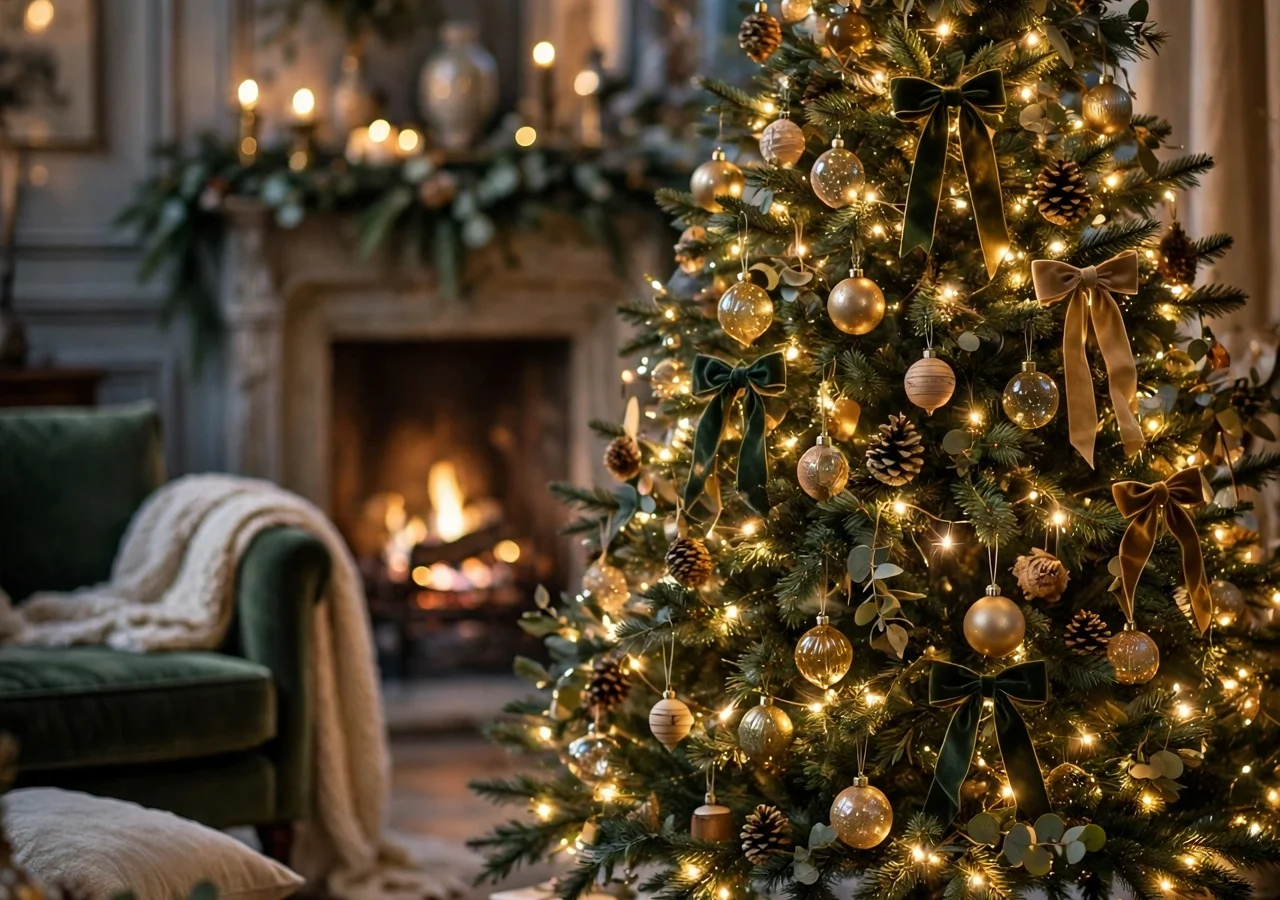
The tree is the one decoration that decides the mood of your entire home in December. You can change the cushions, light every candle you own and bake until the kitchen smells of cinnamon, but if the tree looks like an afterthought, the whole room feels it. A beautifully themed tree, on the other hand, makes even the simplest room feel finished, like you planned it all along.
The trouble is that most trees end up as a collection of accidents. A box of baubles bought over ten years, a colour scheme that drifted from red to gold to whatever was on sale, lights that are half warm and half cool because one set died mid-decoration. It still looks like Christmas, but it does not look like a tree anyone styled on purpose. Every year you promise yourself you will do it properly next time.
This year can be the year. These twelve christmas tree decorating ideas are built around proper themes and colour schemes for 2026, each one a complete look you can copy or adapt. Pick the theme that suits your home, gather the pieces before you start, and decorate in layers, lights, garland, large ornaments, small ornaments, topper, and you will end up with a tree that looks considered instead of collected.
Christmas Tree Quick-Start: Pick Your Theme Before You Shop
Every one of the twelve looks below works with the same five-step method. Run through this checklist first and the whole process gets easier.
- Lights first, always. Wrap lights deep inside the branches before anything else, working from the bottom up and leaving the wire tucked behind the needles. Warm white suits every theme below except the frosted blue look, which wants cool white.
- One theme, one tree. Commit to a single colour story and buy your ornaments in three finishes, matte, satin and one sparkle, within that palette. Mixed themes are how trees turn chaotic.
- Count your ornaments. A 180-centimetre tree needs roughly 60 to 80 baubles plus ribbon or garland to look full. Count before you shop so you buy enough.
- Large ornaments inside, small ones outside. Nest the big pieces deep in the branches for depth, then hang the smaller, prettier ones near the tips where the light catches them.
- Step back often. Squint at the tree from the doorway every twenty minutes. You are looking for even colour distribution, no bare patches and no clumps of the same ornament.
1. Blush Pink & Rose Gold Tree
 Save
Pink Christmas has grown up. The blush pink and rose gold combination that defined 2026’s holiday mood boards translates beautifully to a tree, and it flatters rooms that traditional red and green tend to overpower. Think powdery pink baubles in two sizes, rose gold glass pieces that catch the fairy lights, and a wide blush ribbon woven through the branches in loose, generous loops.
The light choice matters here more than usual. Warm white bulbs keep blush looking soft and expensive, while cool white can push it toward a clinical, icy blue that fights the romance of the scheme. If your existing lights are cool white, this is the year to swap them. Keep the topper quiet: a blush star, a spray of champagne branches, or a simple bow.
This theme is genuinely kind to small living rooms because pale colours recede visually, making the tree feel less bulky than a dark green one dressed in red. For the rest of the house, our guide to pink Christmas decor ideas shows how to carry blush, rose gold and hot pink through every room without tipping into saccharine.
Budget swap: a green artificial tree you already own, dressed head to toe in blush and rose gold ornaments with a pink ribbon garland, reads as a pink tree from across the room at a fraction of the cost of a pink artificial tree.
2. Gingerbread Browns & Cookie Spice
 Save
Warm browns are having a genuine moment, and the gingerbread tree is its cosiest expression. Build the palette from caramel, cocoa, honey and cream, with the ornaments doing the talking: matte brown baubles, amber glass, wooden cookie-cutter shapes and tiny gingerbread-house ornaments in iced white. A cinnamon-coloured velvet ribbon grounds the whole thing and smells faintly of nothing, which is a shame, but the kitchen can handle the scent department.
Texture is what stops this theme from looking flat. Mix polished glass with rustic wood, shiny amber with matte chocolate, and tuck in a few cream ornaments so the dark browns have somewhere to breathe. Real cinnamon sticks tied in bundles with twine make wonderful filler between the baubles, and they last the whole season looking exactly as good as the day you hung them.
If you love this direction, our gingerbread Christmas decor ideas extend the same warm cookie palette to the kitchen, the mantel and the table, so the tree feels like the centrepiece of a plan rather than a solo act.
Try this: bake a batch of salt-dough ornaments in star and heart shapes, paint them cream, and hang them with red twine. They cost almost nothing and smell faintly of the oven for a week.
3. Heritage Tartan & Equestrian Plaid
Nostalgia is the strongest current in 2026 Christmas styling, and the heritage tree leans all the way in. This is the look of old country houses: deep red tartan ribbon, brass and leather-toned ornaments, pine cones, dried orange slices and a few well-chosen vintage pieces. It feels collected over decades even when you bought it all this month.
The plaid does most of the work. Choose one tartan, a classic red-and-green or a muted hunting plaid, and use it in wide ribbon swags plus matching gift wrap under the tree so the whole corner coordinates. Keep the ornaments simple and sturdy: brass bells, wooden stars, glass baubles in deep red and forest green. Avoid anything shiny and plastic-looking; the theme’s charm is in materials that look like they could survive a century in an attic.
Balance is the skill here. Because the palette is dark, the tree can read as heavy in a small room, so leave a little more space between ornaments than your instinct suggests and let the green of the branches show through. A plain cream or natural linen tree skirt keeps the base light.
Designer note: brass bells hung at slightly different heights ring softly when the tree is nudged, which is either charming or maddening depending on your household. You have been warned.
4. White Christmas Monochrome
 Save
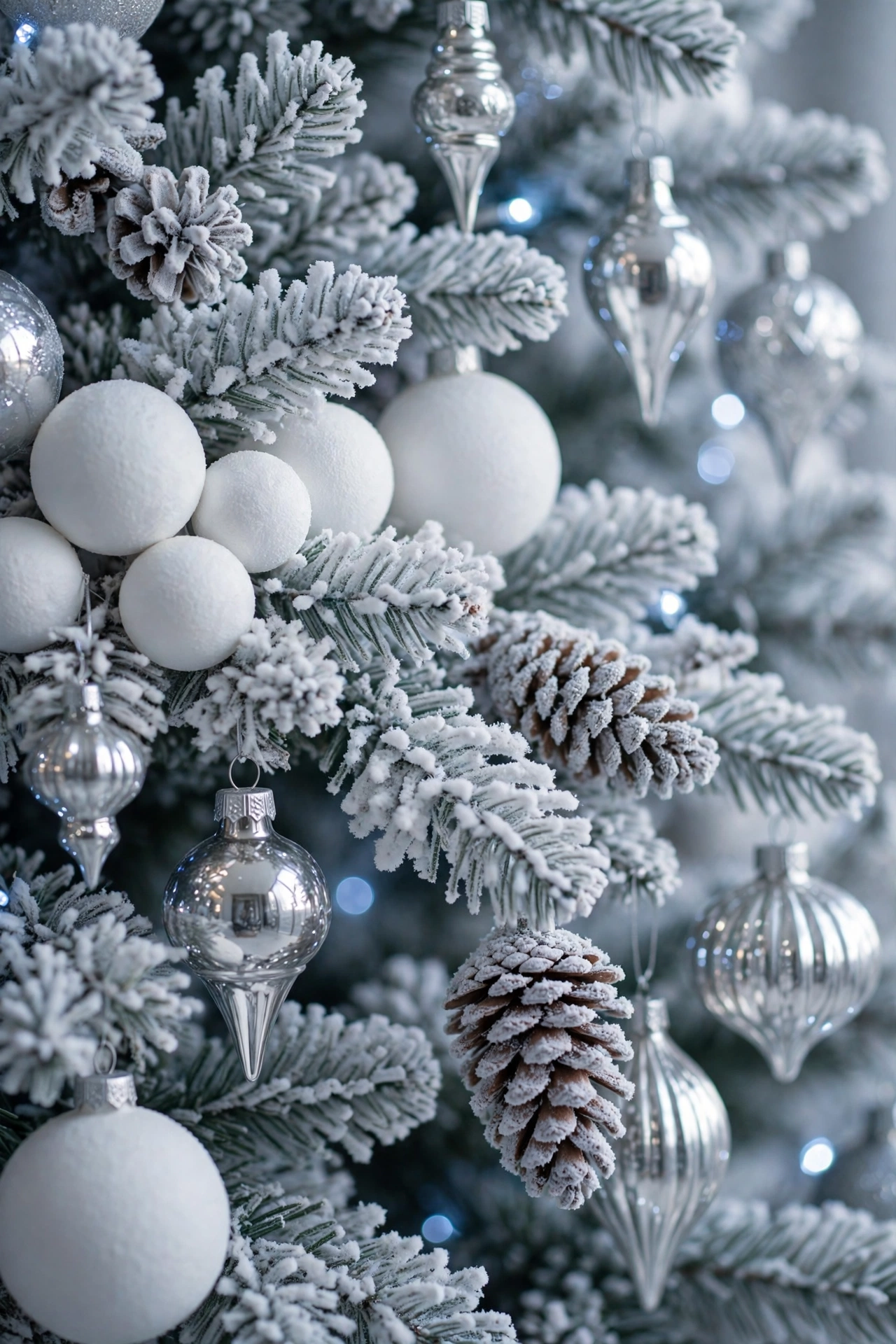
For minimalists, the monochrome white tree is the cleanest look in this list. Start with a flocked artificial tree or a green tree dressed so heavily in white that barely any green shows, then layer white matte baubles, silver glass, frosted pine cones and a silver ribbon. Under cool white lights it glows like a snowfield; under warm white it turns creamy and soft. Both work, so choose by mood.
The risk with all-white is that it reads as flat from a distance. The fix is finish variety: glossy, matte, glitter and frosted, all in white and silver, placed so that no two identical finishes sit next to each other. A few clear glass baubles act like tiny windows, catching the lights and throwing sparkles across the room, which gives the scheme its life.
This is also the easiest theme to refresh year after year, because white ornaments never date and they absorb any accent colour you add later. One year it is pure white; next year you add pale blue or champagne and it is a different tree.
Styling tip: flocked trees shed. Shake the tree outdoors or in the garage before decorating, and lay a washable rug or sheet underneath while you work. Your vacuum will thank you.
5. Sustainable & Nature-Led Tree
 Save
The eco-conscious tree has moved well past the worthy-but-dull stage. A nature-led tree in 2026 is genuinely beautiful: real branches hung with dried orange slices, wooden ornaments, paper stars, pine cones gathered on walks, cinnamon bundles and popcorn or cranberry garlands strung by hand. It smells wonderful, costs very little, and at the end of the season most of it composts.
The styling trick is density. Natural materials are visually lighter than glass baubles, so a sparse natural tree can look underdressed. Hang more than you think you need, cluster the dried citrus in groups of three, and wind the popcorn garland in generous swags rather than thin spirals. Wooden bead garlands in natural tones fill gaps beautifully and cost a few pounds for a long strand.
LED lights keep the footprint low and stay cool against dried materials, which matters when half your ornaments are flammable by nature. For the wider house, our sustainable Christmas decor ideas cover recycled glass, FSC-certified wood and natural wreaths, so the whole home can follow the same principles.
Try this: slice oranges 5 millimetres thick, dry them in the oven at 100 degrees for three hours, turning once. Threaded on twine, they glow amber when the tree lights hit them.
6. Jewel-Tone Maximalist Tree
If minimalism is not your language, the jewel-tone tree is the opposite end of the spectrum and proud of it. Emerald, sapphire, ruby, amethyst and topaz, all at once, layered thick over a dark green tree until it looks like a treasure chest. This is the theme for people who find white Christmas trees faintly depressing.
The secret to maximalism that looks rich rather than chaotic is the lights. Use warm white only, and use plenty, because jewel tones drink light and the tree needs all the glow it can get. Then build in three layers: large jewel baubles tucked deep inside, medium ornaments in mixed finishes through the middle, and the showpieces, peacock feathers, velvet ribbon, oversized glass drops, on the outer tips.
One discipline saves this theme: keep the tree skirt and the presents underneath neutral. Cream, kraft paper or plain gold wrap lets the tree be the undisputed star instead of competing with a riot of patterned paper.
Budget swap: charity shops in November are full of jewel-toned baubles from other people’s scheme changes. A bag of mixed glass ornaments for a few pounds is the cheapest way to start this look.
7. Frosted Blue Winter Tree
 Save
Icy blue is 2026’s cool-toned answer to the warm palettes dominating everything else, and on a tree it is quietly spectacular. Silver-blue baubles, frosted white branches, icicle ornaments and cool white fairy lights combine into something that looks like the tree is holding its breath on a January morning.
This is the one theme where cool white lights are non-negotiable. Warm white turns ice blue muddy and grey; cool white keeps it crisp and luminous. If you are buying lights specifically for this tree, look for ones with a slight sparkle or twinkle setting, which mimics frost catching sunlight.
Because the palette is cool, the tree benefits from one warm accent to stop it feeling sterile. A natural wood tree collar, a jute skirt, or a handful of champagne-gold ornaments mixed through the blue gives the eye somewhere warm to rest without breaking the winter spell.
Designer note: frosted and flocked branches photograph beautifully but the flocking can look patchy close up. Buy the best quality you can afford; cheap flocking is this theme’s biggest enemy.
8. Black & Gold Masquerade Tree
 Save
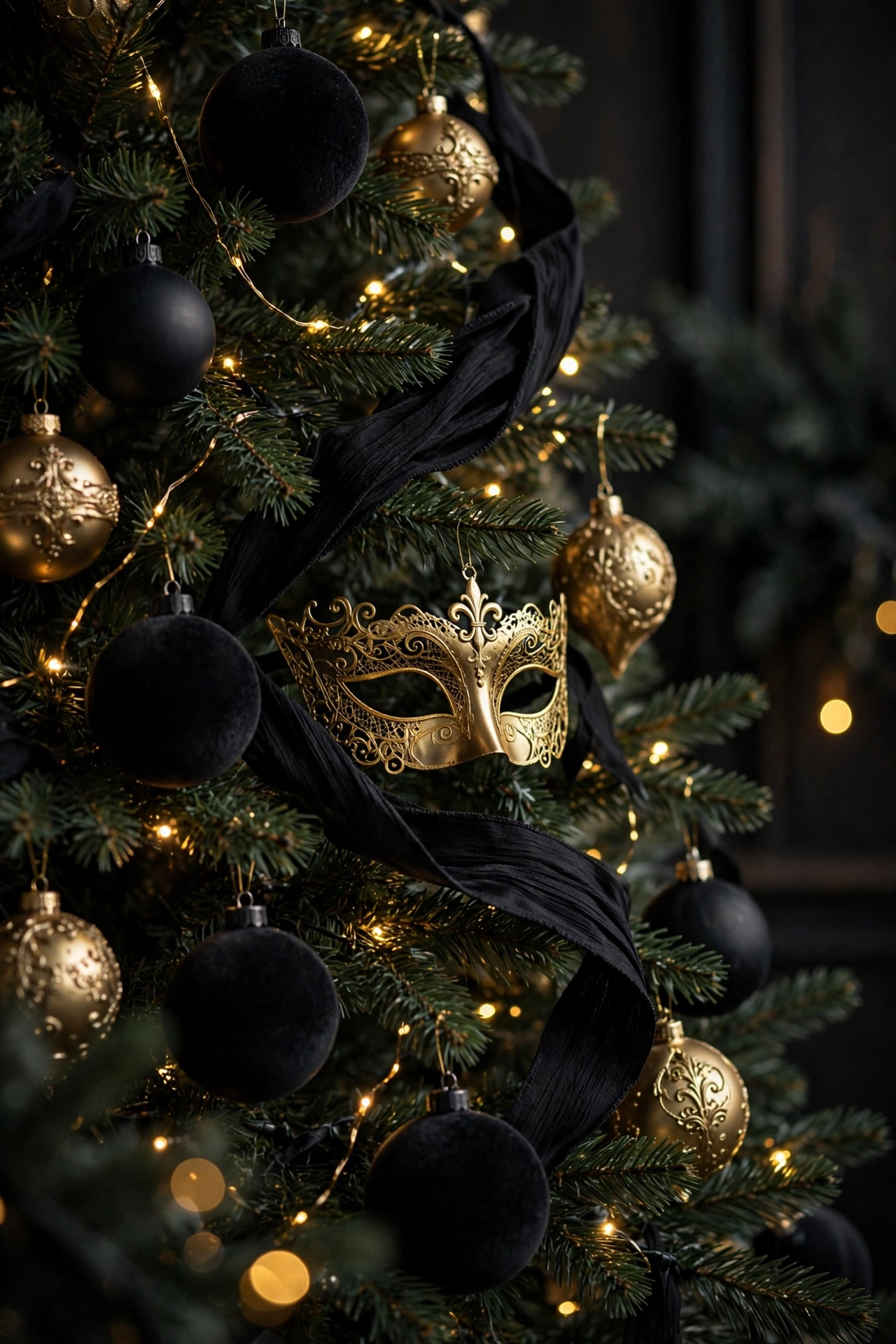
The drama option. A black and gold tree is unapologetically glamorous: matte black baubles, polished gold glass, black velvet ribbon and gold fairy lights, finished with a few feathered or beaded statement pieces. It suits dark-walled rooms, art deco interiors and anyone who thinks Christmas decor should have a little theatre.
Getting the balance right is everything. Too much black and the tree disappears into itself; too much gold and it is just a gold tree. Aim for roughly sixty percent gold to forty percent black, with the black pieces mostly tucked inside the branches so they create depth rather than dominating the silhouette. Gold lights are essential, and more of them than you would use on any other theme, because black ornaments absorb light greedily.
Keep the rest of the room calm. This tree is a statement piece and it needs space around it, plain walls, simple furniture, and a black or gold tree collar rather than a fussy skirt. One dramatic tree plus a quiet room always beats a dramatic tree in a dramatic room.
Try this: spray-paint a handful of pine cones matte black and mix them through the branches. They cost nothing, look expensive, and tie the theme together.
9. Woodland & Foraged Greens Tree
The woodland tree brings the outside in without a single plastic bauble in sight. Think moss-green and bark-brown: pine cones, acorns, wooden animals, dried seed heads, feathers and simple kraft-paper stars, all on a real or realistic tree with plenty of visible branch. It feels calm, honest and quietly festive, like a forest clearing at dusk.
Foraging is half the fun and most of the budget. A November walk with a basket yields pine cones, interesting twigs, dried grasses and seed heads that no shop sells. Clean them, let them dry fully, and hang the sturdier pieces with wire or twine. Wooden bead garlands and plain linen ribbon fill the gaps, and a few beeswax-coloured LED candles tucked safely among the branches add a warm, old-fashioned glow.
Because everything is natural and matte, the lights carry the magic here. Go generous with warm white fairy lights, wrapped right into the interior of the tree, so the whole thing glows from within like embers.
Styling tip: press a few sprigs of eucalyptus or rosemary between the branches near the bottom of the tree. They scent the room for weeks and cost almost nothing.
10. Vintage Glass & Thrifted Baubles Tree
 Save
Some of the prettiest trees are the ones that look like they have a past. A vintage glass tree layers mercury-glass baubles, hand-painted ornaments, tinsel-style garlands and heirloom pieces in faded jewel tones, champagne and dusty rose. Nothing matches exactly, and that is the entire point.
Thrift shops, car boot sales and online marketplaces are the hunting grounds. Look for weight, glass baubles are noticeably heavier than plastic, and for hand-painted details, which signal age and quality. Tarnished silver is fine; broken hangers are not, since rehanging old ornaments is fiddly. Wash everything gently in warm soapy water before it goes on the tree.
The styling rule for mixed vintage is a unifying ribbon. One consistent ribbon, champagne satin or faded gold velvet, woven through the whole tree, pulls a hundred mismatched ornaments into a coherent scheme. Without it, vintage tips into clutter; with it, it reads as a curated collection.
Budget swap: a single box of reproduction mercury-glass baubles mixed with three or four genuine vintage finds gives you the look for the price of one antique-shop visit.
11. Slim Pencil Tree for Small Spaces
Small rooms deserve great trees too, and the pencil tree is the answer. These slim artificial trees are barely 60 centimetres wide but full height, so they deliver all the drama of a big tree in the footprint of a floor lamp. They fit in corners, hallways, beside the sofa and in flats where a traditional tree would eat the room.
Decorating a pencil tree needs a lighter hand. Skip the wide ribbon, which overwhelms narrow branches, and use thin garlands, bead strands or a single spiral of narrow velvet ribbon instead. Choose smaller ornaments, 6 to 8 centimetres rather than 10 to 12, and hang fewer of them; a pencil tree looks best slightly airy, with the lights doing proportionally more of the work.
Placement matters as much as decoration. A pencil tree in a beautiful pot or basket, raised on a small stool or sturdy box to give it presence, reads as a deliberate design choice rather than a compromise. For more ideas that suit compact homes, our small apartment Christmas decor ideas cover trees, tables and mantels that do not make a small space feel cramped.
Try this: cluster three small tabletop trees of different heights on a console or sideboard instead of one floor tree. It gives you a festive focal point with zero floor space sacrificed.
12. Colour-Drenched Monochrome Tree
 Save
Borrowed from the paint world, colour drenching means committing to a single colour everywhere, and on a tree it is strikingly modern. Pick one shade, deep red, forest green, icy blue, even black, and dress the entire tree in it: baubles, ribbon, lights with coloured covers or tint, and a topper to match. The result is bold, graphic and unforgettable.
The technique lives or dies on shade discipline. Gather every ornament in the room together before you start and remove anything that is even slightly off, a cherry red bauble among pillar-box reds will nag at you all December. Within the single colour, vary the finish instead: matte, satin, glitter and glass all in the same shade give the monochrome depth without breaking the spell.
Green-on-green is the easiest entry point because the tree itself provides the base colour; you only need the ornaments. Red is the most festive, blue the most unexpected, and black the most dramatic. Whichever you choose, keep the tree skirt in the same colour family so the base does not interrupt the effect.
Designer note: photograph the tree in black and white on your phone as you decorate. If any ornament jumps out as a different tone in monochrome, it is off-shade and should come off.
Bringing It All Together
Twelve themes, one method. Whichever look you choose, the difference between a good tree and a great one is rarely money; it is commitment. Pick your palette before you shop, buy enough ornaments to fill the tree properly, decorate in layers from lights outward, and step back to check your work as you go.
And remember that the best tree is the one that suits your home, not someone else’s. The blush pink tree is wasted in a house that loves dark wood and leather; the masquerade tree needs a room calm enough to let it perform. Match the theme to the house you actually live in, and the tree will look like it was always meant to be there.
Frequently Asked Questions
How many ornaments does a Christmas tree need?
A 180-centimetre tree looks full with 60 to 80 baubles plus a ribbon or garland, while a 210-centimetre tree needs 90 to 120. Pencil trees need roughly half. When in doubt, buy more than you think; sparse trees look unfinished, and leftover ornaments work beautifully in bowls and wreaths elsewhere.
Should Christmas tree lights be warm white or cool white?
Warm white suits almost every theme and flatters skin tones, wood and traditional colours. Cool white is the right choice only for icy schemes like frosted blue or silver monochrome, where warmth would muddy the palette. Never mix the two on the same tree.
What is the correct order for decorating a Christmas tree?
Lights first, tucked deep into the branches from bottom to top. Then ribbon or garland, then the largest ornaments placed deep inside, then medium and small ornaments working outward, and the topper last. Decorating in this order means each layer sits naturally on the one before it.
Can I mix ornament finishes on one tree?
Yes, and you should. A tree in all-matte or all-shiny ornaments looks flat; combining matte, satin, glitter and glass within one colour palette is what gives a tree depth and richness. The rule is to mix finishes, not colours, unless your theme is maximalist.
How do I store a themed tree’s ornaments so next year is easy?
Pack ornaments by theme in labelled boxes, with the ribbon and topper for that theme in the same box. Wrap fragile pieces individually in tissue, store boxes somewhere temperature-stable rather than a freezing loft, and you will be able to recreate the whole look in an afternoon next December.
2 thoughts