Most living rooms are built from rectangles. Rectangular sofa, rectangular rug, rectangular television on a rectangular wall, and somehow the room still feels unfinished. The pieces are fine on their own, but together they read like a grid, and a grid is not a comfortable place to sit.
The problem is not your taste. Straight edges do useful work, they hold books and frame windows, yet a room made only of them can feel stiff and formal even when the colours are warm. You end up buying cushions and throws to soften edges that the furniture itself keeps sharpening.
One curve changes that. Curved furniture breaks the grid without breaking the room, and it does it quietly. A rounded sofa back, a barrel chair, a kidney-shaped table, each one gives the eye somewhere soft to land. Here are eight pieces worth trying, from the one big statement down to the small accent that does more than you would expect.
Quick Tips Before You Start
- Start with one curve, not five. A single curved piece reads as a choice, five at once reads as a theme park.
- Measure the arc, not just the width. Curves eat floor space in the middle, so check the deepest point against your walkways.
- Pair every curve with something straight. A round table on a square rug, a curved chair beside a straight bookshelf, keeps the room balanced.
- Sit in it before you commit when you can. A beautiful curve that pinches your shoulders is a sculpture, not a chair.
1. The Crescent Sofa
 Save
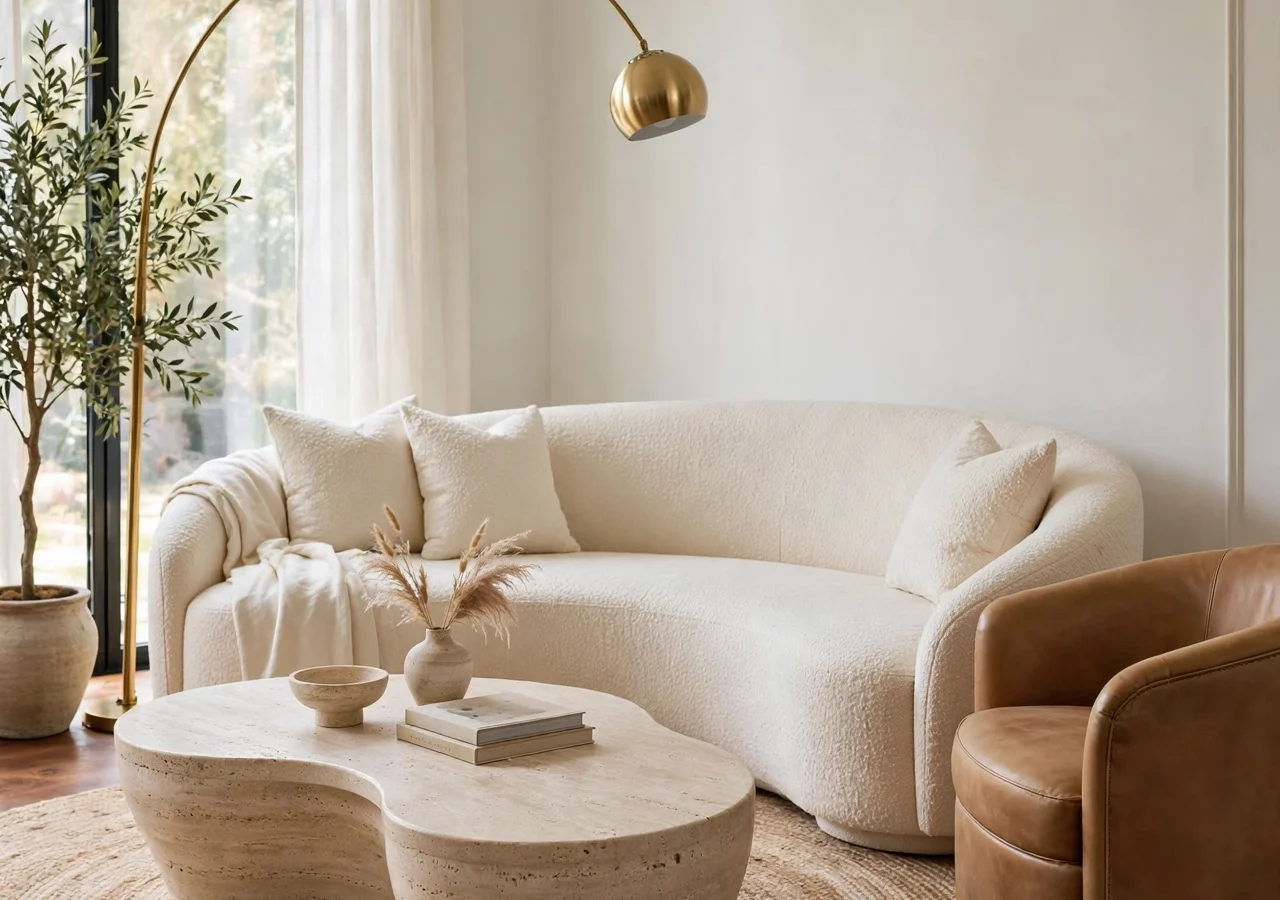
A crescent sofa is the fastest way to change a living room. The back sweeps in a long, gentle arc instead of running straight across the wall, so the whole piece feels like it is gathering the room toward it. People sit closer together on a curved sofa without thinking about it, which is exactly what you want in a room built for conversation.
Size matters more here than with a straight sofa. A crescent in the 220 to 260 centimetre range suits most living rooms, and it works best floated in the room rather than pushed flat against a wall. Leave 60 to 80 centimetres behind it so the curve can breathe, and put a low console or a row of plants in the gap if the bare wall behind it bothers you. The sofa becomes the room divider, the seating and the statement in one piece.
Placement: Float it facing the television or the fireplace, with the open side of the curve toward the room entrance so people walk into the welcome of it, not the back of it.
Colour: Cream bouclé is the classic choice and photographs beautifully, but a deep green or rust velvet holds up better in a house with children, pets or red wine. If your walls are pale, a darker sofa gives the curve something to stand against.
Texture: Bouclé adds the soft, nubby surface that makes a curved sofa look inviting from across the room. Leather looks sharper and cleans faster, though it shows every fingerprint on a dark finish.
Swap: If a full crescent feels too bold or too dear, a curved loveseat in the same shape gives you the line at half the footprint. It works in a reading corner or at the foot of a bed.
Try this: Place a round coffee table inside the arc, about 40 centimetres from the seat edge, so the two curves echo each other and nobody has to reach across a corner.
If the sofa feels too plain on its own, a walnut plinth or dark timber legs underneath it ground the softness. The same trick runs through our guide to dark wood furniture, where warm timber keeps pale, soft pieces from floating away.
2. The Barrel Chair
 Save
The barrel chair is the piece for the corner nobody knows what to do with. Its back wraps around you in a half circle, so a dead corner suddenly has a purpose, and it asks for nothing more than a small side table and a lamp. It is the easiest curve to live with because it is also the smallest.
Look for a seat width of 70 to 80 centimetres and a seat height around 45 centimetres, which suits most adults and most side tables. A swivel base is worth paying extra for, since a barrel chair that turns lets you face the room, the window or the television without dragging furniture across the floor. Fixed legs look tidier, so pick the swivel if the chair will be used daily and the fixed base if it is mostly for show.
Placement: Angle it toward the light, not square to the wall. A barrel chair turned 30 degrees into the room looks deliberate, while one shoved flat into a corner looks like it is in time out.
Colour: Tan leather warms a pale room and ages well, scuffs included. Forest green or ink blue velvet suits a darker, moodier corner and hides dust better than cream.
Texture: Velvet makes a barrel chair feel like a proper armchair, while a woven linen or cotton blend keeps it light enough for a small room. Avoid shiny satin finishes, they crease badly on a curved back.
Swap: If leather feels heavy for the spot, rattan accent chairs bring the same wrapped shape in a lighter frame that suits a sunroom or a bedroom corner.
Try this: Add one cushion in a contrasting solid colour, not a pattern. A curved back already has plenty going on, and a busy print fights it.
3. The Kidney Coffee Table
 Save
A kidney coffee table is the quiet hero of this list. Its bean-shaped top has no corners to catch a shin, no sharp edge to worry about with toddlers, and it slides neatly into the curve of a crescent sofa or a pair of chairs. It looks custom even when it is not, because the shape itself is unusual.
The sweet spot is 110 to 130 centimetres long and 55 to 65 centimetres at its widest point, with a height of 40 to 45 centimetres, just below the seat of your sofa. Travertine tops are having a moment and suit the organic shape, while walnut brings warmth and hides rings better than pale stone. If your budget is tight, a painted MDF kidney table in a matte finish gives you the shape without the stone price, and nobody will know the difference from the sofa.
Placement: Centre it on the sofa, not on the rug, and leave 40 to 45 centimetres between the table edge and the seat cushions so legs fit comfortably underneath.
Colour: Keep the top close to the floor tone. A pale stone table on a pale rug disappears, so go one shade darker or warmer than the rug beneath it.
Texture: Pair a smooth stone top with a textured rug underneath, or a timber top with a flat-weave rug. One smooth surface and one rough one is enough.
Swap: If the kidney shape feels too specific, an oval table gives you the same corner-free benefit in a shape that is easier to find secondhand.
Try this: Style it in threes, one low stack of books, one small vase, one candle, and leave the rest of the surface empty. A curved table styled edge to edge looks cluttered fast.
4. The Sculptural Floor Lamp
 Save
A sculptural floor lamp is lighting that earns its floor space. Instead of a straight pole with a shade, the arched or bent stem leans over the seating area, so the light falls where you actually read instead of washing the wall behind you. It is the closest thing to a pendant lamp that renters can have, since it needs no ceiling hook.
The classic arc lamp stands 180 to 200 centimetres tall with a marble or metal base heavy enough to stop it tipping, which matters in a house with children or a large dog. Check the reach of the arc against your sofa, the shade should hang roughly above the armrest, not above the middle of the seat, or you will be reading in your own shadow. A dimmer switch is not optional here, an arc lamp at full brightness over a reading chair is a spotlight, not a lamp.
Placement: Tuck the base behind the sofa arm or beside the chair, and let the arc lean in over the seat. Keep it clear of walkways, since the leaning stem is easy to walk into in the dark.
Colour: Brushed brass warms a neutral room, matte black disappears against dark walls, and a white or cream shade keeps the light soft. Pick the finish that matches your other metal, not the one that matches the trend.
Texture: A marble base adds weight and a natural stone surface that echoes a travertine coffee table, while a slim metal base suits a cleaner, more modern room.
Swap: If an arc feels too dramatic, a bent bamboo or rattan floor lamp gives you the curve in a softer, lighter material at a lower price.
Try this: Pair the floor lamp with sculptural lighting overhead, one statement pendant or a cluster of small pendants, so the room has two sculptural light sources at different heights instead of one lonely lamp.
Which Curved Piece Fits Your Room?
 Save
| Piece | Best room | Pairs well with | Skip it if |
|---|---|---|---|
| Crescent sofa | Living room | Round coffee table, arc lamp | Your room is under 3 metres wide |
| Barrel chair | Reading corner, bedroom | Small round side table | You need seating for three or more |
| Kidney coffee table | Living room | Crescent sofa, textured rug | Your sofa is straight and boxy |
| Sculptural floor lamp | Living room, bedroom | Low sofa, lounge chair | Ceilings are under 2.4 metres |
| Oval dining table | Dining room | Pedestal base, bench seating | Your dining room is narrow |
| Rounded bedside table | Bedroom | Upholstered headboard, soft lamp | You need deep drawer storage |
| Sculptural lounge chair | Living room, study | Straight bookshelf, floor lamp | You sit for hours at a stretch |
| Curved console | Entryway, hallway | Round mirror, small vase | Your hallway is under 90 cm wide |
5. The Oval Dining Table
 Save
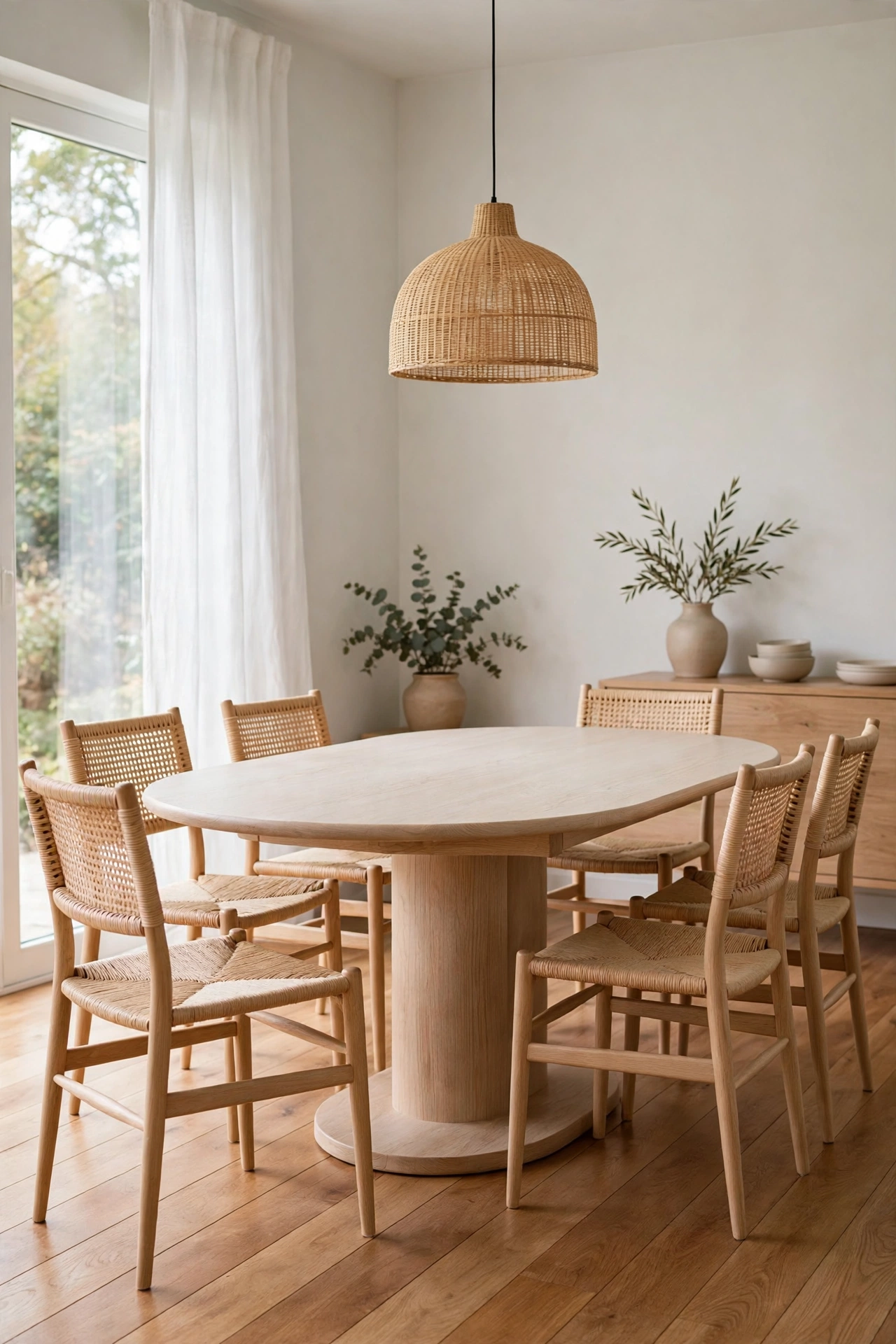
An oval dining table is the curved answer to the dinner party problem. A rectangular table has two ends and two sides, and the people at the ends sit too far from the middle of the conversation. An oval pulls everyone slightly closer, and the pedestal base that most oval tables sit on means nobody is fighting a table leg for foot room.
A 180 by 105 centimetre oval seats six comfortably and eight at a push, and it needs 90 centimetres of clearance on every side so chairs can pull out and people can walk past with plates. White oak is the safe choice, pale enough for a bright dining room and tough enough for daily meals. A dark walnut oval suits a moodier dining room and hides scratches better, though it will show dust on the surface. If you entertain often, look for an extending oval, the leaves hide inside the pedestal and the table grows from four seats to eight without a second piece of furniture.
Placement: Centre it under the pendant light, not under the middle of the room. The light is the anchor, and a table sitting off-centre from its light looks like a mistake even when the room layout is the reason.
Colour: Match the table to the floor, not the chairs. Chairs in a contrasting colour or fabric stop the dining set looking like it arrived in one box.
Texture: A timber top with a matte oil finish feels warm under the hands and can be sanded and re-oiled when it marks. A lacquered top looks sleek but shows every scratch, so save it for a room that is used twice a week, not twice a day.
Swap: If your dining room is narrow, a round table beats an oval. A round table needs less length, seats four easily, and keeps the same corner-free conversation.
Try this: Use a bench on one side instead of chairs. It slides under the table when not in use, seats an extra person when needed, and the straight bench against the curved table is exactly the straight-meets-curve balance this whole list is about.
6. The Rounded Bedside Table
 Save
The rounded bedside table is a small piece that changes how a bedroom feels at night. A square nightstand with sharp corners is the thing you bang your knee on in the dark, and a drum or cylinder table with a curved front removes the problem entirely. It also softens a bedroom full of straight lines, the bed, the wardrobe, the window, without asking for any redecorating.
Aim for a diameter of 40 to 50 centimetres and a height 5 centimetres below the top of your mattress, so you can reach a glass of water or a book without sitting up. A single curved-front drawer holds the essentials, and an open shelf underneath is better than a second drawer you will never open. Rattan, bent plywood and lacquered MDF all work here, and a drum table in a soft colour reads as furniture, not as a plant stand that wandered in from the garden.
Placement: Put it tight to the bed, not floating a handspan away. A bedside table you have to reach across a gap for is a table you will stop using.
Colour: Keep it close to the headboard colour or the wall colour. A bedside table is a supporting piece, and a loud colour there competes with the bed for attention.
Texture: A woven rattan drum adds texture at eye level when you wake up, while a smooth lacquered drum suits a calmer, more polished bedroom.
Swap: If you need real storage, a curved-front chest of drawers does the same softening job at a larger scale, and it holds folded clothes as well as books.
Try this: Put the lamp on the table and the books underneath, not the other way around. A lamp on top of a round table looks settled, while books stacked on top make the curve look like a shelf.
7. The Sculptural Lounge Chair
 Save
A sculptural lounge chair is the piece you buy because you love looking at it, and then discover you love sitting in it too. The moulded shell, whether plywood, fibreglass or upholstered foam, holds its shape in one continuous sweep from the seat to the back, with no visible joints and no straight lines at all. It reads as art from across the room and as a chair from two steps away.
Comfort is the test that matters, and it is the one you cannot judge from a photograph. A shell chair with a seat depth of 45 to 50 centimetres and a slight tilt suits most bodies for an hour of reading, though it is not the chair for a three-hour film. Look for a frame in bent walnut or beech if you want warmth, or a powder-coated steel base if you want the chair to look lighter. A single walnut shell chair is one of the simplest pieces in a living room refresh, since one strong chair can change the whole seating arrangement without replacing the sofa.
Placement: Give it space. A sculptural chair pushed against a wall looks like it is waiting to be used, while one placed a metre out from the wall with a small side table beside it looks like a destination.
Colour: Natural timber and cream upholstery suit a calm room, while a single bold colour, oxblood, forest, ochre, turns the chair into the room’s focal point. One bold chair is a statement, two bold chairs are a matching set that needs the rest of the room to stay quiet.
Texture: Upholstered shells are kinder to bare arms and suit a living room, while a bare timber or moulded shell is easier to wipe down and suits a study or a hallway.
Swap: If a full shell chair is out of reach, a curved dining chair pulled into the living room as an occasional chair gives you the shape at a fraction of the price, and it moves back to the table when guests arrive.
Try this: Sit in it for ten minutes in the shop, with a book, not thirty seconds with your hands on the armrests. A chair that feels good for ten minutes will feel good at home.
8. The Curved Console
A curved console is the entryway piece that makes the whole house feel considered. The half-moon shape, flat against the wall and rounded on the front, gives you a surface for keys and post without the sharp corners of a rectangular console, and it takes up barely 30 centimetres of depth. In a hallway that is too narrow for a proper table, it is often the only console that fits.
The standard size is 100 to 120 centimetres wide and 75 to 80 centimetres high, which suits a round mirror hung above it and a small vase or bowl on top. Stone, timber and lacquer all work, though a half-moon console in a pale stone or cream lacquer makes a dark hallway feel wider, while a dark timber one anchors a pale hallway. If your entryway is a thoroughfare rather than a room, skip the drawers and keep the top clear except for one bowl for keys, since anything more will be knocked off by a bag or a coat.
Placement: Centre it on the wall it sits against, not on the door. A console centred on the door looks wrong the moment the door opens, while one centred on the wall looks right from every angle.
Colour: Match it to the skirting boards or the door frame for a quiet fit, or paint it a shade darker than the wall for a gentle contrast that still reads as one piece with the room.
Texture: A fluted or reeded front adds texture without pattern, and it catches the light in a hallway that gets little natural sun.
Swap: If a half-moon console is too wide for your hallway, a wall-mounted semicircular shelf gives you the same curve and a surface for keys at a fraction of the depth.
Try this: Hang a round mirror directly above it, with the bottom of the mirror about 15 centimetres above the console top. The two curves stacked together make the entryway feel finished with almost no effort.
Test it first: before you buy a curved piece, mark its footprint on the floor with painter’s tape and walk around it for a day. If the curve guides you past it without a bump and the room still feels open, the shape earns its place. If you keep catching the tape or the walkway feels pinched, size down before you spend.
Bringing It All Together
You do not need all eight pieces, and you should not buy them all at once. Pick the one that solves the problem you notice most, the stiff living room, the dead corner, the hallway with nowhere to put your keys, and live with it for a few weeks before you add another curve. The test is simple, if the room feels softer and easier to move through, the curve is working, and if the room feels like a showroom, you have added one too many.
Start big if the living room is the issue, a crescent sofa or a kidney table changes the whole room in one move. Start small if you are unsure, a barrel chair or a rounded bedside table lets you try the shape without committing the room to it. Either way, keep something straight nearby, a square rug, a straight bookshelf, a rectangular mirror, so the curves have something to play against. Curves on their own drift toward soft and shapeless, while curves beside straight lines look deliberate.
Frequently Asked Questions
Are curved sofas hard to arrange in a small room?
They can be, because a curve needs clearance behind it that a straight sofa does not. In a room under 3 metres wide, skip the full crescent and try a curved loveseat or a pair of barrel chairs instead, which give you the soft line without eating the floor space.
Does curved furniture suit a modern home?
Yes, and it often suits a modern home better than a traditional one, since modern rooms already have plenty of straight lines to balance the curves against. The trick is to keep the finishes simple, one timber tone, one metal finish, and let the shape do the talking.
What materials work best for curved pieces?
Bent plywood and moulded fibreglass hold a curve without joints, which is why they appear in so many shell chairs. Bouclé and velvet suit upholstered curves, while travertine and walnut suit curved tables. Avoid thin veneer on a tight curve, it lifts and peels over time.
How do I stop a curved room looking too soft?
Add one straight, structured piece for every curve, a square rug under a round table, a straight bookshelf beside a barrel chair, or a rectangular mirror above a half-moon console. The contrast is what makes the curves look intentional rather than accidental.
Is curved furniture a passing trend?
Curves come and go in fashion, but the shape itself is not new, it has appeared in furniture design for a century. Curves feature in our look at 2027 interior design trends, and the pieces that last are the simple ones, a well-made barrel chair or an oval table, rather than the most dramatic shape in the shop.
One Combination to Keep
The combination: one crescent sofa + one kidney coffee table + one arc floor lamp, with a straight rug underneath and a straight bookshelf on the wall. That is the whole look in one sentence, and every other piece on this list is a variation on it.