You know the feeling. You sit down at your desk in the morning, coffee in hand, and the room just drains you. The walls are flat white, the chair squeaks, cables snake across the floor, and the whole corner feels like an afterthought somebody shoved against a wall. You get through the day, but you never actually enjoy being there.
It does not have to stay that way. A home office makeover is one of the highest-impact rooms you can redo, because you spend hours in it every single day. And it rarely needs a big budget or a contractor. Most tired home offices suffer from the same handful of problems: bad light, a chair that fights you, nowhere to put anything, and walls with zero personality. Fix those, and the room changes completely.
This guide walks through eight practical home office makeover ideas, starting with the moves that cost nothing and building up to the ones worth spending on. Each one works on its own, so pick the two or three that match your room and start there.
Quick Tips Before You Start
- Clear everything off the desk and floor first. You cannot judge a room while it is buried.
- Take a photo of the room before you touch anything. It shows you what your eyes have stopped noticing.
- Work in this order: layout, light, chair, storage, walls, then the pretty stuff.
- Set a hard budget before you shop. A makeover without a number grows legs.
1. Move the Desk Before You Buy Anything
 Save
Before you move a single piece, map the room as it is. Note where the window sits and when daylight reaches the desk, since light decides the desk position and the wall colour. Note how much floor you truly have, since chair clearance and storage follow from it. Note how the room is used beyond work, since a room that doubles as a guest space needs softer seating and quieter storage than a room that is only an office. Those three facts decide which moves below matter most.
The single biggest home office upgrade costs nothing at all. Most people put their desk against the nearest wall out of habit, then wonder why the room feels like a cell. Pull it out, turn it around, and test a few positions before you spend a penny.
A desk facing the room, with your back to a wall, usually feels better than facing a blank wall all day. You see the door, you see the room, and the space behind you stops feeling like a dead zone. If you have a window, try the desk perpendicular to it, so daylight falls across your work surface from the side instead of glaring straight into your screen or your eyes. Side light is the sweet spot: bright enough to work by, soft enough that you are not squinting by ten in the morning.
Measure before you commit. Leave at least 90 centimetres behind your chair so you can push back and stand up without scraping the wall. Keep the desk at least 60 centimetres from a radiator or a draughty window, or you will be too hot in winter and too cold in summer. A tape measure and ten minutes of shuffling furniture will tell you more than any mood board.
Placement: perpendicular to the window, facing into the room. Colour: keep the desk surface light if the room is small, since dark tops swallow light. Texture: a timber top warms up a room that feels too clinical. Swap: if the desk is too deep for the wall, turn it into a floating shelf desk instead.
Try this: live with the new position for two full workdays before you decide. A layout that looks good in a photo can still feel wrong at 3pm.
2. Upgrade the Chair You Actually Sit In
 Save
Nobody regrets spending money on a good office chair. You sit in it for six, eight, sometimes ten hours a day, and a bad one shows up as a sore neck, a stiff lower back, and that slow slide into slouching by lunchtime. If your budget only stretches to one purchase, make it this one.
Look for a chair with adjustable seat height, lumbar support you can move up and down, and armrests that adjust in height at least. You do not need every lever on the market. Sit in it properly before you buy: feet flat on the floor, knees at roughly a right angle, lower back pressed into the support. If your shoulders creep up toward your ears, the armrests are too high.
Test it first: sit in the chair for ten full minutes before you buy, with your feet flat on the floor and your lower back pressed into the support. If your shoulders rise toward your ears as you sit, the armrests are set too high. If your lower back loses contact with the support when you lean forward to type, the support sits too low for you. If both checks pass, the chair fits your body, not just your room.
Style matters too, because this chair is the biggest object in the room. A black mesh task chair suits a modern setup, while a leather or bouclé swivel chair softens a room that doubles as a guest space. Pick a fabric that fits how you use the room, not just how it photographs. If you eat lunch at your desk, a wipeable surface beats pale linen every time.
Placement: centre the chair on the desk, not off to one side, so your shoulders stay square. Colour: a chair in a warm neutral reads softer than pure black in a small room. Texture: woven fabric or leather adds warmth that plastic shells never do. Swap: a lumbar cushion and a seat pad can rescue a decent chair that just lacks support.
Try this: set a timer for 50 minutes. When it goes off, stand, stretch, and reset your posture before you sit back down.
3. Paint One Wall and Change the Whole Room
 Save
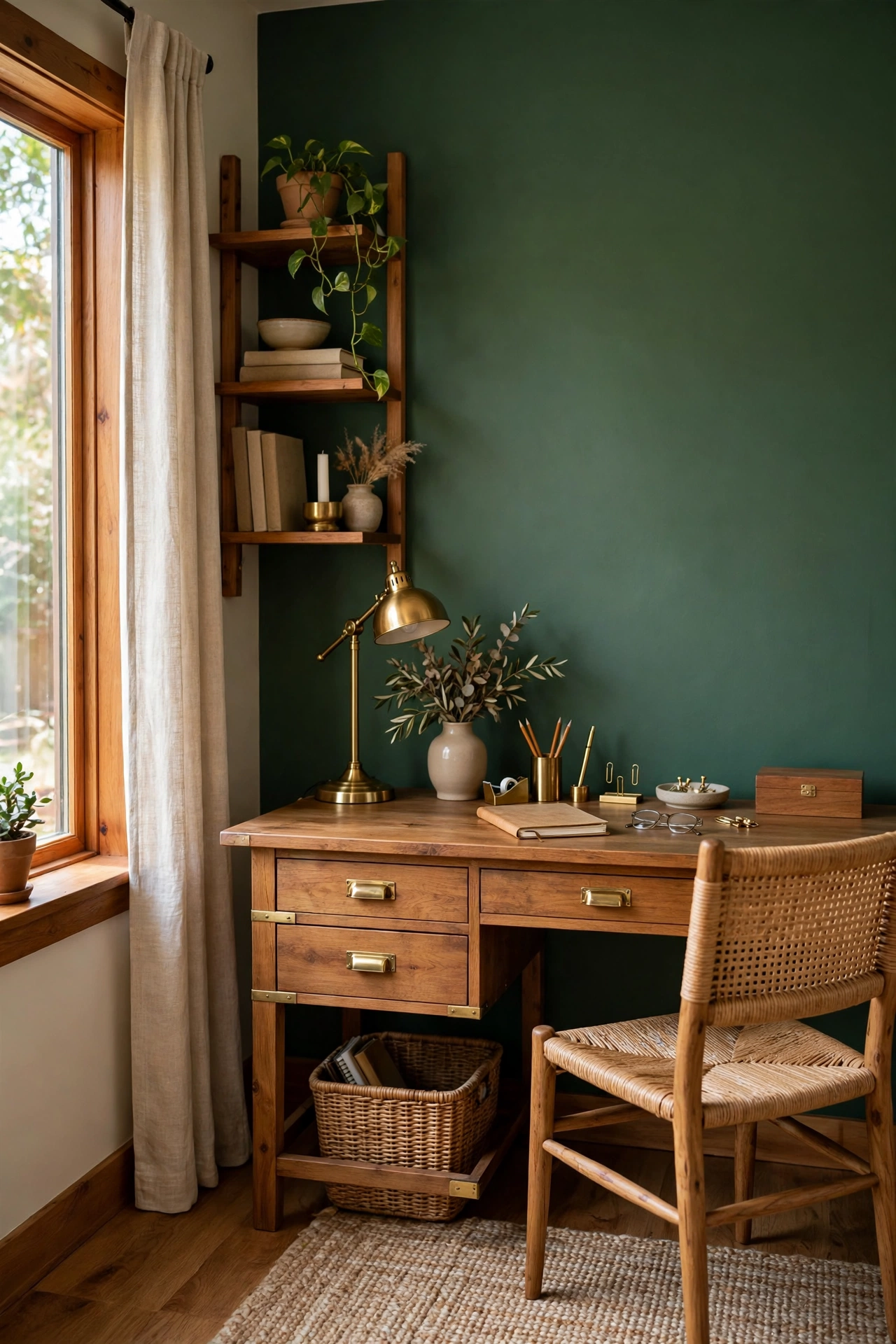
Paint is the cheapest way to make a home office feel designed rather than assembled. One accent wall behind your desk gives video calls a backdrop with actual character, and it costs a single tin of paint and an afternoon. The trick is picking a colour that helps you focus instead of fighting you.
Deep green works beautifully in offices. It reads calm and grown-up, pairs well with timber and brass, and photographs well on camera. Warm terracotta does the opposite job: it adds energy to a north-facing room that always feels grey. If you want something safer, a warm greige, one with a hint of brown in it, lifts a flat white box without shouting about it. Avoid pure white on every wall. It looks clean in photos and feels like a clinic in real life.
Match the wall colour to the light and the job the room must do, not to a trend.
| Wall colour | What it does | Pick it when |
|---|---|---|
| Deep green | Calm, grown-up; pairs with timber and brass | You want a focused room that looks good on calls |
| Warm terracotta | Adds energy and warmth | The room faces north and always feels grey |
| Warm greige | Lifts a flat white box without shouting | You want a safe first step into colour |
Paint the wall behind your desk, not the one you stare at while working. That way you get the colour in your peripheral vision and on camera, but your eyes rest on a calmer surface when you are concentrating. Finish the job properly: two coats, a decent brush for the edges, and painter’s tape on the skirting. A rushed paint job is worse than no paint job.
Placement: the wall behind the desk, full height, edge to edge. Colour: deep green for calm, terracotta for warmth, warm greige for a safe first step. Texture: a matte finish hides wall imperfections better than gloss. Swap: if painting feels too permanent, a peel-and-stick wallpaper panel on the same wall gives you the same effect and peels off cleanly later.
Try this: paint a large test swatch, at least A3 size, and look at it in morning light and evening light before you commit to the tin.
4. Layer the Lighting Instead of Relying on One Ceiling Bulb
 Save
Bad lighting is the reason so many home offices feel gloomy even on a bright day. A single ceiling light casts shadows across your desk, flattens your face on video calls, and makes the room feel smaller than it is. The fix is layers: ambient light for the room, task light for the desk, and a warm accent for the evenings.
Start with the desk lamp. An adjustable arm lamp with a warm white bulb, around 2700 to 3000 kelvin, puts light exactly where your hands and papers are. Add a floor lamp or a wall light in the corner opposite your desk to kill the dark pocket that forms behind you. If the ceiling light is the problem, a sculptural pendant over the desk can replace it entirely, and our statement pendant lamp ideas show styles that work in small rooms. If you take video calls, a small ring light or a lamp bounced off the wall in front of you does more for how you look on camera than any webcam upgrade.
Keep the colour temperature consistent. Mixing a cold blue ceiling bulb with a warm desk lamp makes the room feel off, even if you cannot name why. Swap the ceiling bulb to match the rest, and use a dimmer or a smart bulb if you work late, so you can drop the brightness after dark instead of sitting under full glare at 9pm.
Placement: task lamp on your non-dominant side so your writing hand never casts a shadow. Colour: warm white bulbs throughout, 2700 to 3000 kelvin. Texture: a linen or fabric shade softens light that a bare bulb throws hard. Swap: a clip-on desk light costs very little and works on a shelf or a monitor arm if the desk is full.
Try this: turn off the ceiling light for one workday and see how far the layers alone get you. Most rooms need less overhead light than people think.
5. Give Everything a Home With Proper Storage
 Save
Clutter is the fastest way to make a home office feel drab. It is rarely about owning too much. It is about owning things with nowhere to go, so they pile up on the desk, the floor, and every flat surface in reach. Storage is not the boring part of a makeover. It is the part that makes all the other parts visible.
Start with closed storage for the ugly stuff: a low cabinet, a couple of lidded boxes, or a drawer unit that slides under the desk. Paperwork, chargers, printer supplies, and the cables you might need one day all belong behind a door. Then add one open shelf for the things worth seeing: books you actually reach for, a plant, a framed print. Open shelves work when they are half empty. Cram them full and they become clutter with better lighting.
Wall space above the desk is the most wasted real estate in most offices. A single shelf at eye level when seated, about 40 centimetres above the desk surface, holds notebooks and reference books within arm’s reach. A pegboard or a rail with hooks does the same job for headphones, cables, and scissors, and it keeps the desk surface clear for actual work.
Placement: closed storage low and near the desk, open shelving at seated eye level. Colour: match storage to the desk or the wall so it reads as furniture, not boxes. Texture: woven baskets soften a wall of hard boxes and hide the mess inside them. Swap: a secondhand filing cabinet, painted to match the room, costs a fraction of new storage and holds twice as much.
Try this: empty one drawer completely, then put back only what you used in the last month. The rest goes into a box in another room for 30 days. If you never open it, you do not need it.
6. Tame the Cables and Clear the Desk
 Save
A beautiful desk with a tangle of black cables underneath it still looks messy. Cable clutter is the detail that undoes a makeover in photos and in real life, because your eye goes straight to the mess under the desk every time you sit down. An hour of cable management changes the room more than most people expect.
Run a cable tray or a simple trunking strip along the back edge of the desk and feed every cable through it. One power strip, mounted under the desk with adhesive or screws, replaces the tangle on the floor. Label the plugs you unplug often, like the laptop charger, with a strip of masking tape. Coil spare cable with a velcro tie instead of letting it puddle.
Then set a rule for the desk surface itself. Only four things live on it permanently: your screen, your keyboard, a lamp, and one personal object. Everything else gets used and put away. A small tray for pens and a phone stand keep the daily bits contained without turning the desk into a storage shelf. The first week feels strict. By the second, you will wonder how you ever worked on a desk you could not see.
Placement: cable tray along the back edge of the desk, power strip mounted underneath. Colour: black trunking on a dark desk, white on a light one, so it disappears. Texture: a leather desk mat hides cable exits and gives the surface a finished feel. Swap: if you cannot mount anything, a fabric cable sleeve bundled with velcro ties does most of the job for very little money.
Try this: take a photo under your desk right now. That is your before shot. Fix the cables, take another, and keep both. It is the most satisfying comparison in the whole makeover.
7. Hang Art That Actually Means Something to You
 Save
Bare walls are the signature of a room nobody finished. But the fix is not a random print from a homeware chain. The art in your office should be something you like looking at on a grey Tuesday, not something that matches the sofa. Pick pieces with a personal connection: a framed map of a place you love, a print from an artist you follow, a photograph you took yourself.
Scale matters more than subject. One large piece, at least 60 centimetres wide, over the desk or on the wall you face, anchors the room in a way that four small frames never do. Hang it so the centre sits at eye level when you are seated, roughly 120 to 130 centimetres from the floor. If you are hanging a group, keep the gaps between frames tight and even, about 5 centimetres, and treat the whole group as one shape.
Frames are the detail people skip. Matching simple frames in black, oak, or brass pull a mixed group together instantly. Mismatched charity-shop frames can work too, but only if the frames themselves share a colour or a material. A cheap print in a good frame looks expensive. An expensive print in a bent plastic frame looks like a mistake.
Placement: one large piece centred over the desk, or a tight group on the wall you face. Colour: pick one colour from the art and repeat it once elsewhere in the room, a cushion or a notebook. Texture: a framed textile or a woven wall hanging adds softness that glass and paper cannot. Swap: washi tape frames on a rented wall give you the gallery look with zero holes.
Try this: lean the art against the wall for a week before you hang it. Live with the size and the position first, then commit to the nail.
8. Bring in Plants and Soft Texture
 Save
The final layer is the one that makes a home office feel like a room instead of a workstation. Plants and soft texture do the job that furniture cannot: they make the space feel alive and lived in. A room with nothing soft in it will always feel a little hard, no matter how good the desk is.
Pick plants that survive neglect, because an office plant that dies in a month is worse than no plant at all. A snake plant or a pothos handles low light and irregular watering. A trailing pothos on a high shelf softens the hard line where the wall meets the ceiling. Put the plant where you will actually see it while you work, not hidden behind the monitor.
Texture comes from the small things: a woven rug under the chair, a linen cushion on the spare chair, a woollen throw over the back of it. These pieces absorb sound too, which matters more than people realise. A bare room with hard floors echoes on calls and feels cold underfoot. A rug and a curtain can cut that echo noticeably, and they cost less than most of the furniture in the room.
Placement: one plant on the desk, one trailing plant high up, rug centred under the chair. Colour: green foliage against a painted wall is the easiest colour pairing in the room. Texture: mix at least three textures, like wool, linen, and woven fibre, so the room feels layered rather than flat. Swap: if real plants keep dying, a good-quality faux olive branch in a ceramic vase gives you the shape without the upkeep.
Try this: add one texture at a time and stop when the room feels warm. The goal is a room that invites you in, not a showroom.
The shortcut: move the desk, fix the light, then buy the chair.
Bringing It All Together
A home office makeover does not need a renovation budget or a weekend of disruption. The rooms that work best are the ones where somebody moved the desk first, fixed the light second, and only then started shopping. Layout, light, and a chair you can sit in all day do more than any single purchase, and everything after that is polish.
Start with the two changes that cost nothing: move the desk and clear the cables. Then pick the one purchase that will change your working day the most, usually the chair or the paint. Finish with the layers that make the room yours: art you chose, a plant you keep alive, and a texture under your feet. Give it a week and the room will feel like somewhere you want to sit down in the morning, which is the whole point.
If your office shares space with another room, the same ideas still apply. A desk in a living room corner benefits from the same light, storage, and art rules, just on a smaller scale. For a full-room refresh, our living room refresh ideas show how small updates change a whole space. And if the wall behind your desk needs more than paint, peel-and-stick wallpaper ideas are the renter-friendly way to get the same effect.
Frequently Asked Questions
How much does a home office makeover cost?
A meaningful makeover can start at almost nothing if you begin with layout, decluttering, and cable management. A mid-range refresh with a good chair, paint, lighting, and storage usually lands between a few hundred pounds, depending on what you already own. Spend first on the chair and the lighting, since those change how the room feels every single day.
What is the best colour to paint a home office?
It depends on the light your room gets. Deep green suits most offices because it feels calm and looks good on video calls. Warm greige is the safe choice if you want something neutral. Terracotta warms up a north-facing room that always feels cold. Test a large swatch in morning and evening light before you commit.
Where should I put my desk in a small home office?
Perpendicular to the window is the best starting point, with the desk facing into the room rather than a wall. Leave at least 90 centimetres behind the chair so you can stand up comfortably. In a very small room, a desk against the short wall with a floating shelf above it uses the space better than a desk crammed into a corner.
How do I make my home office look good on video calls?
Put a finished wall behind you, not a blank one or a messy shelf. A painted wall, one piece of art, and a plant read well on camera. Light your face from the front with a lamp or a ring light, and keep the ceiling light off if it casts shadows. If the room doubles as a workspace, our small home office decor ideas cover camera-ready styling in detail.
What is the one change that makes the biggest difference?
Moving the desk. It costs nothing, it takes twenty minutes, and it changes the light, the view, and the feel of the room in one move. After that, a proper chair is the purchase with the biggest daily payoff. Everything else is refinement.
A Room Worth Sitting In
The best home offices are not the most expensive ones. They are the ones where somebody thought about how the room actually gets used: where the light falls at 3pm, where the cables go, where the chair lands when you push back from the desk. Get those details right and the room stops feeling like a corner you work in and starts feeling like a place you choose to be. That is a makeover worth doing, and it starts with moving the desk.