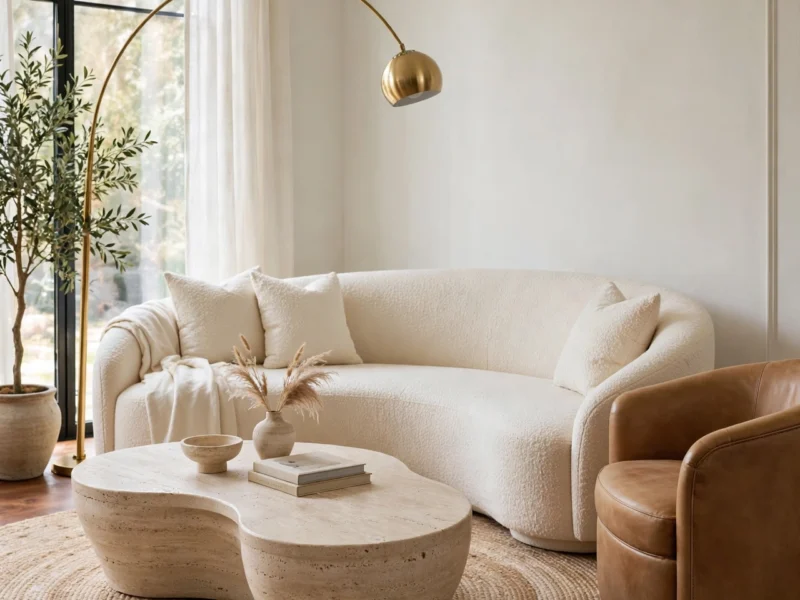
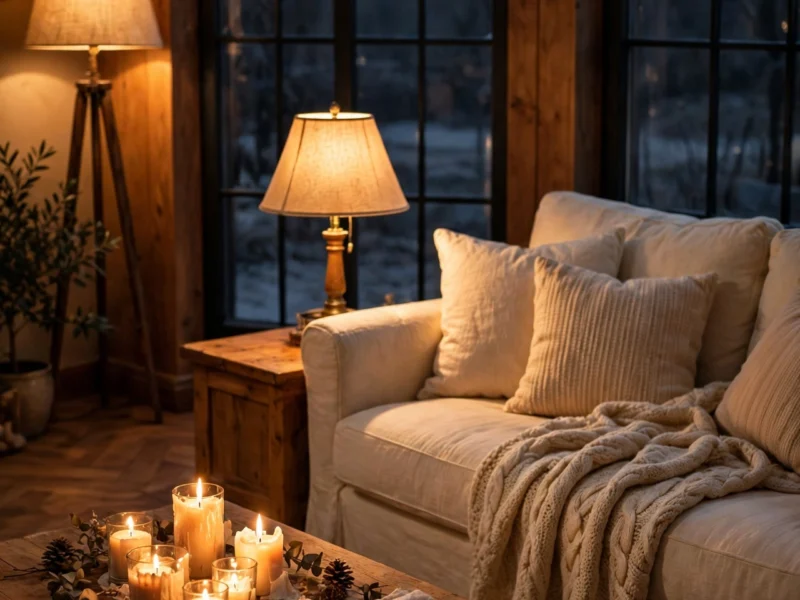
You walk through the front door after a long day and the first thing you feel is your shoulders drop. Not because the room is empty, but because nothing in it is asking anything of you. No cluttered shelf catching your eye, no harsh overhead light, no chair you never sit in. Just a calm room, warm wood under your feet, soft daylight, and the faint smell of linen and cedar. That feeling is the whole point of restorative minimalism, the nature-led way of decorating that is quietly becoming the look of 2027.
It is not the white-box minimalism of ten years ago. That version stripped rooms down until they felt like showrooms, beautiful in a photograph and cold to live in. Restorative minimalism keeps the calm and drops the cold. It trades stark white for sage, clay, oat and soft stone. It trades lacquered surfaces for raw oak, linen, wool, stone and clay. And it trades the rule of owning less for a better question: does this object help me rest?
The idea has been building for a while. Paint companies have spent the last two seasons naming calm, nature-grounded colours as their shades of the year. Designers are talking about rooms that support sleep, focus and slow mornings instead of rooms that photograph well. And after years of maximalist colour and pattern, plenty of us are ready for a home that feels like a deep breath. This guide shows you how to build that feeling room by room, without turning your home into a monastery.
What Restorative Minimalism Actually Means
 Save
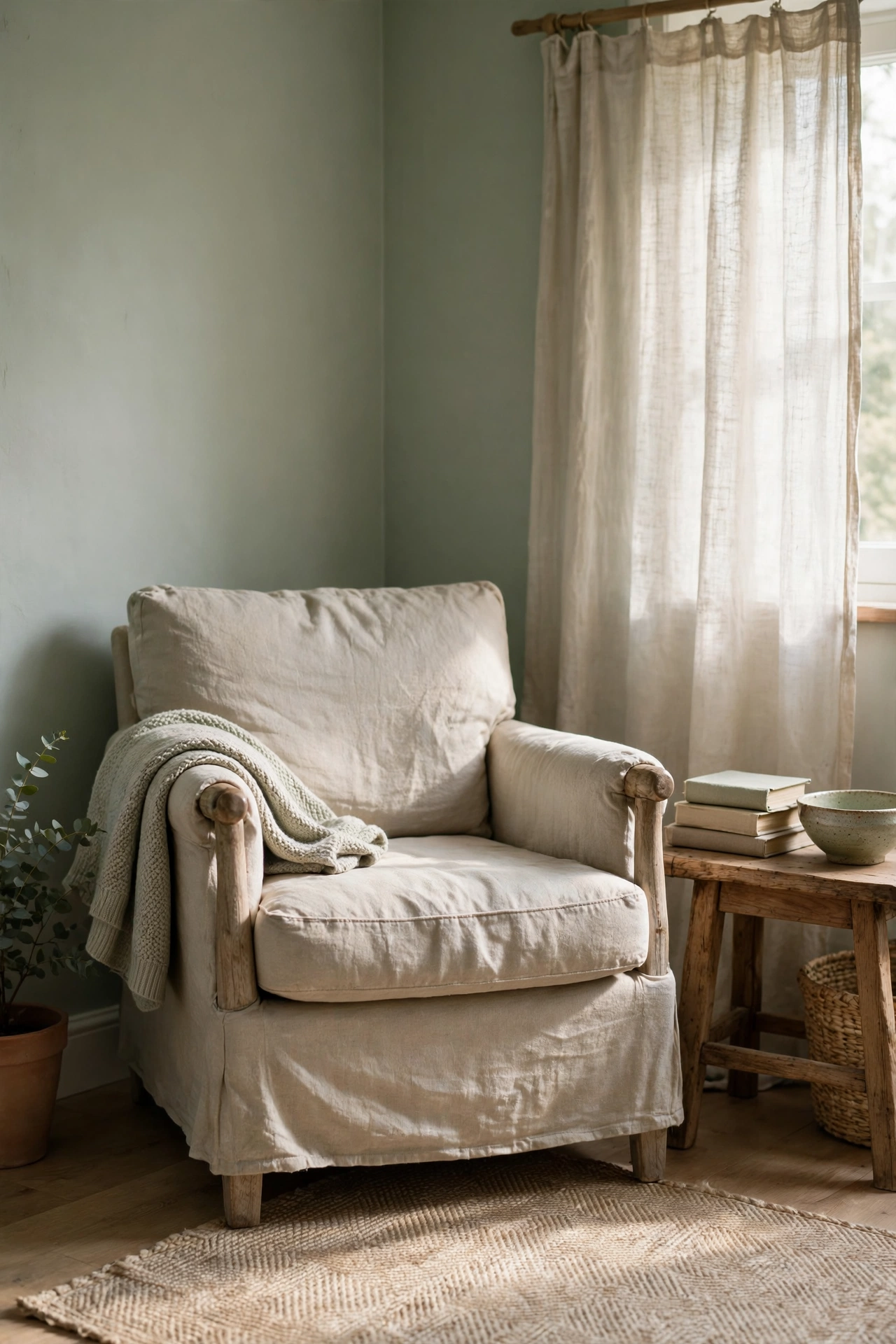
Restorative minimalism is a style built around recovery. Every choice in the room exists to lower stress and help you recharge, whether that means a softer palette, a chair that invites you to sit for an hour, or a surface that is clear enough to think at. The style borrows from Japanese calm and Scandinavian warmth, the same pairing behind our Japandi decor ideas, but it is not a copy of any of them. It is a practical blend: fewer objects, natural materials, and light used the way nature uses it.
The difference from old-school minimalism matters. Classic minimalism chased emptiness as a visual goal, and it often ended up sterile. Restorative minimalism chases a feeling, and it is perfectly happy with a basket of throws, a shelf of well-loved books, or a handmade bowl on the table, as long as each thing earns its place. A room can be full and still feel calm when everything in it is intentional.
Think of it as editing rather than emptying. You keep the armchair you read in every evening. You keep the rug your feet love. You let go of the decorative objects you bought to fill a shelf and never once looked at again. The test is simple: if you took it away, would you miss it? If the answer is no, it goes.
Styling tip: Start with one room, not the whole house. A bedroom or a reading corner is the easiest place to feel the difference quickly, and one calm room will convince you faster than a whole-house plan ever will.
Colour That Lowers the Volume
 Save
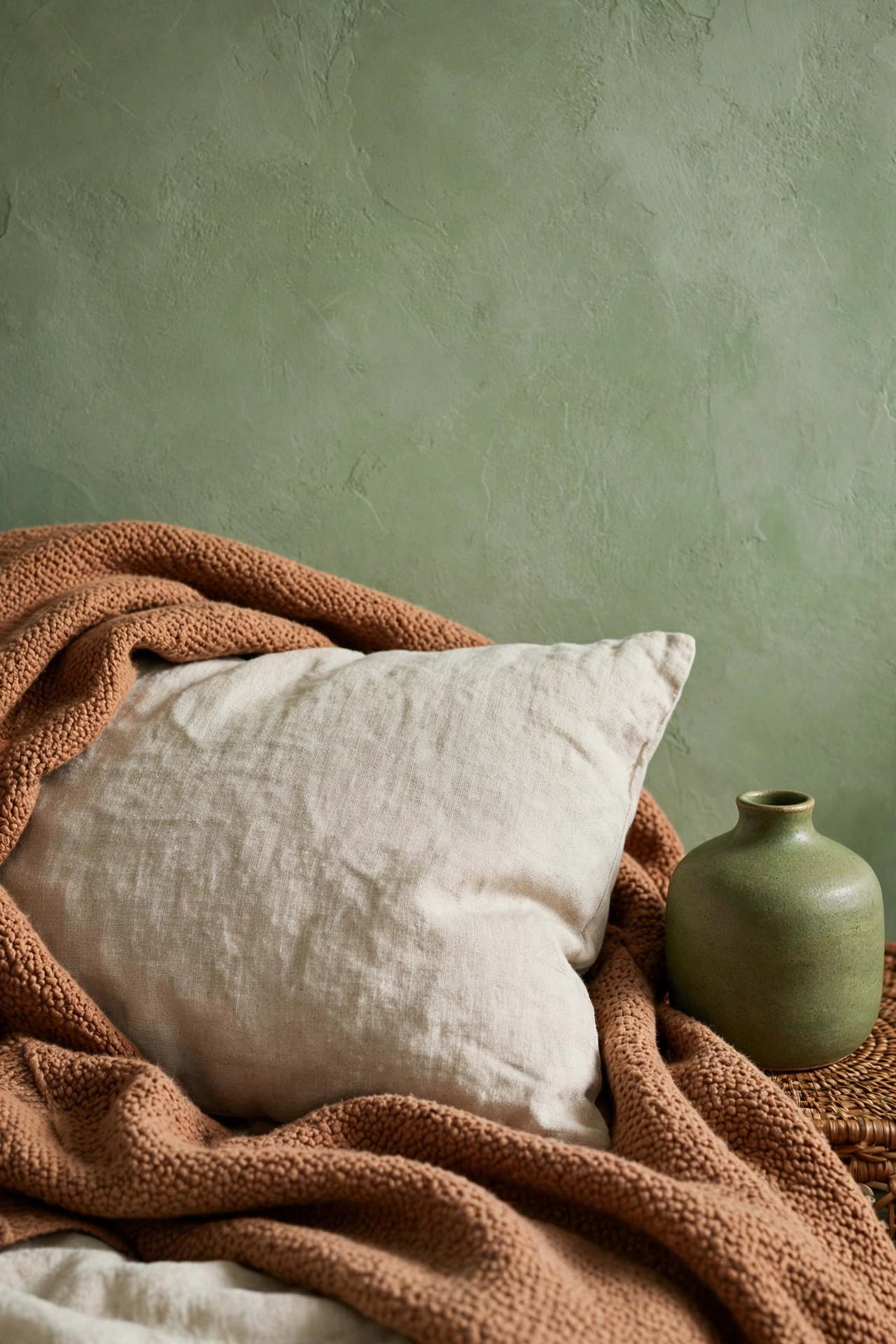
Colour does the heaviest work in a restorative room, and the palette comes straight from nature. Think of the colours you see on a walk through woods in late afternoon: soft sage, warm oat, pale clay, stone grey, muted moss, the dusty green of olive leaves. These are the shades paint brands have been pushing toward for 2027, and they work because they sit at the same quiet volume as the natural world. Our guide to the 2027 colours of the year breaks down the exact shades worth trying first.
The trick is to build a palette of three or four colours and let one of them lead. A warm off-white or pale oat on the walls gives you light without glare. A deeper tone, like a muted sage or a soft clay, goes on one wall, a sofa, or a set of curtains. Then a darker accent, maybe a deep moss green or a walnut brown, appears in small doses: a cushion, a picture frame, the legs of a chair. The room reads as calm because nothing shouts.
| Palette role | Colour | Use it on |
|---|---|---|
| Lead, walls | Warm off-white, pale oat | Walls, large surfaces |
| Deeper tone | Muted sage, soft clay | One wall, sofa, curtains |
| Dark accent | Deep moss, walnut brown | Cushion, frame, chair legs |
Avoid the temptation to paint everything the same flat white. White walls with white furniture and white bedding do not read as calm; they read as unfinished, and they bounce light around in a way that feels clinical. A warm undertone in your white, something with a hint of cream or stone, changes the whole feeling. Hold paint swatches against the wall at different times of day before you commit, because a colour that looks soft at noon can turn cold grey by evening.
Budget swap: If repainting is not on the cards, shift the palette with textiles instead. Oat linen cushion covers, a sage throw and a clay-coloured rug will move a white room toward nature tones for the price of a takeaway dinner.
Texture You Can Feel
 Save
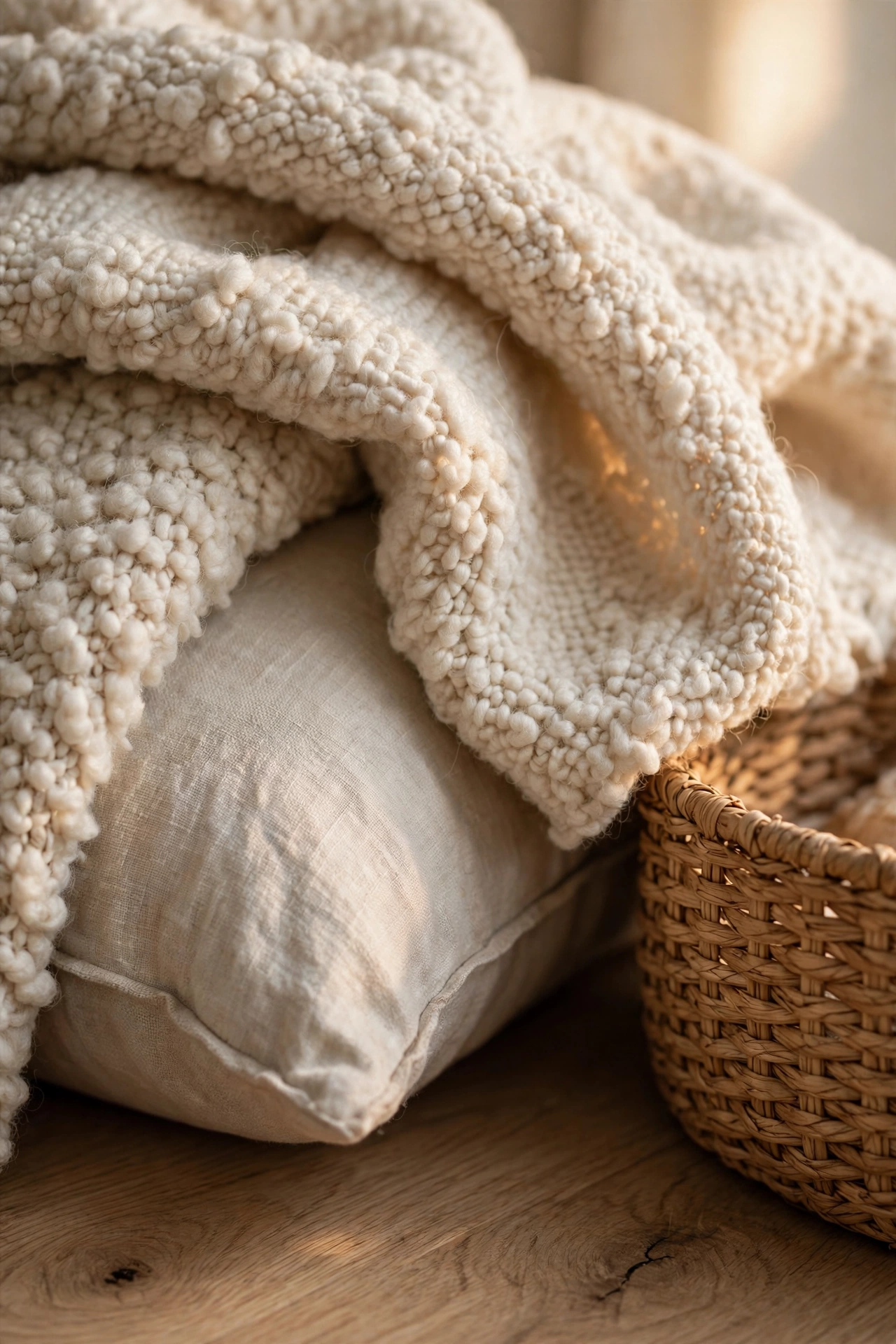
If colour lowers the volume, texture is what makes a calm room feel warm instead of bare. Restorative minimalism leans on touch: the nub of a wool throw, the slub of raw linen, the rough grain of unfinished oak, the cool smoothness of a stone vase. These textures do the work that pattern and ornament used to do, and they invite you to slow down because your hands keep noticing them.
Layering texture is a skill worth learning. Start with the biggest surface, the floor, and work up. A flat-weave wool rug underfoot, linen curtains at the window, a bouclé or cotton cushion on the sofa, a knitted throw folded over the arm. Each layer should feel different from the one next to it. When everything in a room has the same smooth finish, the eye slides off it and the room feels flat. When surfaces vary, the room feels considered and alive. The same layering approach shapes our warm minimalist living room ideas, where texture does the work pattern used to do.
Handmade and imperfect textures matter most of all. A hand-thrown ceramic bowl with a slightly uneven rim, a woven basket with visible fibres, a linen cloth that wrinkles softly, these small irregularities are what stop a minimal room from feeling like a hotel. They carry the mark of the person who made them, and that is exactly the kind of warmth the style needs.
Designer note: Keep to natural fibres where you can. Wool, linen, cotton, jute and rattan age gracefully and feel better against skin than their synthetic lookalikes, which tend to shine under light and flatten a room’s texture.
Natural Materials, Honest Finishes
 Save
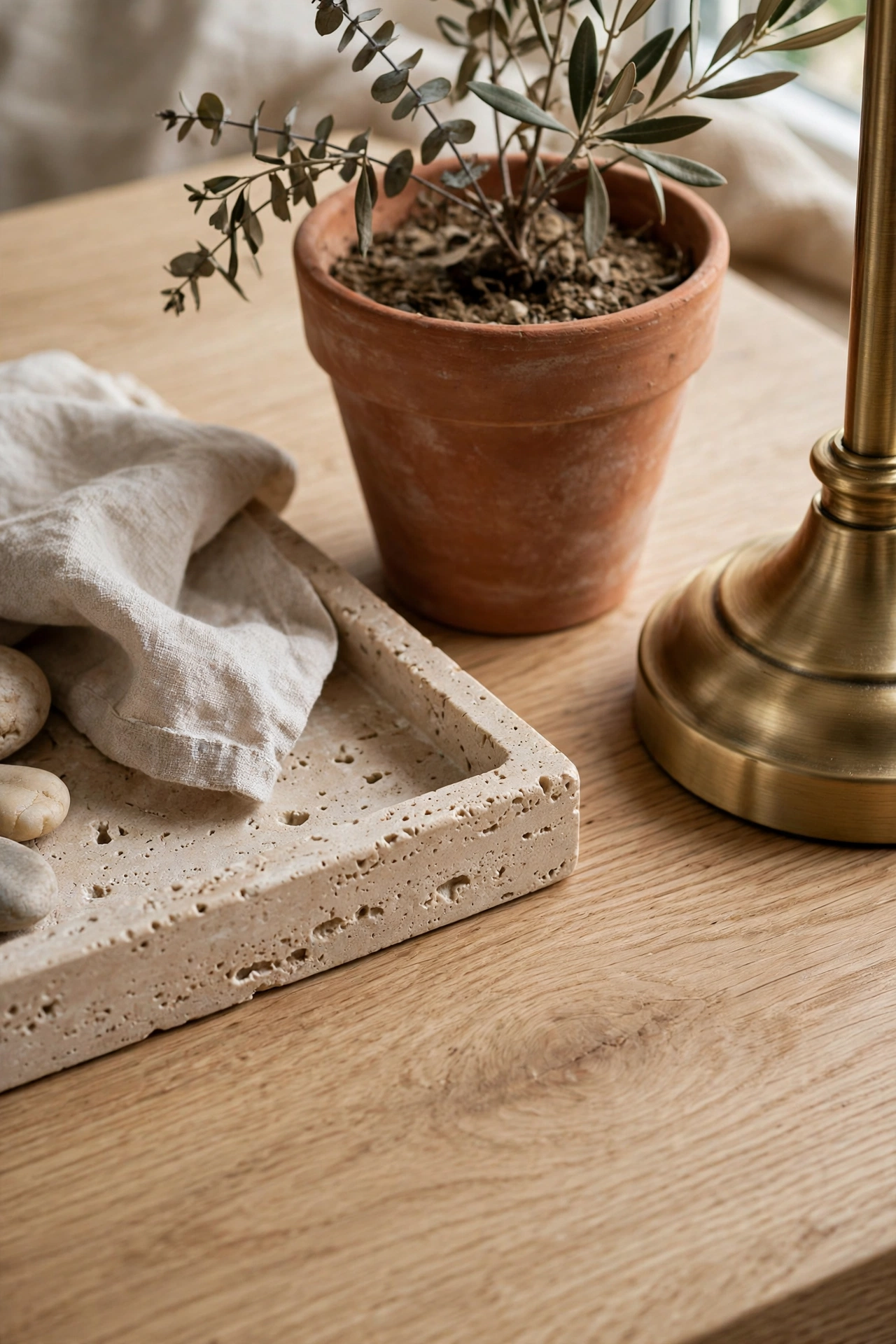
A restorative room is honest about what it is made of. Wood looks like wood, with its grain visible. Stone looks like stone. Clay looks like clay. The style has no patience for plastic pretending to be marble or foil pretending to be brass, because the whole point is a home that feels grounded in the real world.
Oak, ash, walnut and pine are the workhorses here. A light oak dining table, a walnut sideboard, pine shelves with visible knots, each brings warmth that painted furniture cannot match. If your budget does not stretch to solid wood, look for good veneer on real timber frames rather than printed laminate, and let one genuine wooden piece anchor the room while the rest stays simple.
Stone and clay bring the cool balance to all that warmth. A travertine tray on a coffee table, a terracotta pot by the window, a ceramic lamp base, a slate coaster, these small hard surfaces stop a room full of soft textiles from feeling too sleepy. They also age well. A stone surface picks up a patina over years and looks better for it, which fits the style’s belief that a home should grow more beautiful with use, not less. Walls can carry texture too, and our guide to limewash walls shows how a chalky, hand-applied finish adds depth without pattern.
| Material | Where it works | What it brings |
|---|---|---|
| Light oak | Dining table, shelves | Warmth with visible grain |
| Walnut | Sideboard, chair legs | Depth and weight |
| Travertine or terracotta | Tray, pot, lamp base | Cool balance to soft textiles |
| Brushed brass | Lamp, brackets | Quiet glint, matte only |
Metal still has a place, but keep it quiet. Brushed brass, blackened steel, aged bronze, all work when they appear in small amounts and with a matte finish. Polished chrome and glossy gold fight the calm; they reflect too much light and demand attention. One or two restrained metal details, like a slim brass lamp or dark steel shelf brackets, are plenty.
Light, Air and the Rhythm of the Day
 Save
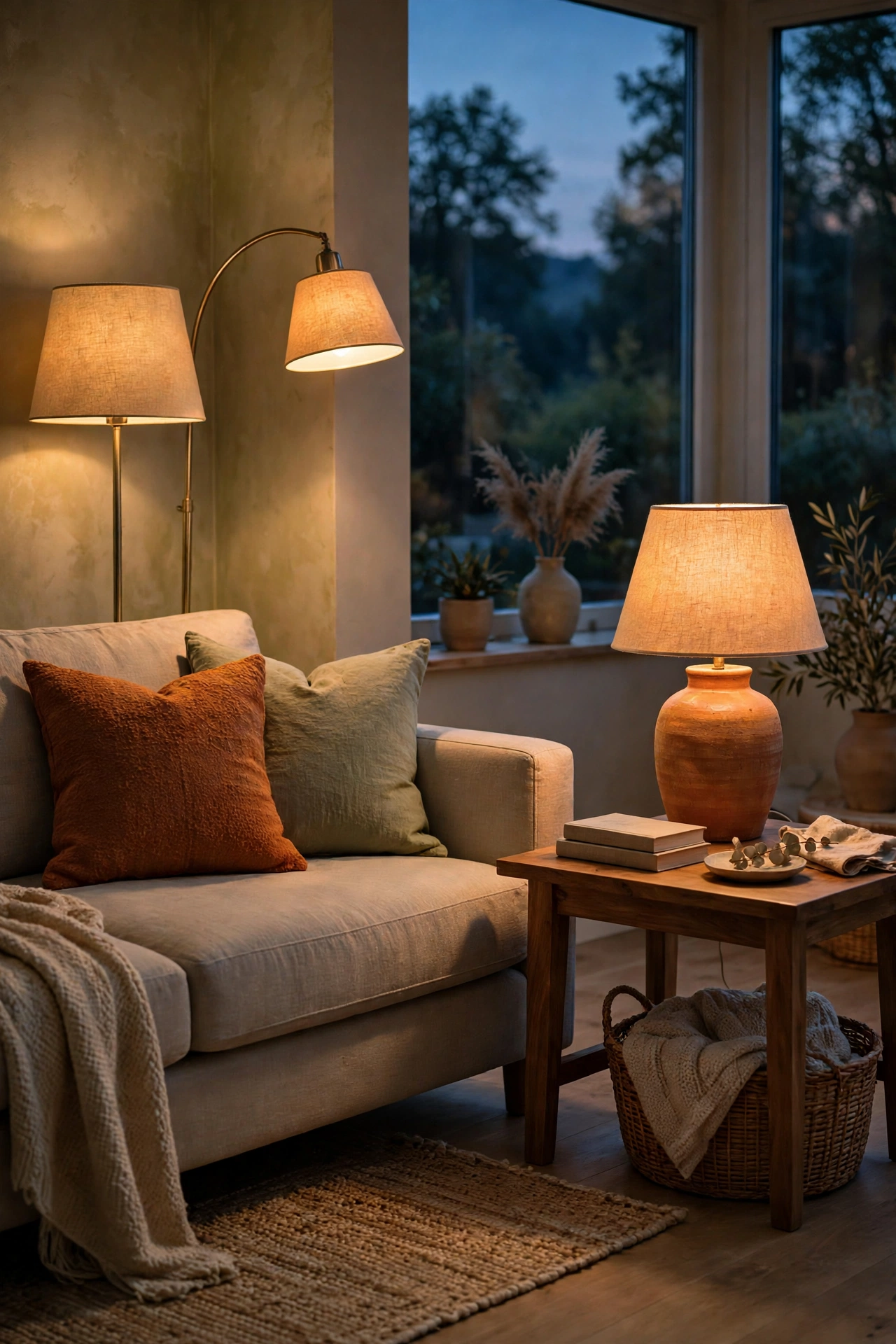
Light is the most underrated decorating tool in a restorative home, and it costs nothing to get right. The goal is to follow the sun: bright, clear light in the morning, soft and warm light in the evening, and darkness at night that actually lets you sleep. Most homes get this backwards, with dim rooms by day and harsh ceiling lights blazing until bedtime.
Start by clearing the windows. Heavy curtains, dusty blinds and cluttered sills all steal daylight. Sheer linen panels or simple roller blinds let light in while keeping privacy, and a clean sill with one plant or one candle reads as calm rather than empty. If a room faces north and never gets direct sun, a large mirror opposite the window will bounce what light there is deeper into the room.
Evening light needs layers. One ceiling light on full brightness is the enemy of rest. Instead, use three low sources: a floor lamp beside the sofa, a table lamp on a sideboard, and a candle or two. Warm bulbs around 2700K mimic sunset and tell your body the day is winding down. Put the brightest lamp where you read and keep the rest dim, and the room will feel like a quiet evening even in midwinter.
Air matters too. Open windows when you can, even for ten minutes, and let the room breathe. Plants help, but they are not the point on their own; the point is a room that feels fresh rather than sealed. If you live somewhere with cold winters, a short sharp airing each morning does more than a plug-in freshener ever will.
Try this: For one week, turn off the overhead light after 6pm and live by lamps and candles. Most people never go back, because the room finally feels like evening.
Fewer Things, Chosen with Care
 Save
This is the part of restorative minimalism that sounds like a chore and turns out to be the most freeing. The rule is not to own as little as possible. The rule is that everything you keep should be useful, beautiful, or genuinely loved, ideally all three. Everything else is noise, and noise is the opposite of rest.
Work through a room with three boxes: keep, move, let go. The keep box holds what you use weekly or love daily. The move box holds things that belong in another room but drifted here. The let-go box holds the duplicates, the gifts you never liked, the gadgets that broke two years ago and the decor you bought because a shelf looked bare. Be honest about the let-go box. A shelf does not need filling; an empty shelf is a calm shelf.
Storage is what makes the system survive real life. Open shelving looks lovely in photographs and becomes a dust trap in a family home, so favour closed storage for the everyday mess: a linen cupboard, a wooden chest, drawers with dividers. What stays visible should be the things you actually enjoy seeing, a stack of books, a favourite vase, a framed photograph. Everything else lives behind a door, and the room stays calm without constant tidying.
Styling tip: Apply the one-in, one-out rule after the first clear-out. Every new object that enters the house means one leaves. It sounds strict, but it is the only way a calm room stays calm past the first month.
Bringing Nature In Without the Clutter
 Save
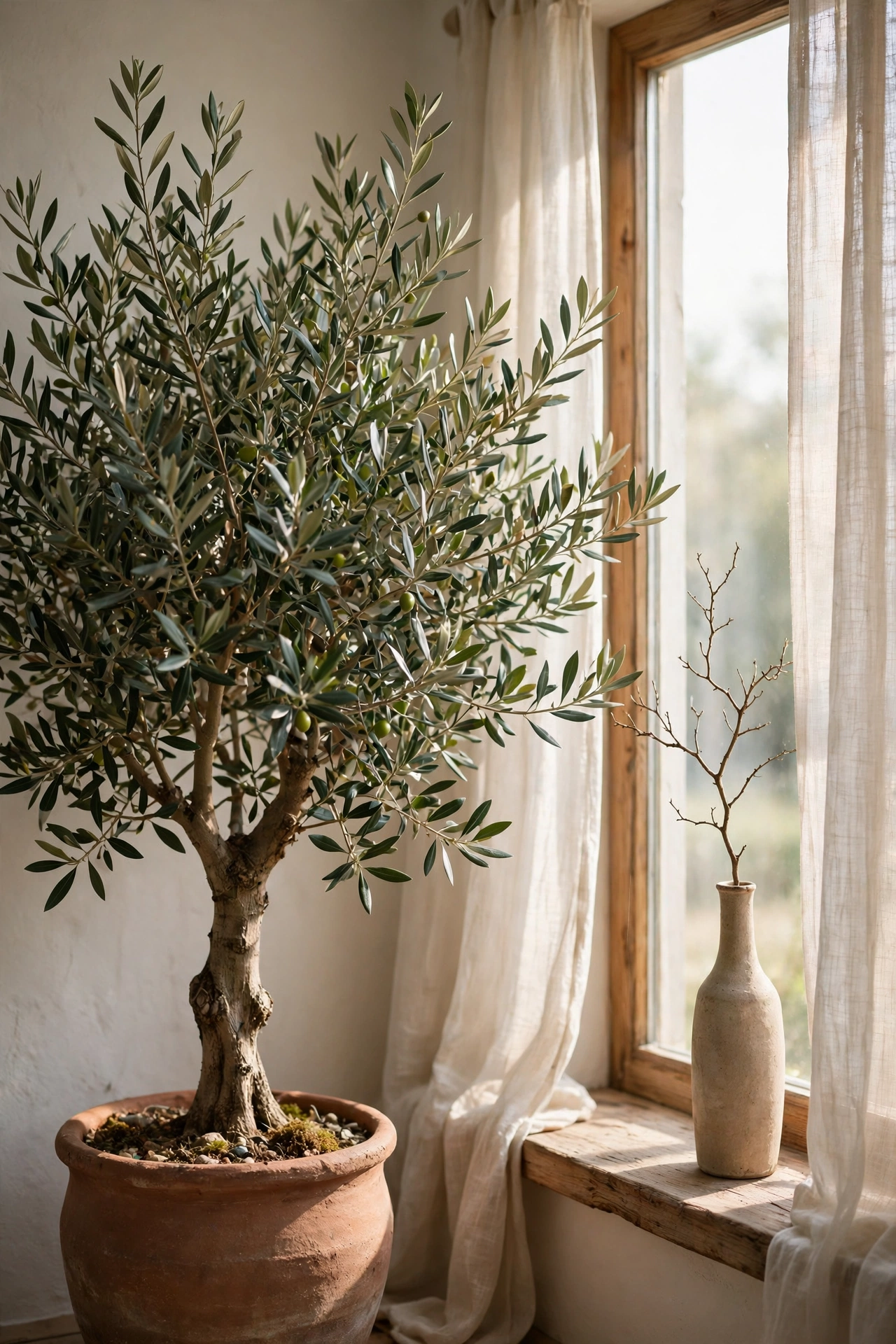
Plants are the signature of a restorative room, but the style treats them as living furniture, not as a collection. One large olive tree in a clay pot does more for a room than twelve small succulents scattered across every surface. Choose two or three plants you can actually keep alive, give them good pots, and let them be the room’s green accent.
If you struggle to keep plants alive, be honest about it and choose accordingly. A snake plant, a pothos, or a ZZ plant will forgive missed waterings for weeks. A fiddle-leaf fig will not, and a dying plant in a beautiful pot is worse than no plant at all, because it becomes one more thing to feel guilty about. Buy the plant for your actual life, not the life in the photograph.
| Plant | Forgiveness | Choose it when |
|---|---|---|
| Snake plant, pothos, ZZ plant | Forgives missed waterings for weeks | You forget to water |
| Olive tree | Needs bright light and steady care | You want one large statement plant |
| Fiddle-leaf fig | Demanding, shows neglect fast | You enjoy regular plant care |
Nature comes in through materials as well as plants. A branch in a tall vase, a bowl of pinecones in winter, dried grasses in a stone jug, a piece of driftwood on a shelf, these are the low-effort decorations that fit the style perfectly. They cost nothing, they change with the seasons, and they bring the outside in without adding visual noise.
Seasonal change is part of the charm. In spring, swap the heavy wool throw for light linen. In autumn, bring in the amber and russet tones with a cushion or a vase of dried leaves. A restorative room is not frozen in one perfect arrangement; it shifts gently with the year, the way a garden does.
The shortcut: three nature colours, one honest wood, three low lights after dark, and one plant you can keep alive. Start there and the calm follows.
Bringing It All Together
Restorative minimalism is not a shopping list. It is a way of asking, of every object and every colour in your home, whether it helps you rest. Start with colour, add texture, choose honest materials, fix the light, edit what you own, and bring in a little nature. You do not need to do it all at once, and you certainly do not need to buy a whole new room to begin. One calm corner, made properly, will show you what the rest of the house could feel like.
The best test of a restorative room is not how it looks in a photograph. It is how you feel when you sit in it at the end of a long day, with a cup of tea and nothing demanding your attention. If your shoulders drop and your breathing slows, the room is doing its job. That is the whole style, and it is worth every bit of the editing it takes to get there.
Frequently Asked Questions
What is restorative minimalism?
Restorative minimalism is a decorating style built around rest and recovery. It combines the calm of minimalism with natural colours, tactile materials like wood, linen and stone, soft layered light and fewer, better-chosen objects. Unlike stark minimalism, it welcomes warmth, texture and handmade pieces.
Is restorative minimalism the same as Japandi?
They share a love of calm, natural materials and clean lines, but they are not the same style. Japandi blends Japanese and Scandinavian design with a specific visual language, while restorative minimalism is a broader approach focused on how a room makes you feel, and it works with many different furniture styles.
What colours work best for a restorative minimalist room?
Nature-led colours work best: warm oat, soft sage, pale clay, stone grey, muted moss and olive. Keep the palette to three or four colours, let one light neutral lead, and use a deeper tone in small doses. Warm undertones matter, because cool whites can make a calm room feel clinical.
Can restorative minimalism work in a small flat?
It works especially well in a small flat, because the style is built on editing and honest storage. Fewer objects, closed storage for everyday mess, light colours and one good plant will make a small room feel calmer and larger than a room packed with furniture and decoration.
How do I start without spending much money?
Start by editing, not buying. Clear one room, move out what you do not use or love, and rearrange what remains so each piece has breathing room. Then shift the palette with textiles you already own, clean the windows for better light, and add one plant. Most of the change costs nothing at all.