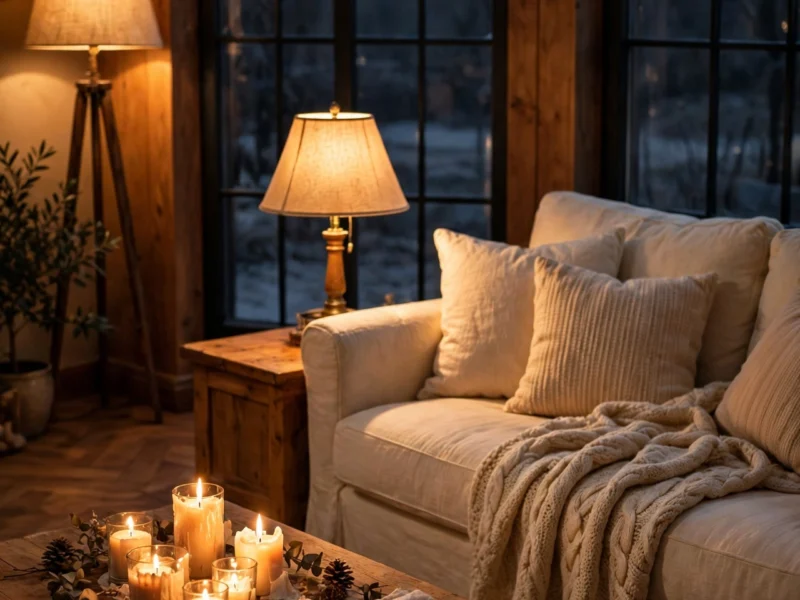
Most households take their Christmas decorations down between 5 and 6 January, on Twelfth Night or Epiphany. That is the traditional window, and it works for almost everyone. If your tree is real and shedding, or the lights are driving up the power bill, taking everything down on 2 January is perfectly fine too. The only date worth avoiding is leaving decorations up past early February, when they start to look tired rather than festive.
There is something a little sad about the morning after the last guest leaves. The house feels quiet, the tree looks thinner than it did a week ago, and the question lands: is it time to pack it all away, or does it get one more weekend? Nobody wants to be the house with a drooping tree still up in March, and nobody wants to rush the magic away on Boxing Day either.
The honest answer is that there is no single correct date. Traditions disagree, families disagree, and the type of tree you have matters as much as the calendar. What follows is a clear look at every date that counts, what each tradition actually says, and how to take everything down without the usual mess of tangled lights and broken baubles.
When Is the Traditional Day to Take Down Christmas Decorations?
 Save
The traditional answer is Twelfth Night, which falls on 5 January, or Epiphany on 6 January. Both dates mark the end of the twelve days of Christmas, and for centuries they have been the two days people point to when this question comes up.
The confusion is real because the counting is not agreed on. Some people count Christmas Day itself as day one, which makes Twelfth Night fall on 5 January. Others start counting on Boxing Day, which pushes it to 6 January, the Feast of the Epiphany. Churches have used both reckonings at different times, so neither date is wrong, and neither is more correct than the other.
In practice, most families pick one and stick with it. The 5th suits people who like a clean break before the first full working week of January. The 6th suits those who treat Epiphany as the proper close of the season. Styling tip: pick your date in advance and put it on the calendar. The takedown feels like a chore when it is decided on the day, and like a small ritual when it is planned.
There is also an older tradition that stretches the season much further. Candlemas, on 2 February, was once the day the last greenery came down in many homes. A few households still keep a wreath or a strand of lights until then, and it is a lovely compromise if the house feels too bare in mid-January. Just be aware that guests may raise an eyebrow at a full tree in February.
| Tradition | Takedown date | Who follows it |
|---|---|---|
| Twelfth Night | 5 January | Most UK households, the commonest choice |
| Epiphany | 6 January | Church tradition, many European families |
| After New Year’s Day | 2 January | Practical households, real-tree owners |
| Candlemas | 2 February | Older tradition, keeps a little greenery longer |
| Whenever it suits you | Any January date | Families with small children, renters, busy schedules |
Is It Bad Luck to Take Down Christmas Decorations Early or Late?
 Save
The old superstition says it is bad luck to leave Christmas decorations up after Twelfth Night, and some versions say it is bad luck to take them down before then too. The story goes that greenery left up past the season invites bad luck for the year, a belief that traces back to the days when evergreen branches were thought to shelter spirits through winter.
Nobody can prove a superstition, and nobody needs to. What is true is that the belief has shaped the habit for generations, which is why so many people feel vaguely guilty about a tree still standing on 8 January. The guilt is cultural, not practical, and knowing that takes the pressure off.
The practical side matters more. A real tree left up too long becomes a fire risk as it dries out, and a fake tree left up too long collects dust and starts to look sad rather than festive. Lights left on into February cost money for no joy. Those are the real reasons to take decorations down on time, and they are reason enough.
Designer note: if the superstition bothers you, take the tree down on 5 or 6 January and keep one small thing, a candle or a winter wreath, up until Candlemas. You honour the tradition and the house still feels dressed.
When Should You Take Down a Real Christmas Tree?
 Save
A real tree should come down as soon as the needles start dropping in handfuls, and for most trees that happens in the first week of January. A well-watered tree bought in early December usually holds until Twelfth Night, but a tree bought in late November or kept near a radiator may be ready to go by 2 January.
The signs are easy to read. Needles fall when you brush a branch. The branches feel brittle rather than springy. The trunk has stopped drinking water, so the stand stays full for days. Once two of those three are true, the tree is done, whatever the calendar says.
Take it down in the right order. Lights off first, then ornaments from the top down, working in sections so nothing gets knocked off. A large sheet or an old fitted sheet spread under the tree catches the needles and saves an hour of hoovering. Carry the tree out in the sheet, needles and all, and shake it gently outside if your council collects trees for chipping.
Check your local council’s collection dates before you drag the tree to the kerb. Most councils run a tree collection in the first two weeks of January, and some garden centres take trees back for composting. A tree left on the pavement in February is nobody’s idea of a good look.
When Should You Take Down Outdoor Christmas Lights?
 Save
Outdoor lights should come down at the same time as the tree, and for the same reasons. Cold, wind and rain wear on the cables, and lights left up through January storms are far more likely to fail next year. Most people aim for the first dry weekend after Twelfth Night.
Safety comes first here. Never take lights down in the dark, in rain, or from a ladder that is not steady. Unplug everything at the socket before you touch a single clip. Work from the top down, and coil each string loosely around your elbow rather than winding it tight, which is how bulbs crack and wires kink.
Budget swap: a set of cheap cable ties and a labelled zip bag per string costs less than a pound and saves you buying a replacement set next December. Label each bag with where the lights hung, front hedge or porch rail, so next year’s setup takes minutes.
If the weather is foul on your chosen weekend, wait for the next dry day rather than rushing it. Lights can stay up an extra week without harm. What damages them is months of exposure, not a few extra days. If you love the glow, swap the Christmas strings for plain warm-white fairy lights on the porch. They read as winter lighting rather than Christmas, and they carry the house through the dark evenings until spring.
For ideas on dressing the outside of the house next year, our guide to Christmas outdoor decor ideas covers lights, porch displays and yard pieces that hold up to winter weather.
How Should You Store Christmas Decorations So They Last?
 Save
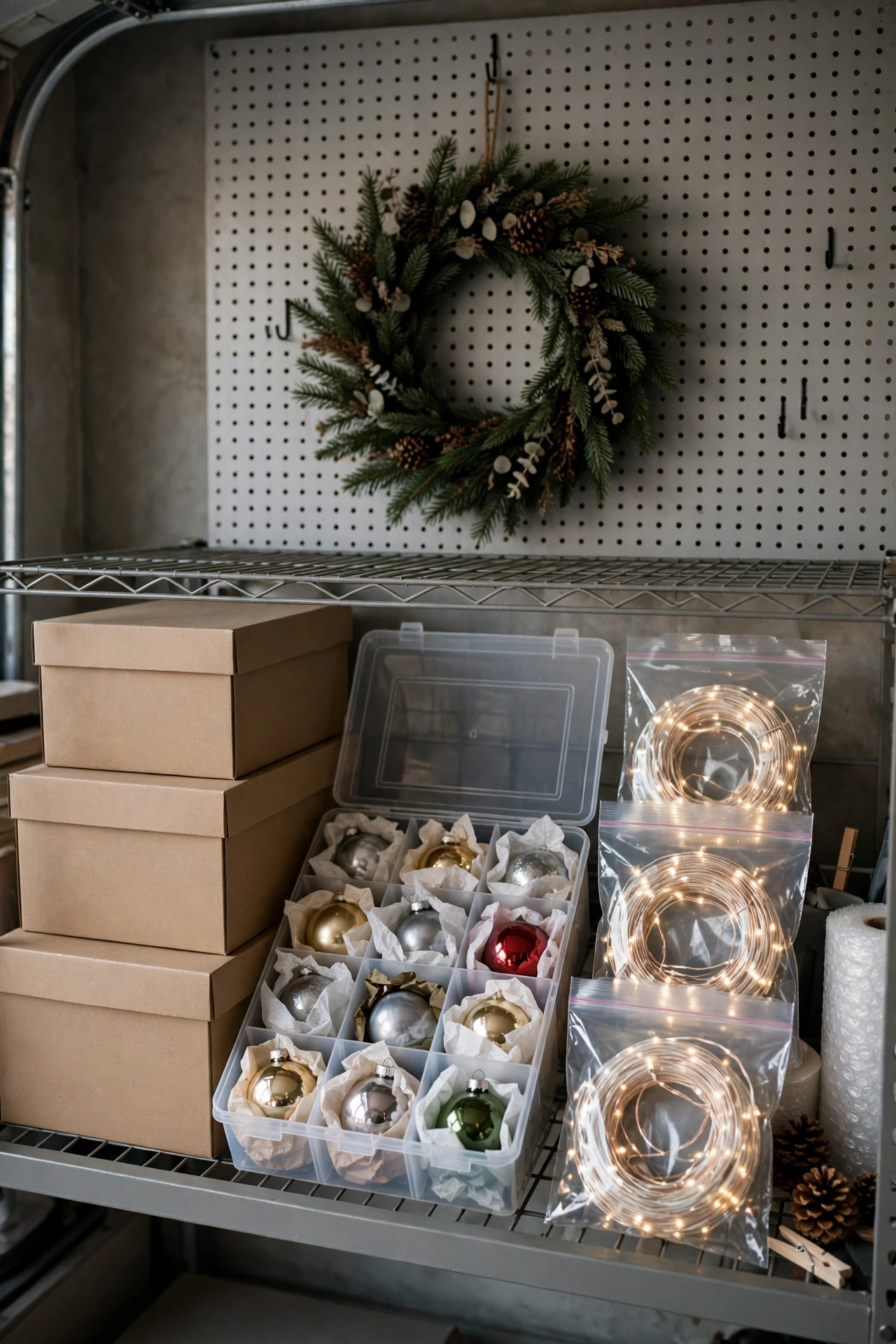
Good storage is the difference between decorations that last a decade and decorations you replace every other year. The rules are simple: dry, dark, labelled, and nothing heavy stacked on anything fragile.
Start with the tree. A fake tree goes back into its box or a proper tree bag, branches folded in the order they came out. If the box is gone, a large storage bag and a strip of tape with “tree, 6ft” written on it does the same job. Store it upright or flat in a dry spot, never leaning against a damp garage wall.
Baubles need individual wrapping. Tissue paper, old tea towels, or the cardboard dividers from a wine box all work. Glass baubles go in their own box with dividers, never loose in a bag with metal ornaments. Heirloom pieces deserve their own small box, labelled with whose they were, so they are never mistaken for spares.
Wreaths and garlands keep their shape if they hang. A hook on the inside of a cupboard door or a nail in the garage wall beats a crushed box every time. Slip a bin bag over the wreath to keep the dust off, and tie the bag loosely at the bottom so air can move.
Match each item to the storage that keeps its shape until next December.
| Item | Store it in | Why it works |
|---|---|---|
| Fake tree | Its box or a tree bag, with a taped label | Branches stay folded in order, in a dry spot |
| Glass baubles | Their own box with dividers, wrapped singly | Dividers stop chips; nothing sits loose with metal |
| Wreaths and garlands | Hung on a hook, with a bin bag slipped over | Hanging keeps shape; a crushed box flattens them |
| Light strings | One labelled zip bag per string, coiled loosely | Labels say where they hung; loose coils stop kinks |
Try this: photograph each room before you take the decorations down. The photo becomes your setup guide next December, and it takes thirty seconds.
Label every box on two sides, not just the top. “Tree ornaments, fragile” and “Mantel garland and stockings” tell you what is inside without opening anything. Stack the boxes you will need first on top, and put the tree itself where you can reach it without moving five other boxes.
What Should You Do With Christmas Decorations You No Longer Want?
 Save
Every takedown turns up pieces you no longer love: the bauble set that never matched, the light string with three dead bulbs, the novelty reindeer from a secret Santa years ago. Keeping them out of guilt only fills the loft.
The 3-question gate: before a box goes back to the loft, answer three questions. One, did this piece go up this year? Two, is it in good enough shape to give away? Three, would you miss it if it left? If it stayed boxed all season and you would not miss it, let it go.
Working lights and ornaments in good condition can go to a charity shop, a school fair, or a local buy-nothing group. Someone else’s tree is always short a few baubles, and charity shops see a rush of January donations because everyone declutters at the same time. Drop them off in January while the shops still want them.
Broken lights go to electrical recycling, not the bin. Most council tips have a small-electricals skip, and many supermarkets run a collection point. Baubles that are cracked or faded go in the general waste, since mixed-material ornaments cannot be recycled. Real trees go to the council collection or the compost heap, never into the general bin if your area offers a greener route.
If the budget allows, replace one tired set each year rather than the whole lot at once. A new string of warm-white lights or a fresh set of baubles in a colour you actually like does more for next Christmas than a full restyle. For inspiration on a calmer, more considered look, our winter living room decor ideas show how to keep the cosy feeling going after the tree is gone.
How Do You Make the House Feel Cosy Again After the Decor Comes Down?
 Save
The hardest part of takedown is not the work, it is the empty feeling afterwards. The mantel looks bare, the corner where the tree stood looks enormous, and the house feels suddenly plain. That is normal, and it passes faster if you replace the Christmas pieces with winter pieces rather than leaving bare surfaces.
Start with light. A few candles on the mantel, a lamp switched on an hour earlier than usual, and the curtains drawn a little sooner make the evenings feel warm again. Warm-white bulbs in the living room beat the cold overhead light every January evening.
Then add texture. A folded throw over the sofa arm, a couple of extra cushions, and a thick rug by the bed turn a stripped-back room into a winter room. You do not need new purchases for this, just the pieces that were pushed aside to make room for the tree.
Bring in something green that is not Christmas. A potted plant, a bowl of hyacinths, or a few stems of eucalyptus in a jug gives the eye somewhere to rest. Houseplants do the job all year, and January is a good month to start one if you have never kept one before.
Styling tip: move one piece of furniture a few inches. Shifting the armchair towards the fire or turning the rug the other way breaks the habit of seeing the empty tree corner, and the room feels fresh without spending anything.
Finally, use the takedown as the start of the January reset. The New Year home reset is a natural next step, and a room that has just been cleared of decorations is the easiest room in the house to declutter.
The shortcut: tree down by Twelfth Night, lights down on the first dry weekend, everything stored dry, dark, and labelled.
Bringing It All Together
There is no single right day to take Christmas decorations down, only the day that fits your tree, your traditions, and your household. Twelfth Night on 5 January or Epiphany on 6 January suits most people, a real tree may need to go on 2 January, and Candlemas on 2 February is there if you want the season to linger a little longer. The superstition is old and harmless, the fire risk of a dry tree is real, and the best storage is dry, dark, and labelled.
Take the decorations down in the right order, store them so they survive, give away what you no longer love, and then dress the house for winter rather than leaving it bare. January looks very different when the lights come down on purpose instead of in a rush.
Frequently Asked Questions
When should you take down Christmas decorations?
Most people take decorations down on 5 January (Twelfth Night) or 6 January (Epiphany). A real tree that is shedding should come down sooner, and outdoor lights should come down in the first dry weekend after Twelfth Night.
Is it bad luck to leave Christmas decorations up after Twelfth Night?
Old tradition says yes, and the belief has been around for centuries. There is no proof behind it, but a dry real tree left up too long is a genuine fire risk, and decorations left up into February tend to look tired rather than festive.
How long can a real Christmas tree stay up safely?
A well-watered real tree usually lasts four to five weeks indoors. Once needles drop in handfuls, branches feel brittle, and the stand stops losing water, the tree is dry and should come down, even if that is before Twelfth Night.
Can I leave outdoor Christmas lights up all winter?
You can, but it shortens their life. Cold, wind and rain wear on the cables, and lights left up for months are more likely to fail next year. Take them down in the first dry weekend after Twelfth Night and store them loosely coiled in labelled bags.
What is the best way to store Christmas ornaments?
Wrap glass baubles individually in tissue paper, keep them in a box with dividers, and label the box on two sides. Store everything in a dry, dark place, hang wreaths rather than crushing them into boxes, and photograph each room before you start so next December’s setup is easy.